





























maxclaw-by-minimax
Always-on managed agent based on OpenClaw powered by MiniMax
MaxClaw Wants to Make Deploying an AI Agent Feel Like Sending a Slack Message
The Macro: Nobody Wants to Be a DevOps Engineer Just to Run an Agent
Here’s the thing about AI agents that the demo videos don’t show: the part after the demo. The environment setup. The API keys rotting in a .env file. The 2am alert that your agent crashed because a dependency updated. This is the actual experience for most people trying to run anything autonomous in production, and it’s genuinely miserable.
The technical lift required to keep an agent running 24/7 is wildly disproportionate to what most people are trying to accomplish. You want a bot that monitors your inbox and files tickets. You end up learning about containerization.
That gap is real, and it’s why there’s a whole wave of products trying to sit between the raw model APIs and the humans who want to use them for actual work. Competitors like Taskade, NanoClaw, and a handful of others (the alternatives list is getting long fast) are all pitching some version of “agents without the infrastructure headache.” Adept, Devin, Claude Code if you squint at it right. Everyone is circling the same problem from slightly different angles.
The broader numbers make the interest obvious. The AI software market was valued at around $122 billion in 2024, according to ABI Research, and the Stanford HAI 2025 index flagged that 78% of organizations reported using AI last year, up from 55% the year before. Demand is not the constraint. Friction is the constraint.
I’ve written before about how the next interesting AI products are the ones that abstract infrastructure away entirely, and the agent deployment problem feels like exactly that moment. The companies that win here probably won’t win on model quality. They’ll win on how little you have to think about to keep something running.
The Micro: One Click, Then It Just Lives in Your Chats Forever
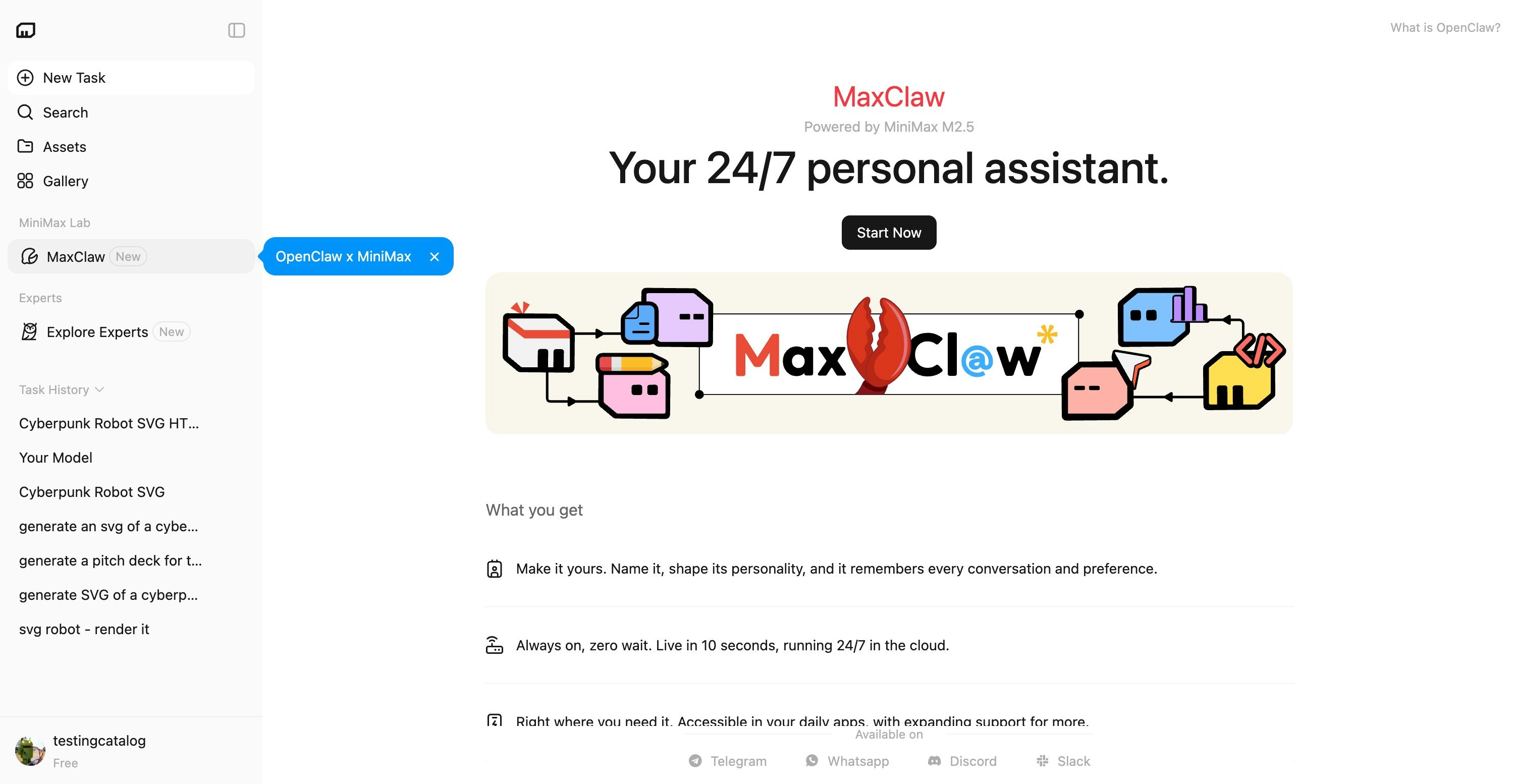
MaxClaw is MiniMax’s answer to the deployment problem, and the pitch is pretty literal: you set it up once and it runs everywhere you already talk to people.
The product sits on top of OpenClaw (MiniMax’s open agent framework) and their M2.5 model, and it deploys into Telegram, WhatsApp, Slack, and Discord. No infrastructure to manage on your end. No extra API fees on top of what you’re already paying. The “7x24” framing in the copy is doing some work there, which is just them saying it stays on and doesn’t need babysitting.
According to a SitePoint writeup on the product, the core value prop is that MiniMax handles the managed layer entirely, so the agent runs without you touching a server. That’s the part that matters. The ready-made “MiniMax Expert ecosystem” they mention in the description suggests there are pre-built configurations you can drop in, rather than building behavior from scratch, though I’d want to see that fleshed out in practice.
The chat platform integrations are interesting as a distribution choice. Most people aren’t opening a dedicated agent dashboard. They’re in Slack already. Meeting them there instead of asking them to adopt a new surface is smart, and it’s the same logic behind why tools that embed into existing workflows tend to get actual usage instead of impressive signups and quiet churn.
It did well when it launched, picking up solid traction on launch day.
One thing I genuinely can’t evaluate from the outside: how good the built-in tools actually are for “real work,” which is a phrase they use and which could mean anything. Upgraded compared to what baseline? That’s the part someone would have to actually use to judge.
The one comment on launch day doesn’t tell me much either way.
The Verdict
I think MaxClaw is solving a real problem with a reasonable approach. The infrastructure abstraction is genuinely useful. The chat-native deployment is a smart distribution play. MiniMax has real model chops behind this, so it’s not vaporware built on someone else’s API with a thin wrapper.
What I’d want to know at 30 days: are people actually running agents through it or just turning it on and forgetting about it? Retention on “always-on” products is tricky because the thing that makes them appealing (you don’t have to think about it) also makes it hard to notice when they stop being useful.
At 60 days, the Expert ecosystem question matters. If the pre-built configurations are actually good, that’s a real moat. If they’re shallow, people will hit the ceiling fast and go looking at alternatives. The competitor list is already crowded and growing.
The thing working in MaxClaw’s favor is that most people building in this space are still asking users to do too much. If MiniMax can genuinely keep that friction near zero, that’s a real position to hold. The question isn’t whether the idea is good. It’s whether the execution stays clean as they scale it.
I’d try it. I’d want to see it six weeks from now.