














collective-os
The Al-powered referral network for agencies & consultants
Collective OS Wants to Turn the Referral Call You've Been Avoiding Into a Flywheel
The Macro: Referrals Run This Industry and Everyone Knows It
There’s a version of agency life that looks like a proper sales funnel. CRM, outbound sequences, pipeline reviews on Fridays. Most agencies aren’t living that version. Most agencies are running on referrals, favors, and the same twelve people they went to college with or met at a conference three years ago.
This isn’t a dirty secret. It’s basically just how professional services works. The consultancy that lands a CFO engagement because a former client made an introduction. The design shop that gets a fintech rebrand because they passed on a conflict. The dev shop that gets overflow work because a bigger agency is drowning. Trust moves deals. Formal sales infrastructure is expensive to build and slow to pay off.
The freelance and agency market is not small. Freelance platforms alone are projected to grow from roughly $8.35 billion in 2025 to nearly $22 billion by 2031, according to multiple market research reports. The broader freelance economy touches hundreds of billions in labor. That’s a lot of deal flow running through informal networks that have no memory, no matching logic, and no ability to scale when you need them to.
The existing infrastructure for this is mostly terrible. LinkedIn works until it doesn’t. Slack communities have good intentions and low signal-to-noise ratios. Marketplaces like Upwork and Fiverr solve a different problem entirely. They’re built for clients finding talent, not for firms finding each other.
That’s the specific gap Collective OS is going after. Not the client acquisition layer. The partner layer. The messy lateral market of agencies and consultants who could be sending each other work if they just knew each other existed.
No one has built great infrastructure for this yet. That’s either the opportunity or the reason to be skeptical about demand. Maybe both.
The Micro: AI Matchmaking for People Who Already Know Referrals Work
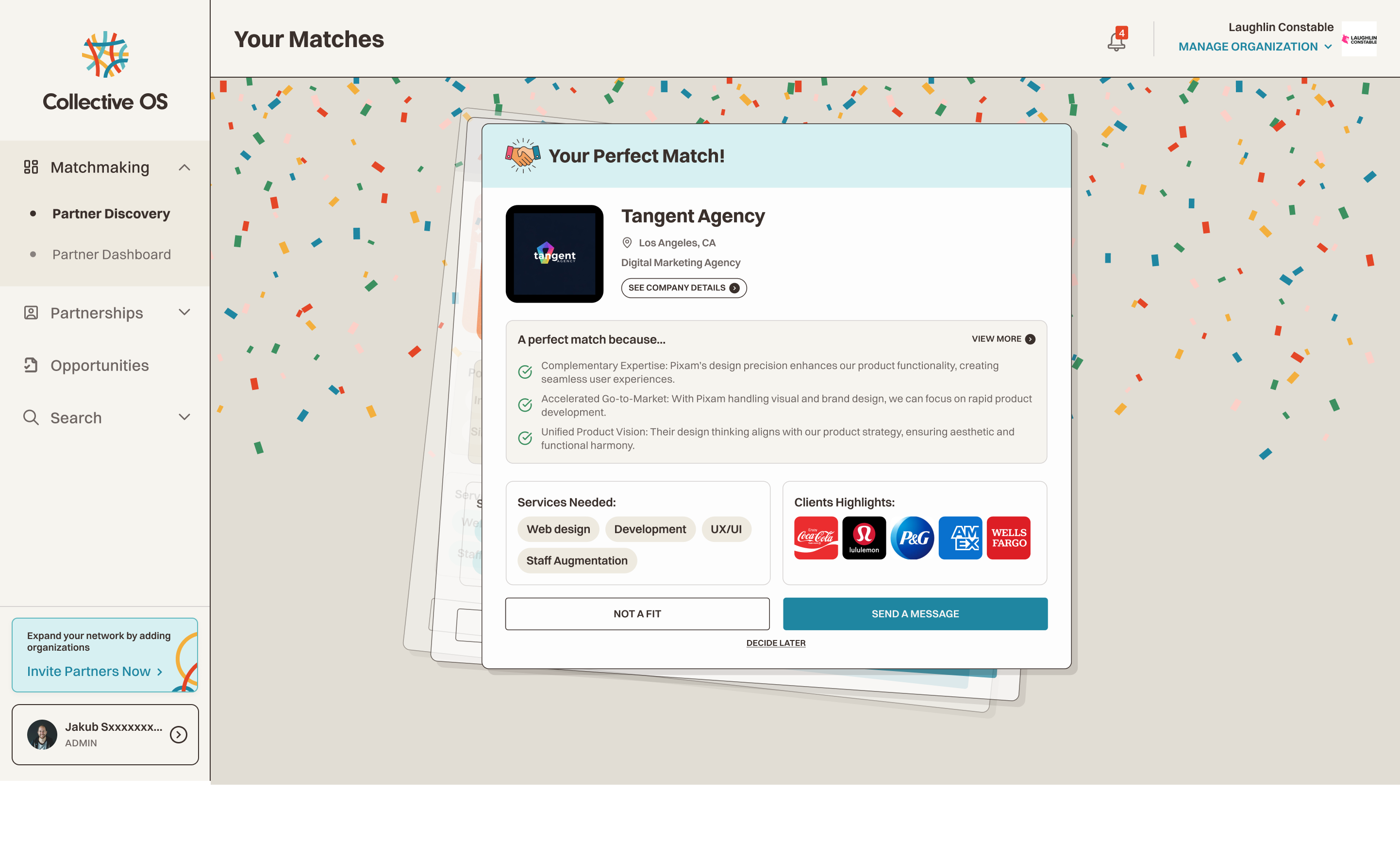
Collective OS describes itself as an AI-powered referral network for agencies, consultants, and creatives. The pitch is tighter than it sounds. You’re not replacing your existing referral relationships. You’re supplementing them with matches you wouldn’t have found on your own.
The matching logic surfaces partners based on expertise, industry, and growth trajectory. The goal is to find complementary firms, not competitors. A branding agency that keeps getting asked about web builds wants to know a good dev shop. A management consultant who keeps bumping into CFOs wants a relationship with a fractional finance firm. Collective OS wants to be the system that makes that connection before you think to ask for it.
The numbers they’re citing are specific enough to be interesting. According to the company, the platform has help over $5 million in deal flow in the last 18 months across thousands of matches. They also claim 70% of firms see new opportunities within 90 days. I’d want to know how they’re defining “opportunities” there, but the directional signal isn’t nothing.
It picked up solid traction when it launched publicly.
CEO Jason Flack previously held a COO role at Steady, according to Crunchbase. The team spent two years building before going public, according to a LinkedIn post from Flack. That’s a meaningful stealth period for a product in this category.
According to one source, Collective OS raised $2.5 million in a pre-seed round. If accurate, that’s a lean war chest for a network-effects business, where the product only gets better as more firms join and the matching pool deepens.
The comparison that keeps coming to mind isn’t another agency tool. It’s closer to what Delta IQ is doing for contract workflows or what Siteline is doing for vendor intelligence. These are all bets that professional services firms will pay for infrastructure that makes their existing processes less reliant on memory and luck. Collective OS is the same bet, applied to partnerships.
The weird product decision, if you want to call it that, is how deliberately narrow the wedge is. They’re not trying to replace your CRM or your proposals or your client delivery. They’re just doing the matchmaking. That focus could be a strength.
The Verdict
I think the core insight here is correct. Referral networks are the actual sales engine for most professional services firms, and no one has built a useful layer of infrastructure around them. Collective OS is making a real bet on a real problem.
What I’d want to watch in the next 90 days is whether the matches feel genuinely valuable or whether they feel like algorithmically generated introductions that firms politely ignore. Network-effects products live and die on match quality. One bad introduction is fine. A feed of them is churn.
The $5 million in help deal flow is a reasonable proof point for early traction, but the math only works at scale. A lot of firms need to be on the platform for the matching pool to have real depth across verticals and geographies. Getting to that density is the whole game.
I’m also genuinely curious how they handle the trust problem. Referrals work because I trust the person giving them. An algorithm is not a person I trust yet. Whether Collective OS builds in enough social proof and reputation signaling to close that gap will probably determine whether this stays a useful tool or becomes something firms actually depend on.
If they solve the trust layer, this is worth paying attention to.
Also featured on HUGE: Astro Energy Uses AI to Find Land for Renewable Energy Projects Before Anyone Else Knows It’s Valuable · Bindwell Is Using AI to Design Pesticides and Paul Graham Thinks They’ll Do Alright · Enhanced Radar Is Building AI for Air Traffic Control and I Think They Might Actually Pull It Off