














cline-cli-2-0
Parallel agents & headless CI/CD in your terminal
Cline Wants to Be the AI Agent That Actually Lives in Your Pipeline
The Macro: The IDE Was Never the End Goal
The AI coding assistant market got comfortable very fast, and it got comfortable in the same place: inside the IDE. Copilot autocompletes your thoughts. Cursor rewrites your files. Codeium suggests things politely. They all live in the same box. A GUI, a text editor, a human hovering over a keyboard. Useful, fine, but also kind of a local maximum.
The more interesting question is what happens when you remove the human from the loop entirely. Not for everything. For the repeatable, automatable grunt work: dependency audits, diff reviews, pre-commit checks, nightly code quality scans. Nobody wants to babysit that. Nobody should have to.
Terminal-first AI agents are the logical next step.
The space is starting to fill up. Anthropic’s Claude has shell tooling. OpenAI’s operator-style agents are creeping toward CI. Aider has been doing terminal-based AI coding for a while now and has been quietly respectable in that lane. GitHub Actions is increasingly a platform for AI-assisted automation, which means every serious tool in this category needs a credible CI/CD story. No story there, no story at all.
Market estimates for open source services in 2025 range from around $18 billion to nearly $40 billion depending on which research firm you ask, with CAGRs in the 15-17% range projected through the early 2030s. The variance is wide enough that you should treat those figures as directionally true rather than precisely true. The direction is up, and fast.
The question isn’t whether terminal agents are coming. It’s who builds the one developers actually trust enough to let run unsupervised.
The Micro: npm install and Let It Cook
Cline CLI 2.0 is an open-source AI coding agent that runs in your terminal. Not as a wrapper around your IDE. A first-class CLI tool. One npm install -g cline and you’re in, with Node.js 18+ required, which is a reasonable ask in 2025.
Three headline features: parallel agents, headless mode, and ACP support.
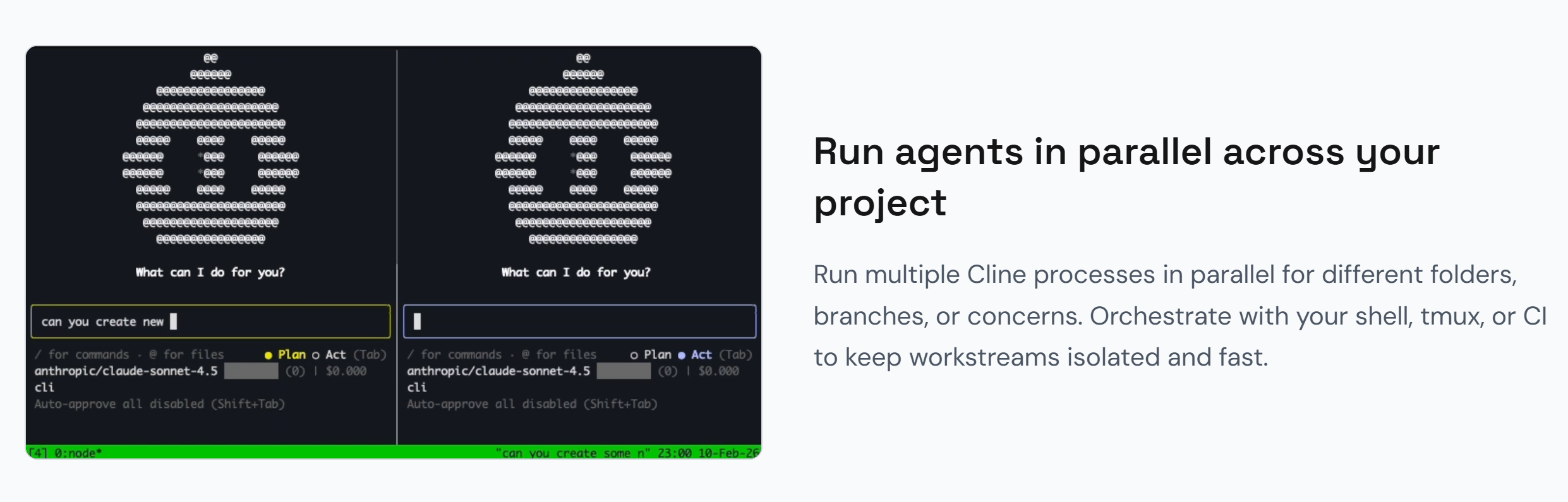
Parallel agents means you can run multiple Cline processes simultaneously across different folders, different branches, different concerns, and orchestrate them with whatever shell tooling you already use. tmux, CI runners, your own scripts. This is genuinely useful if you’ve ever tried to coordinate multi-repo work and ended up manually babysitting five terminal windows. Most people have.
Headless mode is the CI/CD pitch, and it’s the most interesting one technically. The -y flag strips out the interactive UI entirely, letting you pipe content in and get structured output back. The product site shows a CI snippet that’s actually readable: git diff origin/main | cline -y "Review this diff. Flag bugs, security issues, and style violations." That’s not marketing copy. That’s something you could paste into a GitHub Actions YAML right now and have it do something real. Whether it does something good is a separate question, but the plumbing is there.
ACP, Agent Client Protocol, is the third piece and the most forward-looking. The --acp flag lets Cline act as an agent that any ACP-compatible editor can connect to. Zed and Neovim are cited specifically. This is Cline hedging against IDE lock-in while also making a bet that ACP becomes a real standard. That’s either smart positioning or wishful thinking, depending on how protocol adoption goes.
It got solid traction on launch day on Product Hunt. The 5M+ developer claim appears consistently across their own materials and LinkedIn posts, though independent verification isn’t available.
The Verdict
Cline CLI 2.0 is doing the right things in the right order. The open-source credibility is real. The CI/CD angle is differentiated from most IDE-centric competitors. Parallel agents is the kind of feature power users will actually use, not just screenshot for LinkedIn.
That said, this is a crowded and fast-moving lane. Aider has a head start on terminal-native AI coding. GitHub’s own tooling is closing the automation gap from the other direction. And the ACP bet is an unproven standard that could look prescient or irrelevant in twelve months. Both outcomes are genuinely possible.
I think this is probably the right tool for teams already running headless automation who want AI-assisted code review baked into their pipelines. It’s a harder sell for developers who live primarily in a single IDE and don’t have strong feelings about their CI setup.
What I’d want to know before fully endorsing it: how does it actually perform on real CI pipelines at scale? The demo commands are clean, but production environments are not demo commands. I’d also want the 5M developer figure unpacked. Active users versus total installs is a meaningful distinction that doesn’t get made here.
At 30 days, the adoption signal is whether the Zed and Neovim communities actually use the ACP integration or quietly ignore it. At 90 days, watch the GitHub stars trajectory and whether enterprise teams start showing up in the community. If the headless mode is as solid as advertised, someone’s going to build something interesting with it. Whether that someone credits Cline is the whole game.
Also featured on HUGE: OpenUI Wants AI Apps to Stop Talking and Start Showing · ByteRover Thinks Your AI Agent’s Memory Problem Is Actually a File System Problem · One CLI to Rule Them All (If You Have 44 AI Agents, Which, Look)