














origami-chat
Find your perfect leads with one prompt
The Prompt That Finds Your Next 1,000 Customers
The Macro: Sales intelligence is a $4B market waiting for a better front door
The sales intelligence market is enormous, fragmented, and exhausting in the specific way that markets get when the power users have been around long enough to write the documentation themselves. Apollo has 275 million contacts and a filters panel that takes a meaningful afternoon to master. ZoomInfo charges enterprise prices for a database that still surfaces phone numbers from 2019 with quiet confidence. Clay is remarkable, genuinely flexible, genuinely powerful, and equally capable of making a growth engineer feel like they’re configuring a rocket ship just to send a cold email to someone who probably won’t respond.
The underlying problem is translation.
Salespeople and founders know exactly who they want to reach. They can describe their ideal customer in one sentence, in plain English, without stopping to think about it. What they frequently cannot do is express that knowledge as a structured set of boolean filters across a database they didn’t build and don’t fully understand. The entire industry has been built on the assumption that you’ll learn to speak the tool’s language. Origami.chat is betting on the opposite. That the tool should learn to speak yours.
This is not a frivolous bet. The same inflection that made text-to-SQL tractable, large language models that actually understand intent rather than just pattern-matching on syntax, makes plain-language prospecting viable in a way that would have been impressive-but-unreliable two years ago. The window is genuinely open right now.
The Micro: 100+ data sources, zero prompting expertise required
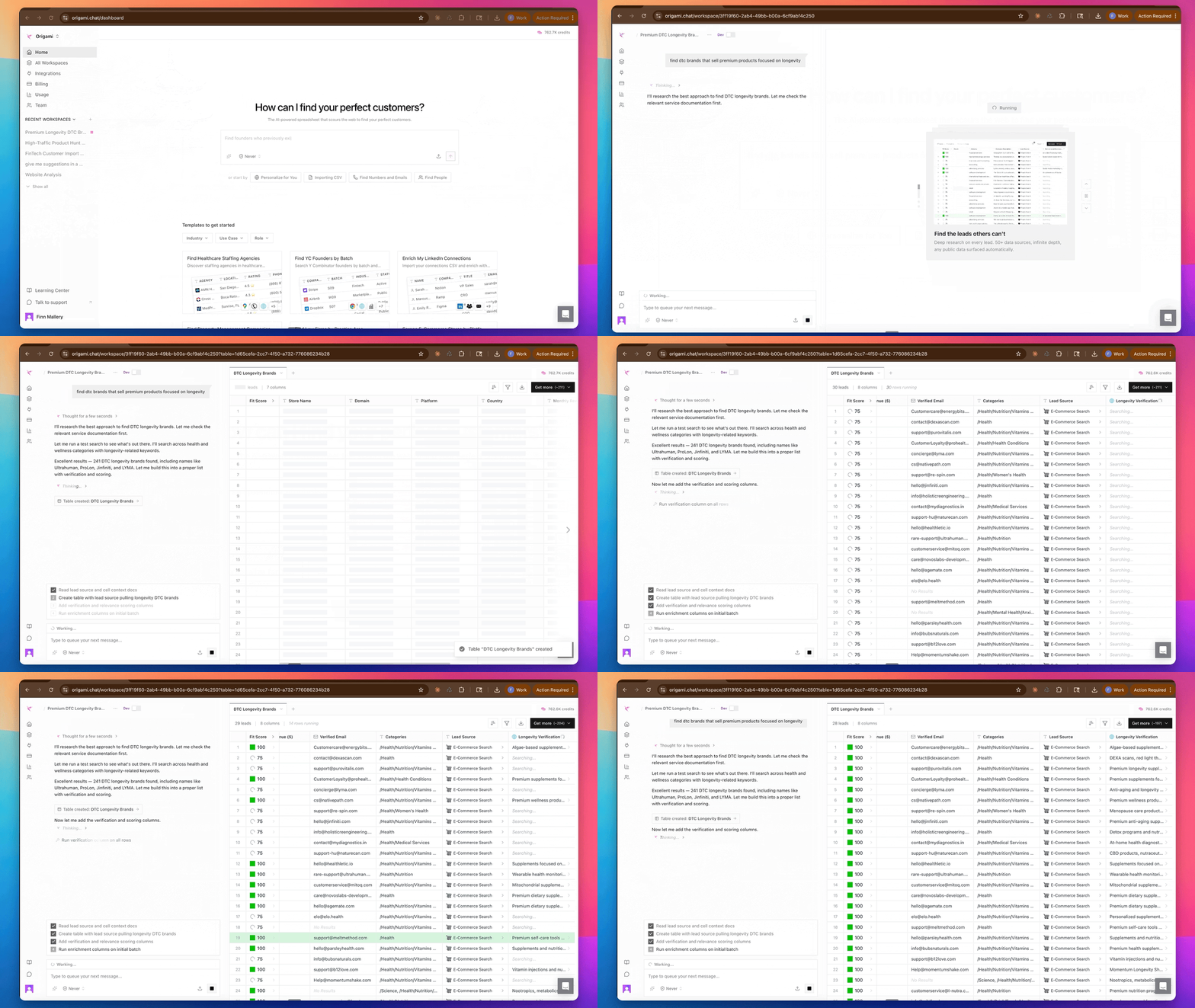
Origami.chat has one primary interface: a text prompt. You describe your ideal customer. Something like “B2B SaaS founders in the US who raised a Series A in the last 18 months and are actively hiring sales engineers.” The system produces a matching lead list with names, companies, titles, contact information, and enrichment data. The gap between prompt and result is where Origami does its work, presumably parsing intent through an LLM layer, mapping it to queries across multiple data sources, deduplicating, and ranking.
The “100+ data sources” claim deserves a moment.
Aggregating from many sources is actually the harder way to build this. It introduces consistency problems, data freshness variance, and coverage gaps that are genuinely difficult to reconcile at scale. A single curated database is easier to maintain and easier to quality-control. But aggregation is also more defensible. Any single data provider can be switched out by a competitor, whereas a well-normalized multi-source layer becomes structural. If Origami’s normalization is solid, the breadth is a real advantage. If it isn’t, you get impressive-looking lists with a non-trivial percentage of wrong or stale data, which is exactly the thing this product is supposed to eliminate.
It got solid traction on launch day on Product Hunt, and the audience that votes there skews heavily toward founders, growth engineers, and operators. These are the people who spend the most actual hours inside Apollo and feel its friction the most acutely. When that group shows up in volume on first contact, it usually means the demo landed on something real.
The Verdict
Lead generation tools live and die on data quality. The honest answer is that data quality is not visible from a launch page.
The promise of one-prompt prospecting is genuinely compelling, and the natural language interface removes a real barrier for people who know their ICP with precision but have no interest in learning a filter panel. The comment volume alongside the upvotes suggests genuine engagement rather than reflexive enthusiasm. People had thoughts. That matters.
The caveat I’d hold onto: “100+ data sources” is a pitch before it is a feature. Its value depends entirely on whether the normalization is good, the sources are current, and the deduplication is clean. None of that is verifiable from the outside.
I think Origami.chat is probably a strong fit for founders and small sales teams who know exactly who they’re targeting but find tools like Apollo genuinely tedious to operate. I’m more skeptical it displaces Clay for anyone who’s already built workflows there and has the technical appetite to maintain them. The real test isn’t the demo. It’s whether users who sign up today still have the tab open in 90 days.
The timing is right. The question is execution, which is always the question.
Also featured on HUGE: Paloma Thinks Your Post-Sales CRM Is a Mess and Honestly It Probably Is · Caseflood.ai Is Betting That Law Firm Intake Is Broken Enough to Fix With AI · OpenIntake Turns Missed Law Firm Calls Into Signed Clients