














starnus
Find and reach your next customers on autopilot
Starnus Wants to Be Your Entire Outbound Sales Team. That's Either the Pitch or the Problem.
The Macro: The Outbound Stack Is Collapsing Into Itself
B2B outbound sales spent the last five years collecting tools the way a distracted founder collects productivity apps. A prospecting tool here, an enrichment API there, a sequencer on top, a CRM underneath, and somewhere in the middle a sales rep manually copying data between all of them. The average SDR stack at a mid-size company runs through Apollo or ZoomInfo for leads, Clay for enrichment, Smartlead or Instantly for sequencing, and HubSpot or Salesforce to log whatever survives. Four or five paid subscriptions doing one job badly, in pieces.
The consolidation argument has been building for a while.
Clay arguably kicked it off by making enrichment actually composable. Apollo has been quietly absorbing sequencing features. Then the AI agent wave arrived and everyone started asking the obvious question: if you can describe a workflow in plain language, why are you still clicking through five dashboards to run it?
The market here is substantial and well-documented as growing. The incumbents are not exactly beloved. Apollo has a functional-but-cluttered reputation. ZoomInfo is enterprise-priced and regularly criticized for data freshness. Clay is powerful and famously carries a learning curve steep enough that some companies hire a dedicated operator just to run it. The door is open for something that trades configurability for usability without giving up output quality.
The timing argument holds up reasonably well. AI agent infrastructure matured enough through 2024 and into 2025 that multi-step autonomous workflows are no longer a research project. The real question is whether the execution matches the architecture.
The Micro: Twenty-Four Agents and a Prompt Box
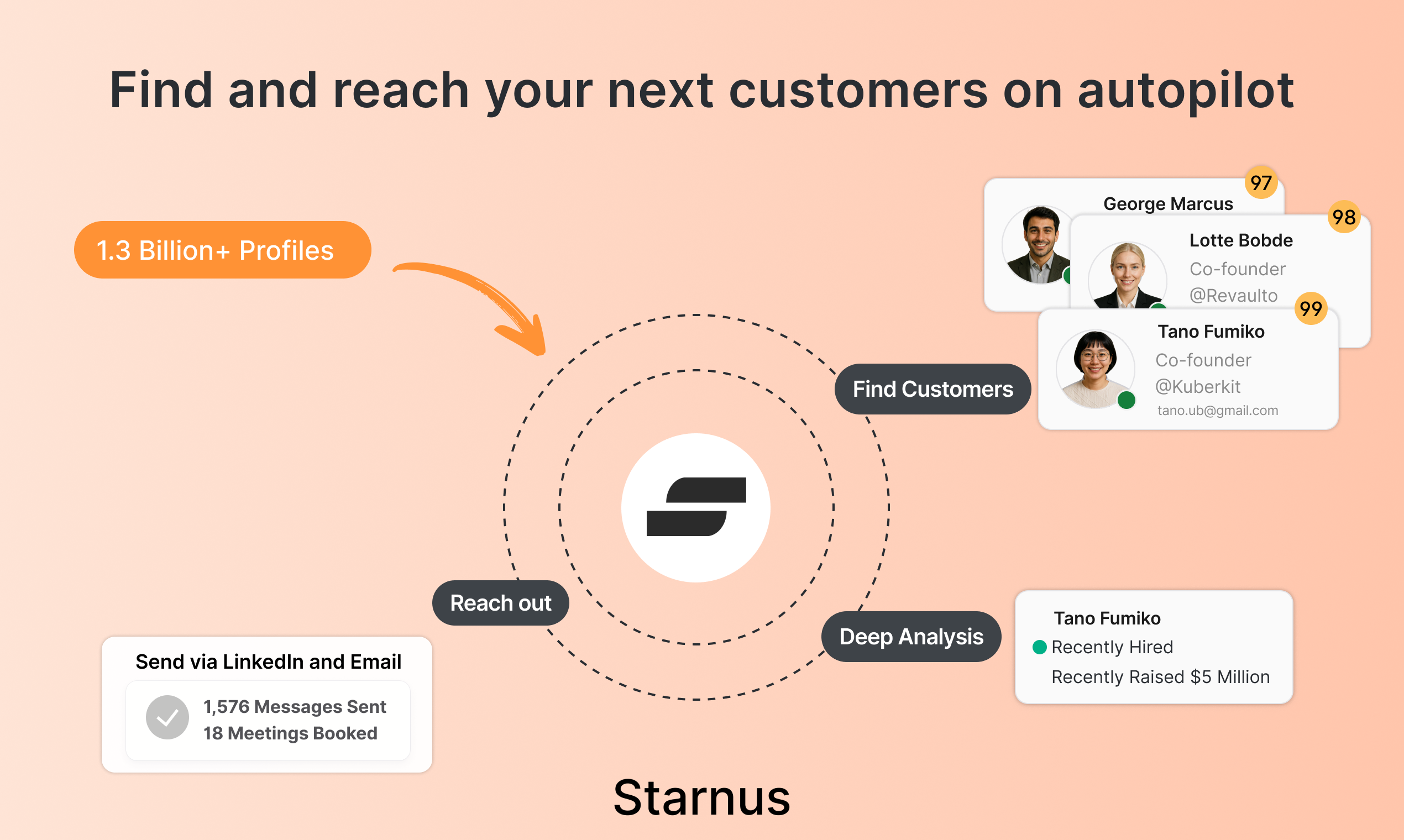
Starnus is positioning itself as an end-to-end outbound platform built around a natural language interface. The core loop is straightforward: describe your ideal customer profile in a prompt, let the platform find lookalike prospects, enrich those leads with business and contact data, generate personalized outreach copy, send it, and track replies. All without leaving the platform.
The website lists 24 live agents.
They cover lead generation, deep research, campaign setup, campaign monitoring, email management, CRM updates, social media, and task management. That is an ambitious surface area. The integrations shown include Unipile and Smartlead, which suggests the email execution layer is at least partially handled via established infrastructure rather than built from scratch. That is a reasonable call given how deliverability-sensitive outbound email actually is.
The framing is “AI employee in sales” rather than “AI-assisted workflow,” and that distinction matters. They are not selling copilot features layered onto your existing stack. They are selling the stack replacement. You describe the job once, Starnus runs it for days, and it surfaces for approval when a reply needs a human.
It got solid traction on launch day, which suggests genuine interest beyond a well-organized launch network.
What is harder to assess from the outside is data quality. Lead enrichment is only as good as its underlying sources, and nothing in the available research discloses what data partnerships or crawling methodology Starnus actually uses. Personalization quality at scale is similarly opaque. “Personalized outreach” in 2026 ranges from genuinely contextual to mail-merge-with-LinkedIn-job-title, and you cannot tell which one you are getting until you are in it.
The Verdict
Starnus identified the right problem. The outbound stack is fragmented and genuinely annoying to operate. The agent-first, prompt-driven interface is the correct UX bet for this category right now, and the launch momentum looks real rather than manufactured.
The 30-day question is data quality. If the leads are stale or the enrichment is thin, no amount of clean UX saves the conversion rate. The 60-day question is deliverability. Outbound email is a compliance and reputation minefield, and platforms that make it frictionless sometimes make it frictionlessly bad. The 90-day question is whether 24 agents is a coherent product or a feature list that has not been stress-tested at volume.
I would want to see real reply rate benchmarks from actual users before fully endorsing this. Not cherry-picked case studies. Real numbers, and clarity on where the data comes from.
The comparison to Clay is inevitable and probably unfair to both products, but Starnus still needs a cleaner answer to “why not just use Clay plus Smartlead” than “it’s simpler.” Simpler is only a moat until someone ships a better template library. It works for people who find Clay’s learning curve a genuine blocker and want something running faster. It probably does not work for teams who already have a tuned Clay setup and care more about configurability than speed.
The instinct is right, the timing is defensible. Worth watching.
Also featured on HUGE: Cuckoo Puts a Real-Time AI Translator in Your Zoom Call, and Snowflake Is Already Using It · LinkedIn Is Eating the Cold Email Playbook, and Extrovert Is Betting Everything on It