














revo-ai-email-assistant
AI with accurate replies that tackle the next-step tasks
Revo Wants to Answer Your Emails For You. The Bar Is Low Enough That It Might Actually Work.
The Macro: The Inbox Is a Graveyard and Everyone’s Trying to Dig It Up
Here’s the thing about email AI tools: there are approximately one million of them, and almost none of them are good. The market pressure is obvious. 4.48 billion people used email regularly in 2024, a number expected to climb toward 4.85 billion by 2030 according to multiple industry trackers. The email marketing software market alone is projected to hit somewhere between $4.27 billion and $45 billion by the mid-2030s, depending on which analyst you ask and how generous their assumptions are. Email is not dying, and everyone building tools for it knows it.
The crowded end of this space, Superhuman, SaneBox, the native AI drafting baked into Gmail and Outlook, tends to solve for speed or filtering. Write faster, read less, triage smarter. What almost no one has nailed is the context problem.
You get an email asking about a deliverable. The answer is buried in three Slack threads, a meeting you half-attended, and a CRM note from six weeks ago. Your email client doesn’t know any of that. So you go find it yourself, which is exactly the part that takes forever.
That’s the gap Revo is aiming at. It’s a real gap. The question is whether they’ve actually closed it or just described closing it very confidently on a landing page. The integration-first approach is the right instinct. Whether the execution matches is what the next few months will tell us.
The Micro: It’s an Inbox Layer, Not Another Email Client
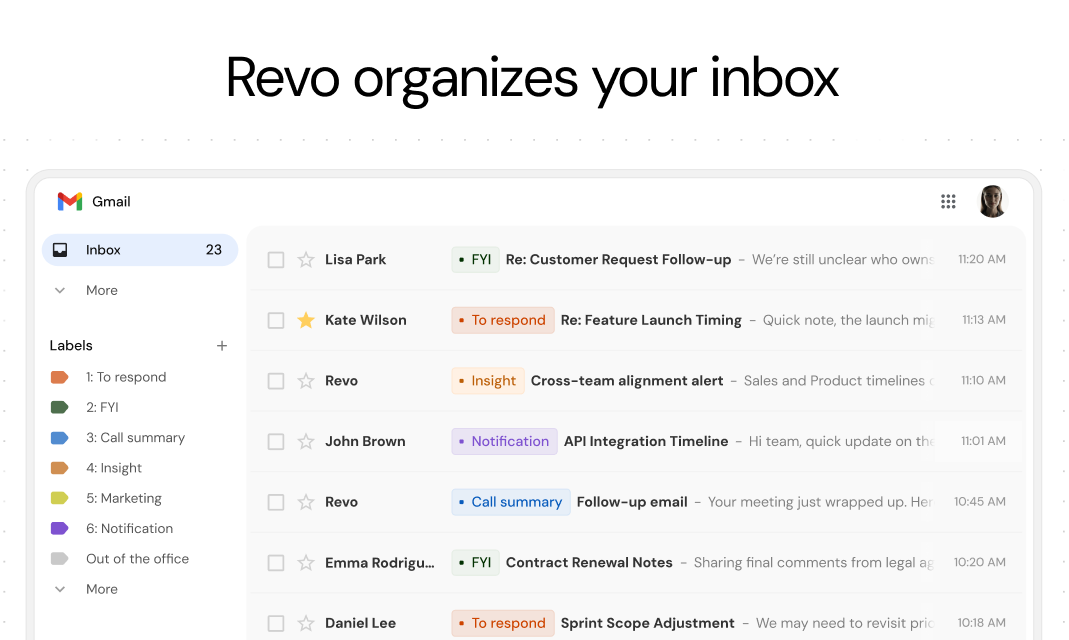
Revo isn’t asking you to switch email clients. It works on top of Gmail and Outlook, which is probably the right call given that most people have strong opinions about their email client and will not change them under any circumstances. Setup is reportedly fast, which matters for a product targeting people who already feel behind.
The core mechanic, according to their product materials and at least one independent writeup, is pulling context from 50-plus integrations. Slack, Jira, CRM systems, docs. The pitch is that when someone emails you asking for a status update, Revo has already read the Slack thread where your teammate posted the update yesterday and can draft a reply accordingly. That’s a meaningfully different proposition than “here is a grammatically correct version of what you were going to say anyway.”
That distinction matters more than it sounds.
The compliance stack is real and visibly front-loaded on their site: SOC 2 Type II, ISO 27701, GDPR. For any product touching corporate email, that’s not optional. It’s smart to lead with it rather than bury it in a footnote.
The product got solid traction on launch day on Product Hunt, with 82 comments suggesting actual engagement rather than pure vote-farming. People were asking real questions, which usually means real interest. The customer logos on their site include Uber and General Catalyst, which, if accurate, suggests at least some enterprise traction beyond the enthusiast crowd.
What’s genuinely unclear from publicly available information: pricing, what AI model sits underneath, and how gracefully it handles ambiguous or sensitive emails where a confident wrong answer is worse than no answer at all.
The Verdict
Revo is solving a problem that is real, specific, and actually annoying in a way that makes people willing to pay to fix it. The integration-first approach is the right architecture. Context is the whole game here, and everyone who skipped that step built a slightly better autocomplete.
The 30-day question is retention. Email AI tools have a well-documented hype-to-abandonment arc: people sign up, try it on five emails, get one weird draft, and quietly stop opening it. Revo survives that if the context-pulling works consistently. It fails if it’s impressive in demos and unreliable in production.
At 60 days, the question becomes enterprise stickiness. The compliance certifications and logo wall suggest they’re going after teams, not just individuals. That’s the right market, but enterprise sales cycles are long and IT approval processes are brutal.
At 90 days, I’d want to know the activation-to-retained-user ratio. I’d also want to know whether anyone is actually letting it send emails autonomously or just using it for drafts, because those are two very different products in practice.
Revo is probably the right tool for teams drowning in cross-platform context, where the pain is specific and the integrations actually map to their stack. I’d be less convinced for solo operators or small teams who live mostly in one tool. And no, I wouldn’t let it reply to your board yet.
Also featured on HUGE: TamLabs Thinks AI Can Redesign Knowledge Work and They’re Starting with Professional Services · Stamp Thinks Your Email Client Should Think For You · Vercel Wants to Own the Whole Stack, Not Just the Edge