














lunair
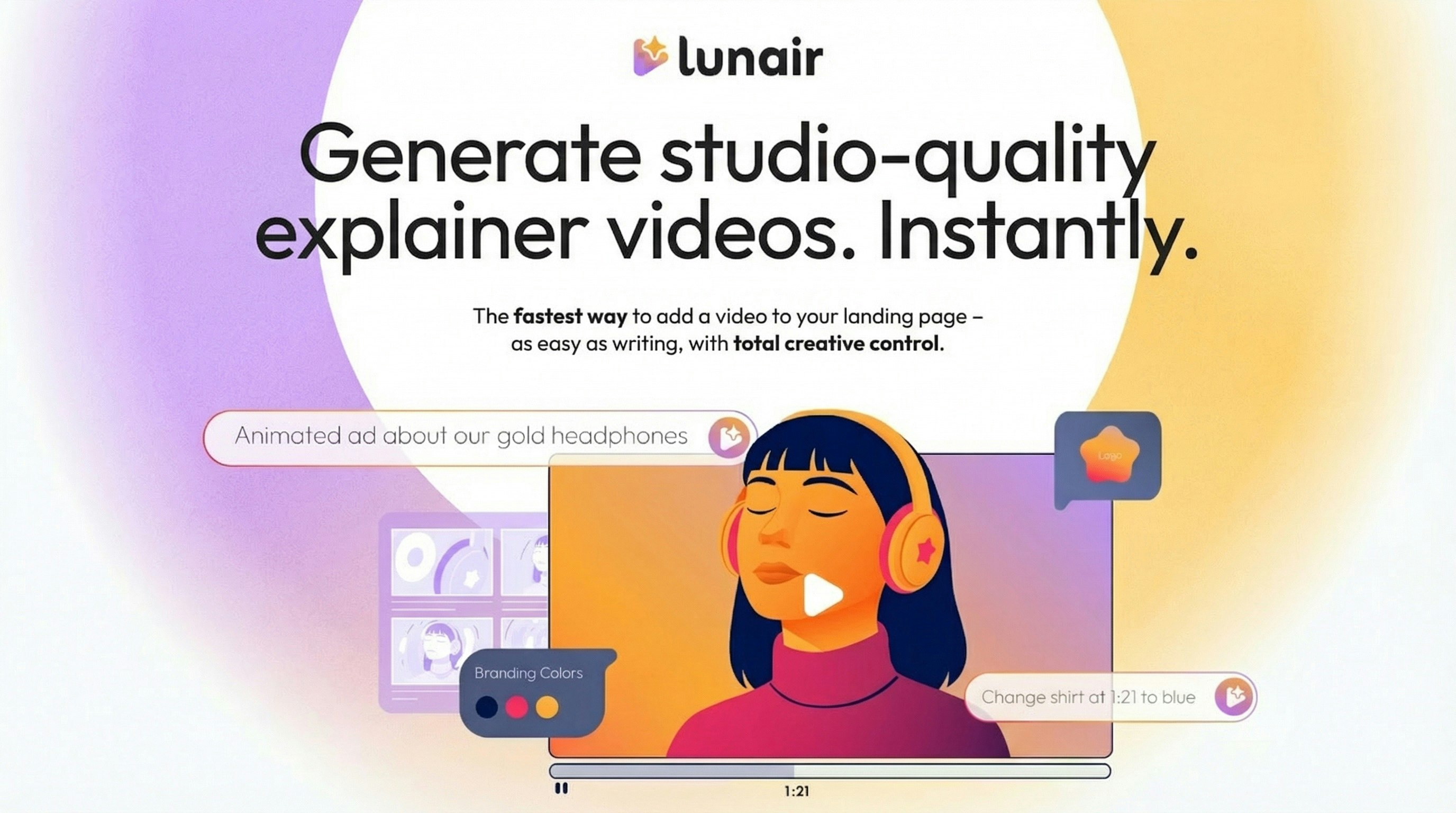
Generate studio-quality explainer videos. Instantly.
One Guy, One Prompt, and a $50K ARR Argument Against the Entire Stock Footage Industry
The Macro: Everyone Needs a Video, Nobody Wants to Make One
Here’s the problem with explainer videos: every SaaS landing page needs one, and almost nobody wants to sit down and make it. Three options exist. Hire an agency, which is slow and expensive. Use a template tool, which is fast and visibly, embarrassingly generic. Or record yourself talking at a camera, which most people would genuinely rather not do. That gap between “I need a video” and “I have a good video” has quietly sustained a cottage industry of motion design freelancers for a decade.
AI is doing what AI does, which is wedging into that gap as hard as it can.
The space in 2026 is genuinely crowded. Sora, Runway, Pika, HeyGen, Synthesia, and a long tail of newer entrants are all competing for some slice of the video creation workflow. The digital marketing market hit roughly $410 billion in 2024 and is projected to nearly triple by 2033, per Research and Markets. The addressable market is not the problem. The problem is differentiation.
Most of the major players are chasing either hyper-realistic video generation or avatar-based talking-head content. What’s comparatively underserved is the middle lane: branded, animated explainer videos. The kind a startup drops above the fold to explain what the hell they actually do. That’s not a new need. It’s just one that tools like Vyond and Animaker have historically served with results that look, charitably, dated. GenVid and Creaibo are sitting in adjacent territory, but neither has managed a first-place Product Hunt finish. That’s at least a signal worth taking seriously.
The timing argument is simple. AI generation quality crossed a threshold recently where “good enough for a landing page” became achievable without a production team behind it.
The Micro: Prompt In, Branded Video Out (With Edits, Apparently)
Lunair’s core loop is simple enough to explain in one breath. You describe your product. It generates a complete animated explainer video, characters, scenes, voiceover, music, motion, and hands you back a file you can actually use. No timeline scrubbing. No asset libraries. No After Effects.
The edit layer works the same way, plain language. Swap the narrator, adjust the script, refine a scene. This is the part I’d pay attention to, because most AI video tools give you generation without meaningful iteration. You get what you get, and then you work around it.
The “consistent characters” claim is where things get technically interesting. Generating a coherent visual style across multiple scenes is genuinely hard. It’s the same problem that makes AI-generated comics look slightly unhinged when a character shifts expression between panels. If Lunair has actually solved scene-to-scene visual consistency at usable quality, that’s a real product decision, not just copy written by a marketer. The demo on their site exists, but limited evidence is still limited evidence.
On launch: it got solid traction on Product Hunt. The 5,000-plus creator count on their site suggests some pre-launch momentum, though that number is self-reported and I can’t verify it independently.
The founder, Guy Manzur, Hebrew University, based in Israel, reportedly built this solo on top of Base44 and bootstrapped to $50K ARR before the launch, according to a LinkedIn post from an investor. Solo bootstrapped to five figures is the kind of origin story that’s either inspiring or a future cautionary tale about technical debt. Usually both. Building on Base44 says something deliberate about prioritizing speed to market over a custom stack.
Pricing isn’t detailed in available materials. There’s a free first video offer for early users.
The Verdict
Lunair is a legitimately interesting product in a space moving fast enough that “interesting” has a short shelf life.
The core bet, that founders and marketers would rather describe a video than make one, is almost certainly correct. The question is how deep the execution actually goes.
At 30 days, the thing to watch is retention. Product Hunt launches generate curiosity traffic, not loyalty. Does the free video convert to paid? At 60 days, the consistency claim gets stress-tested. Can it handle weird B2B products, niche industries, edge-case brand guidelines? That’s exactly where template tools have always collapsed into the same three visual styles on rotation.
At 90 days, the competitive moat question becomes urgent. If Runway or HeyGen adds an explainer mode, and they will try, what does Lunair have that’s genuinely sticky? Right now the answer seems to be simplicity and speed for a specific use case. That’s a real answer. But only if they execute on it better than a larger team with more resources can replicate.
I’d want to see actual output quality across a variety of prompts before endorsing it fully. But a solo founder who bootstrapped to $50K ARR before a first-place launch day is, at minimum, someone who knows how to ship.
That’s not nothing.
Also featured on HUGE: AI Video Has a Consistency Problem. Visla Is Betting a Storyboard Layer Fixes It. · Nobody Likes Filling Out Forms. This Open-Source Project Wants You to Talk Instead. · Anthropic Just Put a Slide Jockey Inside PowerPoint. That’s Actually the Interesting Part.