




























visla-ai-director-mode
Continuous scene-by-scene AI video generation
AI Video Has a Consistency Problem. Visla Is Betting a Storyboard Layer Fixes It.
The Macro: AI Video Is Winning, But Only One Scene at a Time
AI video generation in 2025 is genuinely impressive and almost entirely useless past the fifteen-second demo. Tools like Runway, Sora, and Kling produce individual clips that would have looked like science fiction three years ago. Stringing those clips into something coherent, with a consistent character, consistent setting, and consistent brand, is the part that quietly breaks everyone’s workflow.
The market is large. Depending on which analyst you ask, somewhere between “very large” and “absurdly large.” Multiple sources put the global AI market in the hundreds of billions now, growing toward the trillions by the early 2030s. Stanford’s 2025 AI Index found that 78% of organizations reported using AI in 2024, up from 55% the year before. AI video is a slice of that, but it’s the slice getting the most attention from enterprise buyers and solo creators who’ve figured out that motion content converts better than static.
The competition is already entrenched. Runway has the filmmaker credibility. Pika has the virality. HeyGen owns the avatar-talking-to-camera lane. Katalist, which Visla directly compares itself to on its own blog (bold move, actually useful for consumers), is playing in a similar structured-storyboard space. The undifferentiated middle, the “just generate a video from a prompt” tier, is crowded past the point of meaning anything.
So the interesting question isn’t whether AI video is a real category.
It obviously is. The question is whether anyone has solved the scene-to-scene coherence problem at a workflow level, not just a model level. That’s the specific bet Visla is making with Director Mode.
The Micro: A Director’s Chair Made of Dropdowns (in a Good Way)
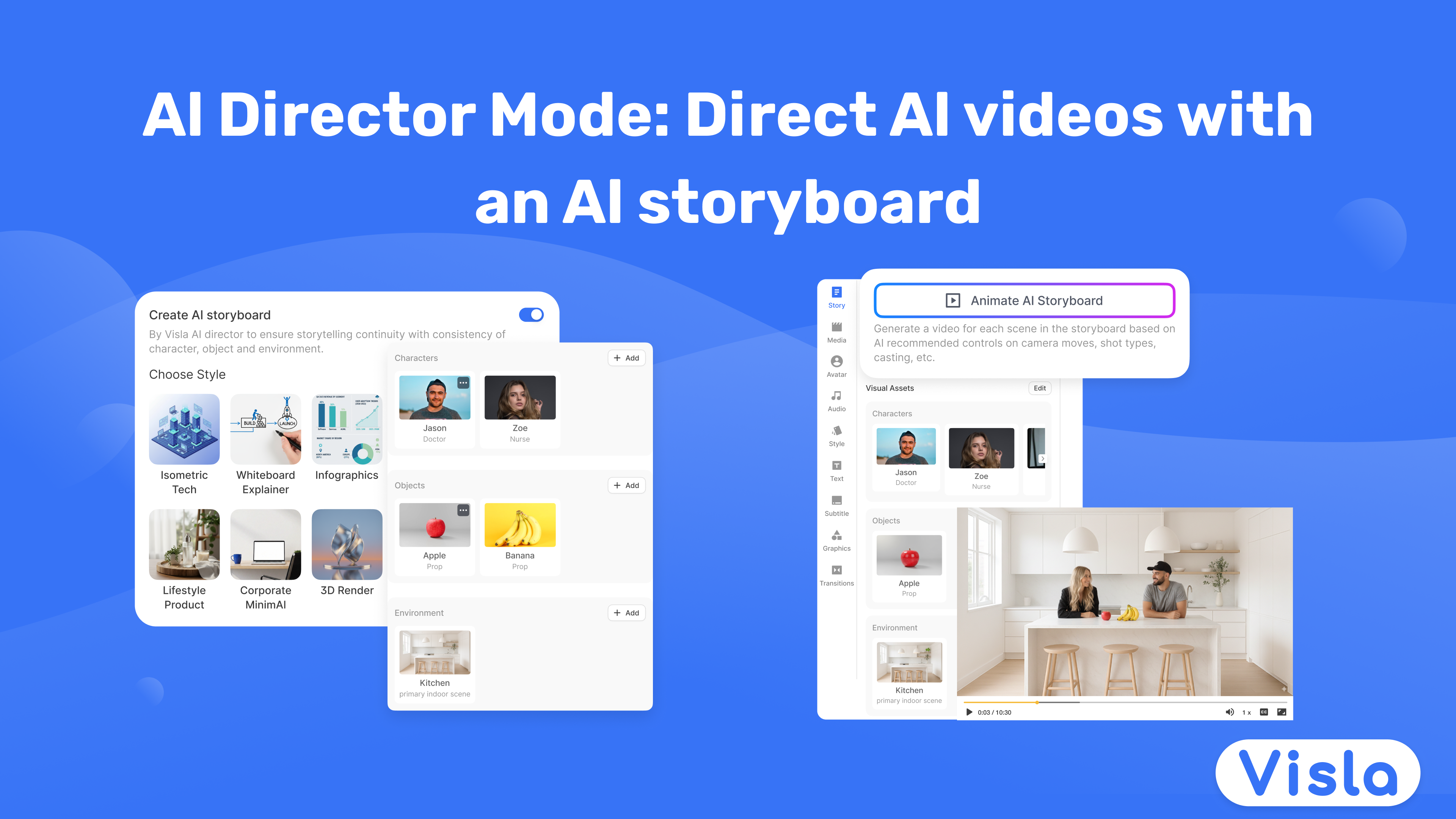
AI Director Mode is, structurally, a pre-generation control layer. That framing matters. Visla isn’t primarily competing on the quality of its underlying video generation. It’s competing on what happens before the generation runs.
Here’s how it actually works. You feed it an input, which could be a script, URL, PDF, slide deck, raw footage, images, or a rough idea. The list is deliberately broad. Visla produces an AI-generated storyboard broken into discrete scenes. Before anything gets rendered into video, you make decisions: cast, props, environments, pacing, voiceover style. Brand assets, logos, products, get locked in so they persist across scenes rather than hallucinating into something adjacent to your actual product by scene four. Then you selectively promote scenes from storyboard images to full AI video clips, instead of burning compute on every frame at once.
That last part is the quietly smart design decision.
Treating storyboard images and video clips as different tiers, and letting the user choose which scenes deserve the full treatment, is both cost-conscious and creatively sensible. Most videos have filler scenes. You shouldn’t pay the same price for a transition shot as for your hero moment.
It got solid traction on launch day on Product Hunt, which suggests Visla has an audience that showed up. But the engagement reads more like a feature launch for existing users than a cold acquisition play. That’s not a criticism. It’s a calibration.
One thing worth flagging from the research: Visla’s Director Mode is apparently bundleable alongside Veo 3.1 for photorealistic generation. If that integration is real and stable, it’s a more interesting pitch than the standalone product on its own.
The Verdict
Visla AI Director Mode is solving an actual problem. That already puts it ahead of roughly half the AI video tools that launched this year.
The storyboard-first, tiered-output approach is thoughtful. The brand asset consistency angle speaks directly to people who’ve already tried AI video and gotten burned by drift. I think this is probably the right tool for marketing teams and content ops people who need structured, repeatable video production without starting from scratch every time. It’s a worse fit for anyone whose work lives or dies on output quality at the frame level, because workflow elegance only carries a product so far.
At 30 days, the question is whether the actual frames are good enough that users don’t immediately feel the ceiling. At 60 days, it’s whether brand consistency holds up across diverse asset types or starts failing at edge cases. At 90 days, it’s whether Director Mode has become a retention driver or just a launch spike.
What I’d want to know before fully endorsing it: what does scene-to-scene character consistency actually look like across a 10-scene video when you’re not using their demo assets. That’s the specific failure mode that kills products like this. The marketing materials, predictably, don’t show it.
The concept is coherent, the positioning is sharper than most, and the free tier lowers the risk of finding out for yourself. Just don’t expect it to be the last tool in your stack.