





















lyria-3-by-google-deepmind
Turn any photo or thought into a custom song inside Gemini
Google Wants to Be the DJ at Your Camera Roll's Birthday Party
The Macro: The AI Music Race Already Has a Leaderboard
Suno exists. Udio exists. Both have been making weirdly competent AI-generated tracks for over a year now, and both have been sued by major labels for it. The legal situation around training data in generative music is genuinely unresolved, and anyone who tells you otherwise is guessing.
The broader market signal is interesting regardless. Digital audio advertising is projected to hit over $12 billion in 2025, according to Statista data cited by HubSpot. That’s not music creation, but it tells you something about how much money is already chasing audio attention. People are listening, and brands are paying to reach them there.
What’s been missing from the AI music space isn’t quality, exactly. Suno can produce a surprisingly passable indie folk track from a two-word prompt. The gap is integration. Most of these tools live on standalone websites you have to visit intentionally, with accounts you have to create and interfaces you have to learn. They sit outside the workflows where people are actually generating content.
That’s the specific bet Google is making with Lyria 3. Not that it sounds better than the competition, though that may also be true. The bet is that embedding it inside Gemini, where people are already asking questions and editing photos and drafting captions, changes who uses it and how often. Distribution as product strategy is not a new idea. But Google has more distribution than almost anyone.
The comparison that matters here isn’t Lyria 3 versus Suno on audio quality. It’s whether Google can make music generation feel as casual as asking for a synonym. That’s a different problem, and honestly a harder one.
The Micro: A Photo Goes In, a 30-Second Song Comes Out
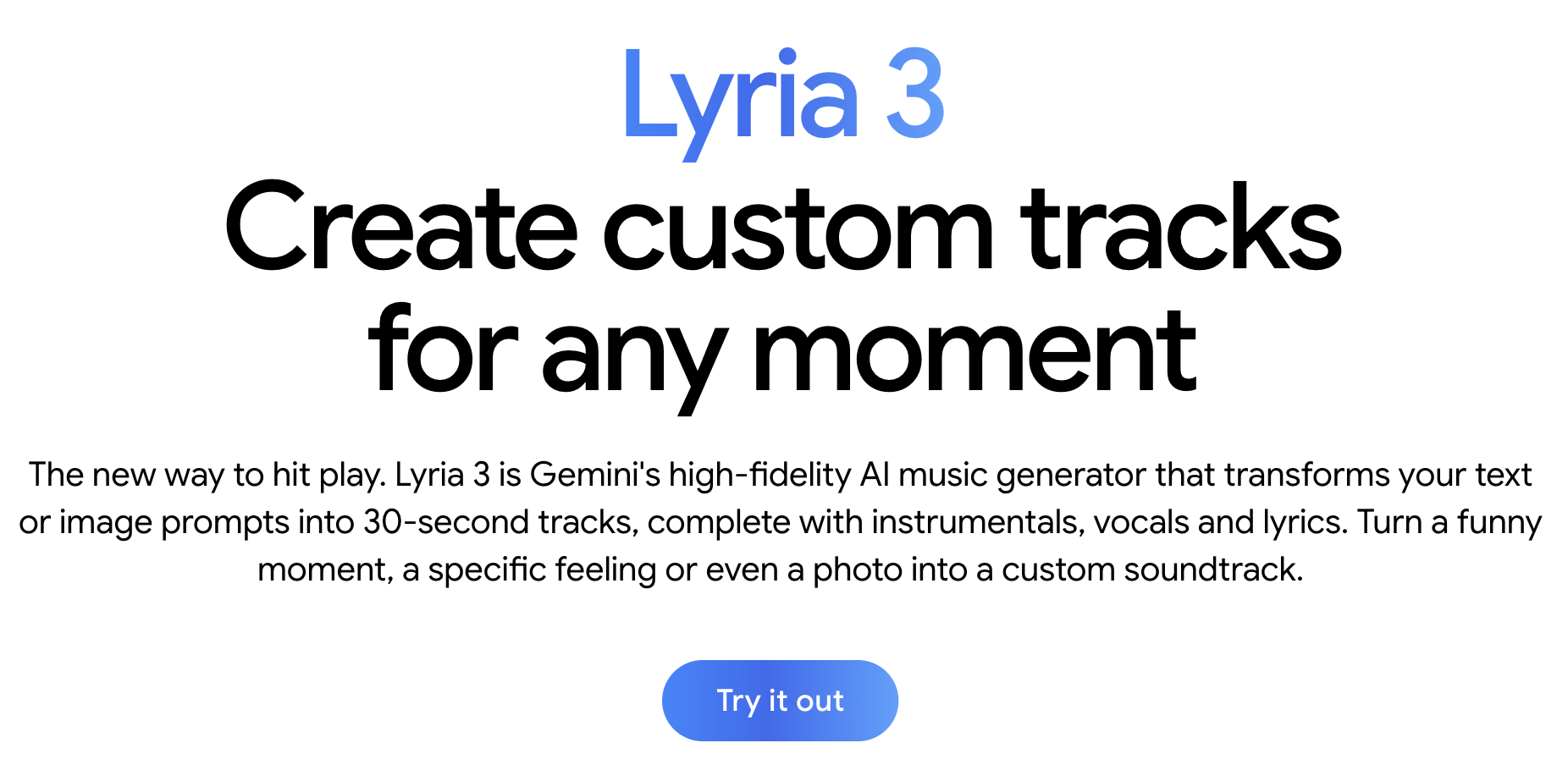
The mechanic is simple enough that it almost undersells itself. You open Gemini, drop in a photo or type a prompt, and Lyria 3 generates a 30-second track with instrumentals, vocals, lyrics, and cover art. The whole thing is contained. You don’t export to somewhere else. You share it directly from there.
The track examples on the product page give you a real sense of what they’re aiming for. “Pizza or Tacos” is tagged Disco Pop, Funk, High Energy. “Dryer Love” is R&B, Soulful, Ad-Libs. These are not accidental genre tags. The system is clearly designed to let you specify mood and era alongside subject matter, which matters because the difference between “a song about my dog” and “a funk song about my dog with a horn section” is the difference between a result you send in the group chat and one you close the tab on.
The image-to-song feature is the more interesting product decision. Feeding a photo into a music model is a multimodal problem. The system has to interpret visual content and translate something non-auditory into sonic choices, tone, tempo, lyrical content. Google is calling this “lyrics that match the moment perfectly,” which is marketing language, but the underlying technical challenge is real.
There’s a template gallery as a starting point for people who don’t know what to ask for. That’s a smart onboarding choice. Blank-prompt paralysis is a genuine user behavior problem, and a gallery of examples doubles as a demo of range.
It got solid traction when it launched, landing in the top two on Product Hunt the day it went live.
It’s currently in beta, so the honest caveat is that “most advanced music generation model” is Google’s own characterization. I’d want to hear independent comparisons against Suno and Udio at scale before treating that as settled. As I’ve written about elsewhere, Google’s Gemini products have a pattern of impressive demos that require more scrutiny on actual repeated use.
The Verdict
Lyria 3 is a real product with a clear use case and the right distribution vehicle behind it. That combination is genuinely uncommon. Most AI tools have one or the other.
The question I keep coming back to is depth versus virality. Thirty seconds is a social object, not a creative one. You can share it, react to it, post it. You can’t build anything with it. That’s probably fine for what Google is optimizing for here, which looks more like engagement and stickiness inside Gemini than market share in serious music production. Those are different games.
The thirty-day test is whether the feature pulls people back. Novelty works once. If the outputs are consistently good enough that people reach for Lyria 3 the second time a moment feels song-worthy, that’s a real behavior shift. If it’s a party trick people try and forget, it becomes a footnote in the Gemini changelog.
I’d also want to know how Google is handling the copyright and training data questions that have landed Suno and Udio in court. The product page says nothing about this, which is either deliberate or an oversight. Either way, it’s the part of the story that isn’t written yet.
For casual users who just want something fun to drop in a story, this is probably exactly good enough. For AI tools trying to earn regular use, good enough on day one isn’t the same as indispensable by day sixty.