














guideless
Create AI-narrated software video guides in minutes
Guideless Thinks the Screen Recording Era Is Over. It Might Be Right.
The Macro: Everyone Is Bad at Explaining Their Own Software
Most software teams have the same dirty secret: their documentation is terrible. Not maliciously, just practically. Writing good explainer content takes time nobody has, screen recordings accumulate like debt, and the person closest to the product is usually the worst person to narrate it. So teams ship a Loom with awkward pauses, or a help article that’s six months stale, and hope users figure it out.
The market around this problem is genuinely large. According to multiple research sources, the global business productivity software market sits somewhere between $62 billion and $110 billion depending on how you draw the lines, and it’s growing toward the $140 to $195 billion range over the next several years. That’s a big tent. Inside it, a specific category has gotten crowded fast: tools that help teams make product walkthroughs, onboarding flows, and software demos without hiring a production crew.
Loom owns mindshare in async video. Scribe turned click-capture into step-by-step guides. Trupeer, Arcade, and Guide Magnet are all working adjacent angles. The space is not empty.
What’s interesting is where the current tools tend to fall apart. The screen-recording-plus-voiceover workflow still requires a human to sit down, speak clearly, not flub the script, and then edit the result. Interactive demo tools like Arcade are powerful but closer to marketing assets than everyday documentation. Scribe is fast but mostly produces static annotated screenshots, not video.
The gap Guideless is aiming at is real: narrated video that doesn’t require a recording session. Whether that gap is big enough to build a company in is a different question.
The Micro: Click, Capture, Done (That’s the Pitch)
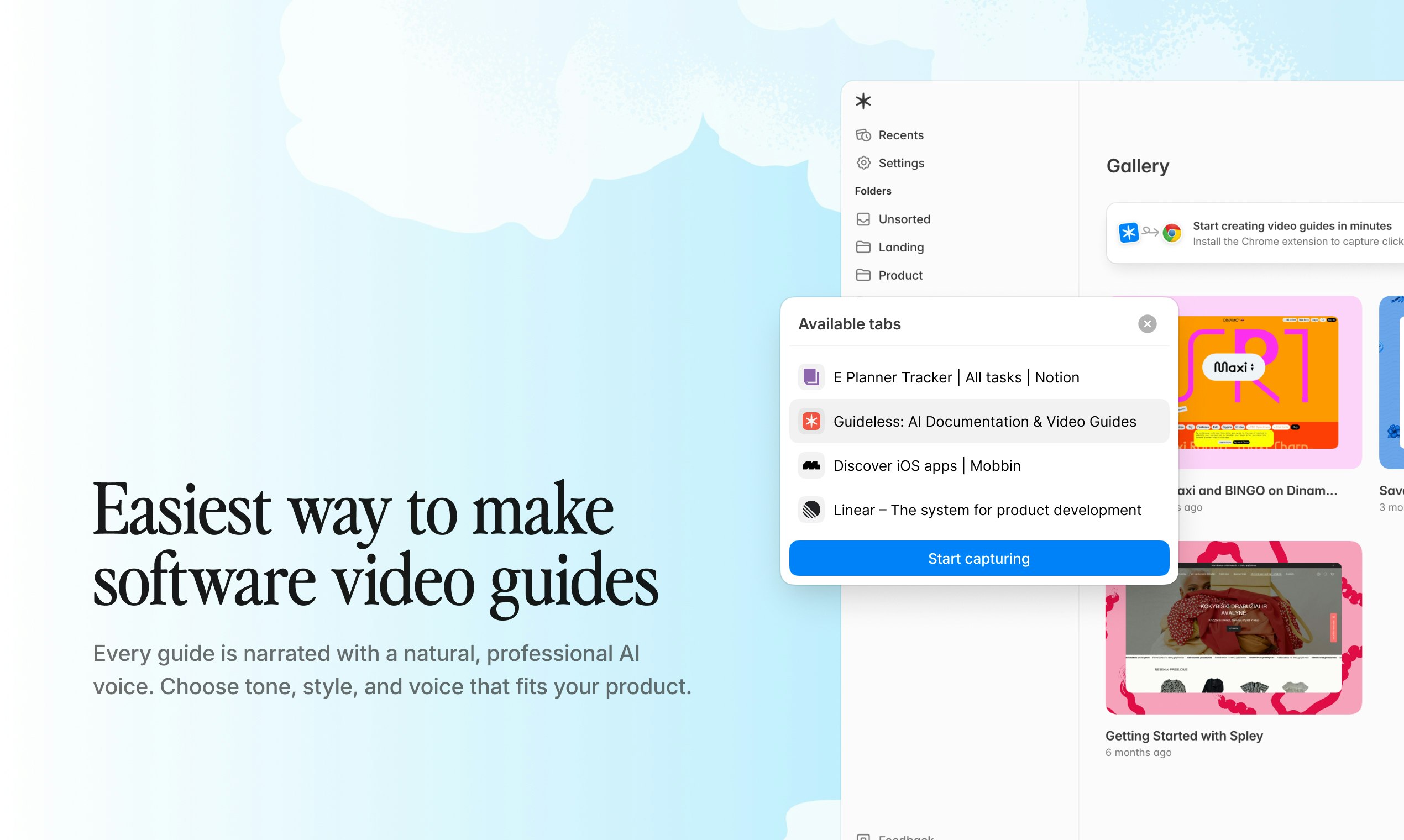
Guideless works as a Chrome extension. You install it, start a capture session, and go through whatever workflow you want to document inside your browser. The extension logs your clicks. From that, it generates a script automatically, applies an AI voiceover, and produces a narrated video guide. No microphone required. No retakes.
The voiceover selection reportedly includes multiple voices, tones, and languages. The branding layer lets teams apply their own colors and logo so guides don’t look like they came from a third-party tool. The output can be shared via link, embedded in docs or help centers, or exported as an MP4. There’s also a GIF export option, which is a smart call for teams who need lightweight previews inside Notion or Confluence.
Built-in analytics track how people watch the guides, which is something I’d actually use. Knowing where users drop off in a walkthrough tells you more than knowing they watched it.
The product is currently browser-only, which is a real constraint. If your software is a desktop app, a native mobile experience, or anything outside Chrome, Guideless can’t capture it. That’s not a flaw exactly, it’s a scope decision, but it’s worth knowing before you get excited.
According to LinkedIn posts from one of the founders, Evaldas Bieliūnas, the product was built on evenings and weekends alongside a day job. The site lists Databox, Nimo, Alloy, and a handful of other teams as early customers. It got solid traction on its Product Hunt launch, which suggests there’s genuine market curiosity here, not just founder-network enthusiasm.
The UX philosophy the team describes, obsessing over output quality rather than feature count, is the right instinct for this category. Most competitors over-built and underdelivered on the core thing, which is a guide that looks good and sounds like a real person made it.
The Verdict
Guideless has a clear and specific point of view: the production overhead of making video guides is the problem, and AI narration is the fix. I find that argument mostly convincing.
The real question is whether “browser-only” becomes a ceiling or just a starting constraint. A significant portion of the teams who need this kind of documentation are building web products, SaaS tools, internal dashboards. For them, the Chrome extension scope is fine. For teams with desktop-heavy workflows or native apps, it’s a dealbreaker today.
At 30 days I’d want to know whether users are actually finishing guides or abandoning them mid-flow. At 60 days I’d want to see whether the AI-written narration is genuinely good enough that teams stop wanting to tweak it. That’s the hard bar. AI voiceover has a way of sounding natural in demos and slightly off in real use.
I’d also want to see the analytics product mature. That’s the stickiest part of the value proposition if they develop it well. Tools like Monologue and others in the AI productivity category are learning that the retention play isn’t capture, it’s insight.
Guideless is a focused tool solving a real problem in a crowded space. That’s a legitimate starting position. Whether it’s a wedge into something larger or a feature waiting to be acquired depends on how fast they move on the constraints they’ve already identified.
Also featured on HUGE: TamLabs Thinks AI Can Redesign Knowledge Work and They’re Starting with Professional Services · Vercel Wants to Own the Whole Stack, Not Just the Edge · OpenAI’s New Codex Helped Build Itself. That’s Either Impressive or a Warning Label.