














delta-iq
Shows how contract changes affect prior approvals
The Contract Amendment Problem Nobody Talks About Because Everyone Just Rereads the Whole Thing
The Macro: Contracts Get Amended, Approvals Get Forgotten
Here’s the thing about contract management software: most of it is basically fancy file storage with a search bar bolted on. You upload your agreements, you can find them later, great, problem solved. Except the problem was never really about finding documents.
The actual problem is that contracts change. Amendments get added. Riders get stapled on. A credit agreement from eighteen months ago has been touched seven times since the original sign-off, and nobody has a clean picture of which clauses have been re-reviewed and which ones are just kind of floating there, approved in a context that no longer applies.
This is especially painful in credit and risk workflows, where a single amended covenant can cascade into a dozen downstream decisions. The teams doing this work aren’t incompetent. They’re just using tools that were designed to store documents, not track the decision history layered on top of them.
Contract lifecycle management (CLM) as a category has been trying to fix parts of this. EvolveCLM has talked publicly about how 11% of contract value leaks post-signature, which is a number that tends to get people’s attention in procurement meetings. But most CLM tooling still treats a contract as a text artifact to be compared, not a living object with approval state attached to each clause.
Fintech investment overall bounced back in 2025, with global totals reaching $116 billion across roughly 4,700 deals according to KPMG, up from $95.5 billion in 2024. The smarter money, though, has been chasing vertical SaaS plays with real workflow depth, not just AI wrappers. Delta IQ is clearly betting it falls into the former category.
Whether it actually does is the more interesting question.
The Micro: Approvals as First-Class Objects
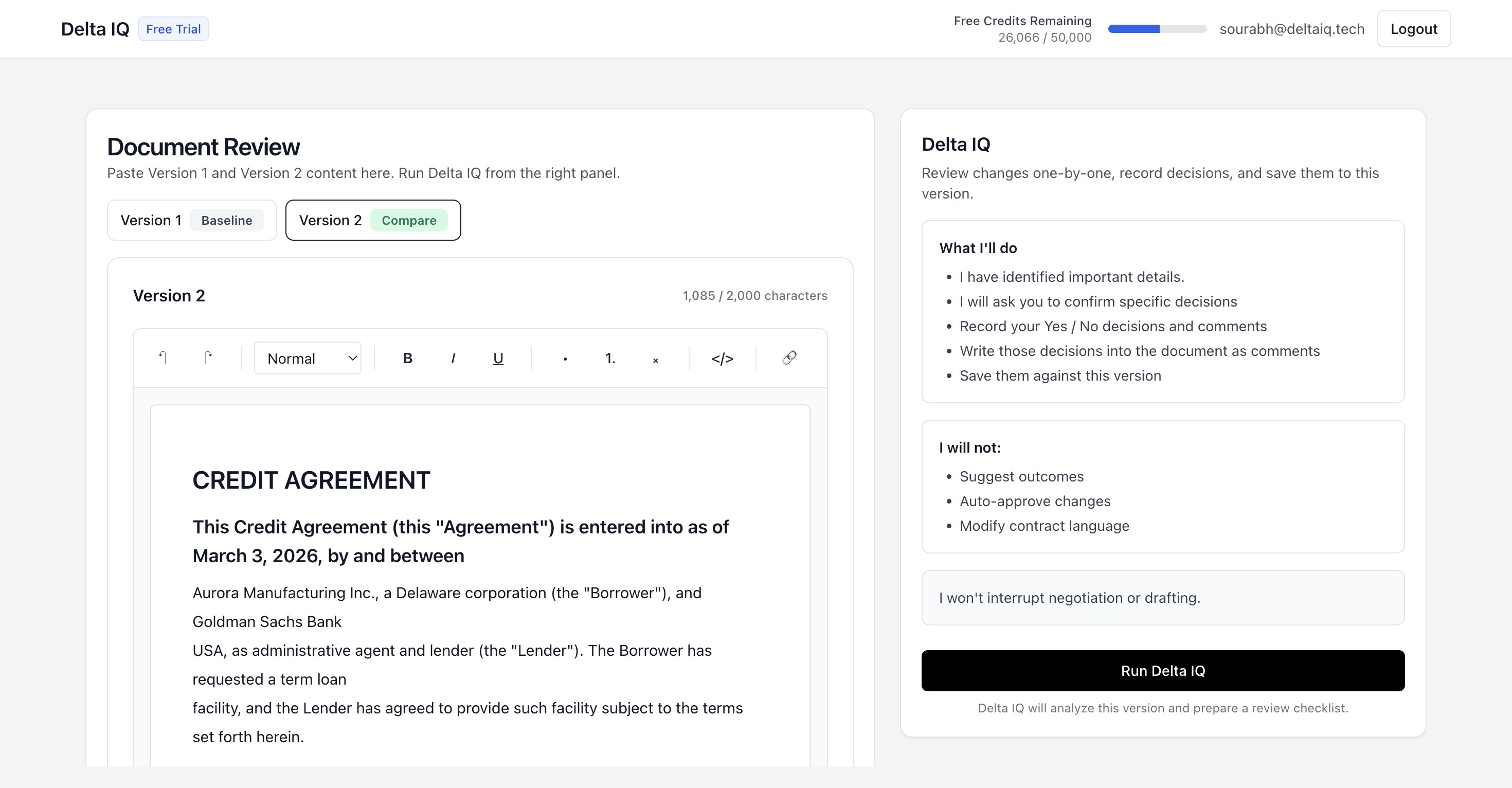
Delta IQ’s core idea is simple and kind of elegant. Instead of treating a contract as a document and approvals as an external process that happens to reference it, they make approvals a property of specific clauses at specific versions. When an amendment comes in and gets uploaded to the system, Delta IQ highlights which provisions changed and surfaces whether the approvals tied to those provisions still hold or need a fresh look.
That’s it. That’s the product.
And honestly, that framing alone is interesting enough to pay attention to. Most review fatigue in contract-heavy teams comes from not knowing what you actually need to re-examine. The default move is to read everything again, which is how you end up with a paralegal spending three hours on a two-paragraph amendment because it touched a cross-referenced section that might matter. Delta IQ is trying to make that call programmatically.
The product sits at the intersection of AI and document workflow in a way that feels more grounded than a lot of what I’ve seen in this space. It’s not generating contract language or summarizing agreements in the abstract. It’s tracking state. That’s a different and, to me, more defensible thing to build.
From the founder research, it looks like at least one person behind this came from CIO and technology leadership backgrounds before going independent, which would explain why the product reads like something built by someone who actually sat in the meetings where this problem was annoying. That kind of origin story tends to produce more specific tooling.
It picked up solid early traction when it launched, which suggests the problem resonates with people who immediately got what it was trying to do.
The website right now is basically just a login screen, so there’s no public demo to poke at. That limits how much I can say about the actual UX or how the amendment upload flow works in practice.
The Verdict
I think this is a real problem and a credible framing of it. The insight that approvals should be versioned alongside clauses, not just exist as a separate paper trail, is the kind of thing that sounds obvious once someone says it and apparently nobody has built cleanly before.
What makes me cautious is how narrow the initial use case is. Credit and risk workflows are a real market, but they’re also a slow, enterprise-y market where buying cycles are long and integrations with existing systems are load-bearing. If Delta IQ is asking teams to upload amendments manually into a new tool that doesn’t talk to their existing CLM or document management setup, adoption is going to be friction-heavy.
The 30-day question I’d want answered: what does the integration story look like? Does this sit on top of existing tools like something Helply is doing in its own vertical, or does it require ripping out part of an existing workflow?
At 60 days, I’d want to know if they’re seeing repeat usage or one-time curiosity. And at 90 days, the question is whether they can get a reference customer willing to talk publicly, because that’s how you sell into risk and compliance teams.
The idea is tight. The execution window is narrow. I’m watching this one.
Also featured on HUGE: FullSeam Wants to Replace Your Accounts Payable Team With AI Agents · Helply Bets Its Business Model on a Number: 65% · Hyperline Is Building the Billing Stack That SaaS Pricing Models Actually Require