





















springfield-oracle
Every Simpsons prediction sourced, scored, fact-checked
The Simpsons Didn't Predict the Future. The Internet Did It For Them.
The Macro: The Misinformation Is the Content Now
There’s a specific kind of brain rot that happens when you’ve been online long enough. You stop asking whether something is real and start asking whether it feels real enough to share. The Simpsons prediction pipeline is maybe the purest example of this in the entertainment space right now.
The clips spread fast. Some guy on TikTok cuts together a scene from a 1998 episode next to a news headline, slaps some dramatic music on it, and six million people watch it before anyone asks if the episode is real. Spoiler: a lot of them aren’t. AI video generation has made this dramatically worse. You can now fabricate a completely convincing Simpsons clip in about forty minutes, and there is essentially no infrastructure to call it out.
This sits inside a much larger problem with how we consume media verification in 2025. Deloitte’s digital media trends research points out that hyperscale social video platforms are actively reshaping how people process information, and not in ways that reward accuracy. The incentive structure rewards the share, not the fact-check. Short-form video is optimized for feeling, not sourcing.
The broader entertainment and media market hit $2.9 trillion in revenue in 2024 according to PwC, and a meaningful chunk of that growth is coming from exactly this kind of fast, viral, emotionally resonant content. The problem is that the verification layer never got built alongside it.
Nobody is really doing what Springfield Oracle is attempting here. The closest thing would be Snopes-style fact-checking for memes, but that’s slow, text-heavy, and not built around a specific cultural artifact the way this is. There’s a real gap between “someone on Reddit debunked this” and “there is a structured, searchable database that tells you the episode, the air date, and the actual real-world event it supposedly predicted.” That gap is what this product is betting on.
The Micro: A Database With an Actual Opinion
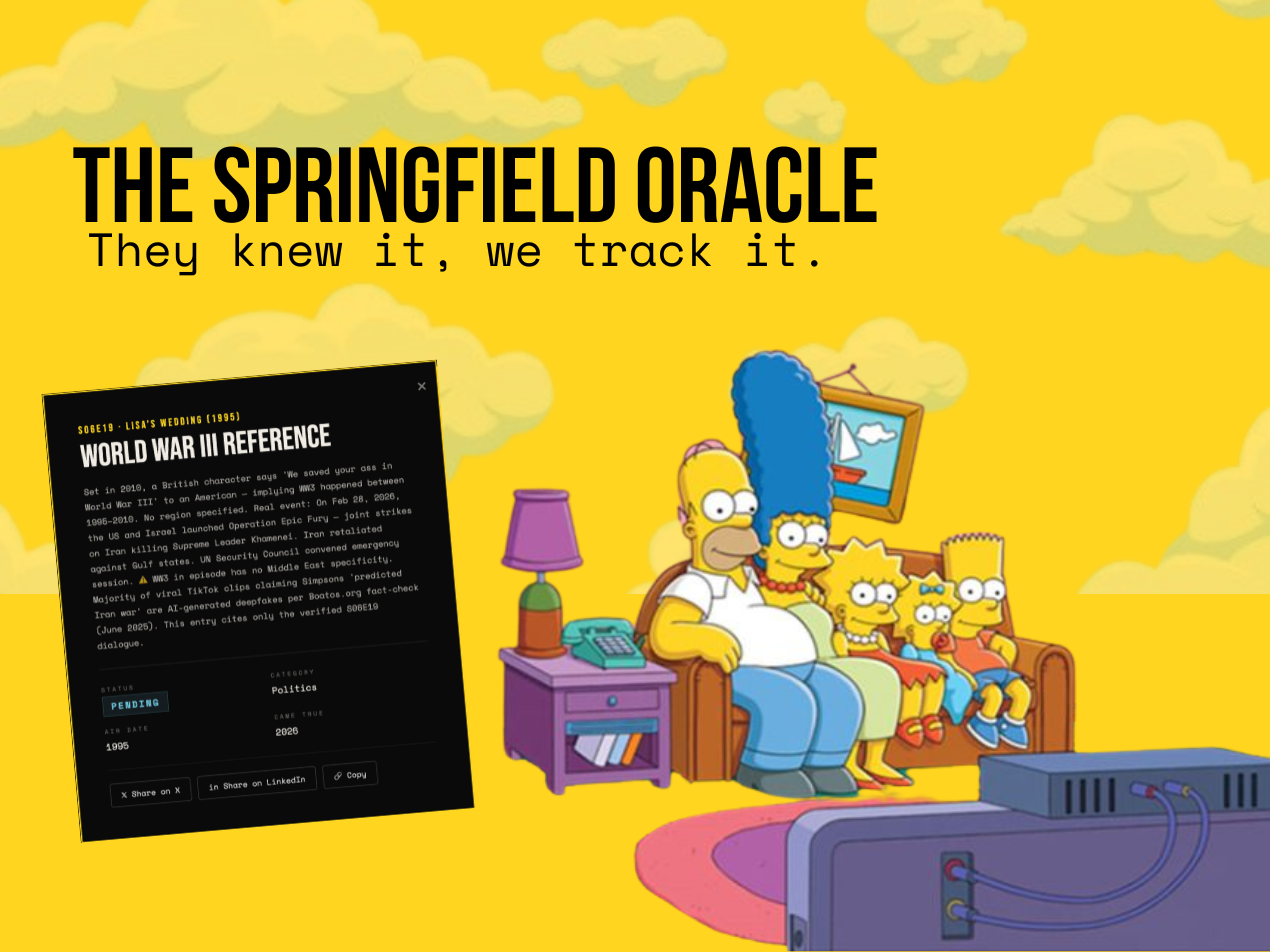
Springfield Oracle is doing something specific: it’s building a sourced, scored, fact-checked record of every Simpsons prediction claim that circulates online. Not just “did this happen,” but here’s the episode reference, here’s the real event citation, here’s whether the claim holds up.
The scoring piece is what makes this interesting to me. It’s not just a binary true/false database. The “scored” part suggests there’s some kind of credibility rating or confidence weighting applied to each claim. That’s a real product decision. It acknowledges that prediction claims exist on a spectrum, from genuinely spooky coincidences to completely fabricated AI clips, and a flat fact-check doesn’t capture that nuance.
The AI angle is also doing real work here. The explicit call-out that half the viral clips are AI-generated fakes isn’t just marketing copy, it’s the actual problem the product solves. Detection and verification at the clip level is genuinely hard. I’d want to know if Springfield Oracle is doing any automated detection or if the sourcing is all manual, because that changes the scalability story significantly.
It got solid traction when it launched, which makes sense. This is exactly the kind of product that appeals to the “well actually” demographic (I say this affectionately, I am this demographic).
The product website wasn’t available for me to dig into the actual UX, which is a gap in what I can tell you. But the core proposition is clear enough: structured truth layer on top of a chaotic meme.
This is a different kind of AI-adjacent product than, say, what SuperMoney is building with its decision-layer AI or the way WEIR AI is thinking about personal brand management. Those are generative. Springfield Oracle is corrective. It’s using the tools to audit the output of the tools, which is a genuinely different and underexplored category.
The Verdict
I think this is a real problem with a real audience. The Simpsons prediction meme is not going away. It’s been running for twenty years and AI just gave it a second life. The people who care about whether these claims are real are everywhere: journalists, trivia nerds, the specific kind of person who cannot let a wrong thing stand unchallenged on the internet. That’s not a small group.
The thirty-day question is whether the database is actually comprehensive. A fact-check database is only useful if the thing you’re looking for is in it. If I search for a specific viral clip and get nothing back, I’m gone.
The sixty-day question is whether the AI detection side is real or just a tagline.
The ninety-day question is the hard one: is this a product people return to, or is it a novelty they check once and forget? The retention case requires either regular content updates (new viral claims, new fact-checks) or a community layer that keeps people contributing.
I’d genuinely use this. I’d probably also argue with it on Reddit, which is the highest compliment I know how to give.