


























html-pub
Turn AI-generated HTML into a live URL via MCP/API
HTML Pub Wants Your AI to Ship the Website, Not Just Write the Code
The Macro: The Deploy Problem Nobody Fixed
The website builder market is crowded in a way that should embarrass everyone in it. Estimates vary, but multiple research firms put the global market somewhere between $2.8 billion and $3.9 billion today, with projections pointing well past $5 billion by the early 2030s. Shopify alone reported $8.88 billion in revenue for 2024. The money is clearly there.
And yet the core experience of getting a website live has barely changed.
Wix, Squarespace, Webflow. Drag, drop, click publish. They are good at what they do. Webflow has been pushing hard on AI-assisted building, trying to solve the blank canvas problem with prompts. The incumbents are not sleeping. But all of them were designed around a human sitting in an editor, making decisions, clicking buttons.
The world has shifted under that assumption. People are now generating entire landing pages inside Claude or ChatGPT. The AI writes clean, deployable HTML. And then the person copies it, opens a new tab, finds a host, configures DNS, and does fifteen other things that have nothing to do with the original idea. The momentum dies. A lot of those pages never go live.
That friction is the gap HTML Pub is targeting. Not the AI generation side, which the big models handle fine. The publish side. The “make this real” step that no AI chat interface was built to complete on its own.
It is a specific, unsexy problem. Those are sometimes the most durable ones to solve.
The Micro: MCP as the Actual Product
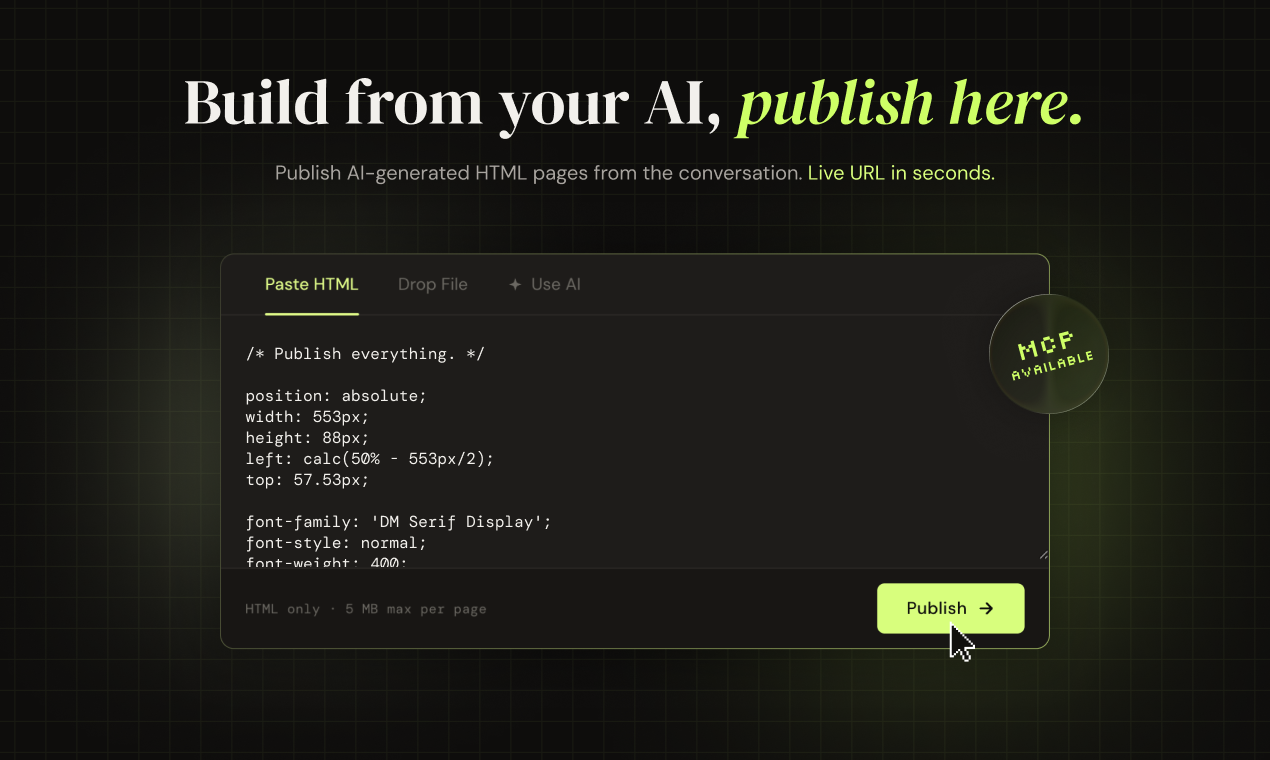
HTML Pub does one core thing. It takes HTML and makes it live, fast, with no setup required.
You can use it three ways: let the site’s own AI generate a page from a prompt, paste raw HTML directly, or drop a file. The third option is the interesting one. Through an MCP server connection, you can wire HTML Pub directly into Claude or any other LLM that supports the Model Context Protocol. Once connected, your AI does not just write the page. It publishes it, without you leaving the chat.
That is a genuinely different workflow.
What you get on the published URL is not a placeholder. The product lists forms, checkout, integrations, custom domains, blog functionality, and analytics with heatmaps as included features. The showcase on their homepage has working examples: a unit converter tool, a waitlist page, a game, a prototype of a Leadpages onboarding flow. These are not marketing screenshots. They are live pages you can click through.
The no-account, free-to-try entry point is smart. There is no signup wall before you see whether it works. That lowers the cost of trying it to approximately zero, which matters when you are asking people to change a workflow habit.
It got solid traction when it launched, landing in the top three on Product Hunt for the day.
Omar Farook, who is listed as a founder and whose LinkedIn connects him to both Glorify (reportedly acquired) and this product, has been vocal about the MCP angle being central to the vision. The positioning is deliberately AI-native rather than AI-assisted. That distinction matters for how you think about who this is actually for.
The Claude Code context makes this feel timely. As Anthropic keeps expanding what its tools can do autonomously, the surface area for products that sit at the “execution” end of an AI workflow keeps growing.
The Verdict
I think this is a real idea. The MCP integration is not a gimmick. If you are someone who already uses Claude to build things, the friction HTML Pub removes is friction you have definitely felt. The workflow goes from “generate, copy, paste, configure, deploy” to “generate, done.” That is a meaningful compression.
The risk is distribution. Squarespace and Webflow have brand recognition and years of SEO. HTML Pub needs to find the people who are already inside an AI chat trying to build something, and convert them before they figure out a workaround or before the AI platforms build this themselves. Anthropic and OpenAI could ship native publish buttons. They probably will, eventually.
What I would want to know at 30 days: are people coming back after the first publish, or is this a one-and-done tool? Retention is everything here. A site builder that people use once is a toy. One they manage ongoing pages through is a business.
At 60 days, I would want to see whether the checkout and forms features are getting real use, or whether people are just publishing static pages and stopping there.
The product is sharp. The window is real but not permanent.