













claude-import-memory
Switch from ChatGPT to Claude with import memory feature
Anthropic Wants to Make Switching to Claude Feel Like Nothing
The Macro: Everyone’s Fighting Over the Same Tired Users
The AI assistant wars are fully a retention game now. Not an acquisition game. Not a capability game (okay, a little still a capability game, but stay with me). The part that actually moves the needle in 2026 is whether users stick around after the first week, or quietly slide back to whichever chatbot already has their muscle memory.
According to the Stanford HAI 2025 AI Index Report, 78% of organizations reported using AI in 2024, up from 55% the year before. That number sounds impressive until you realize it says nothing about which AI, for how long, or whether anyone is actually satisfied. The market research numbers are all over the place depending on who you ask, ranging from $122 billion in AI software revenue to headline figures north of $600 billion, but the consistent signal across sources is that growth is fast and the window to lock in loyal users is short.
ChatGPT has the brand. It’s the name your non-technical relatives use. Claude has been winning on quality with a specific kind of user, the one who reads the model cards and has opinions about system prompts. But quality alone doesn’t close the deal when switching feels expensive.
Switching cost in AI right now is almost entirely psychological and logistical. Not financial. Most of these tools cost $20/month. The real friction is context loss. If you’ve spent three months training ChatGPT to know how you work, what your projects are, what tone you hate, what your job actually involves, that accumulated context is genuinely hard to give up. It’s the same reason people stayed on Google Docs even when Notion was clearly more powerful for certain workflows. The cost wasn’t the subscription. It was the migration.
This is the space Claude Import Memory is trying to occupy. And it’s a smarter move than it initially looks.
The Micro: Copy, Paste, Don’t Start Over
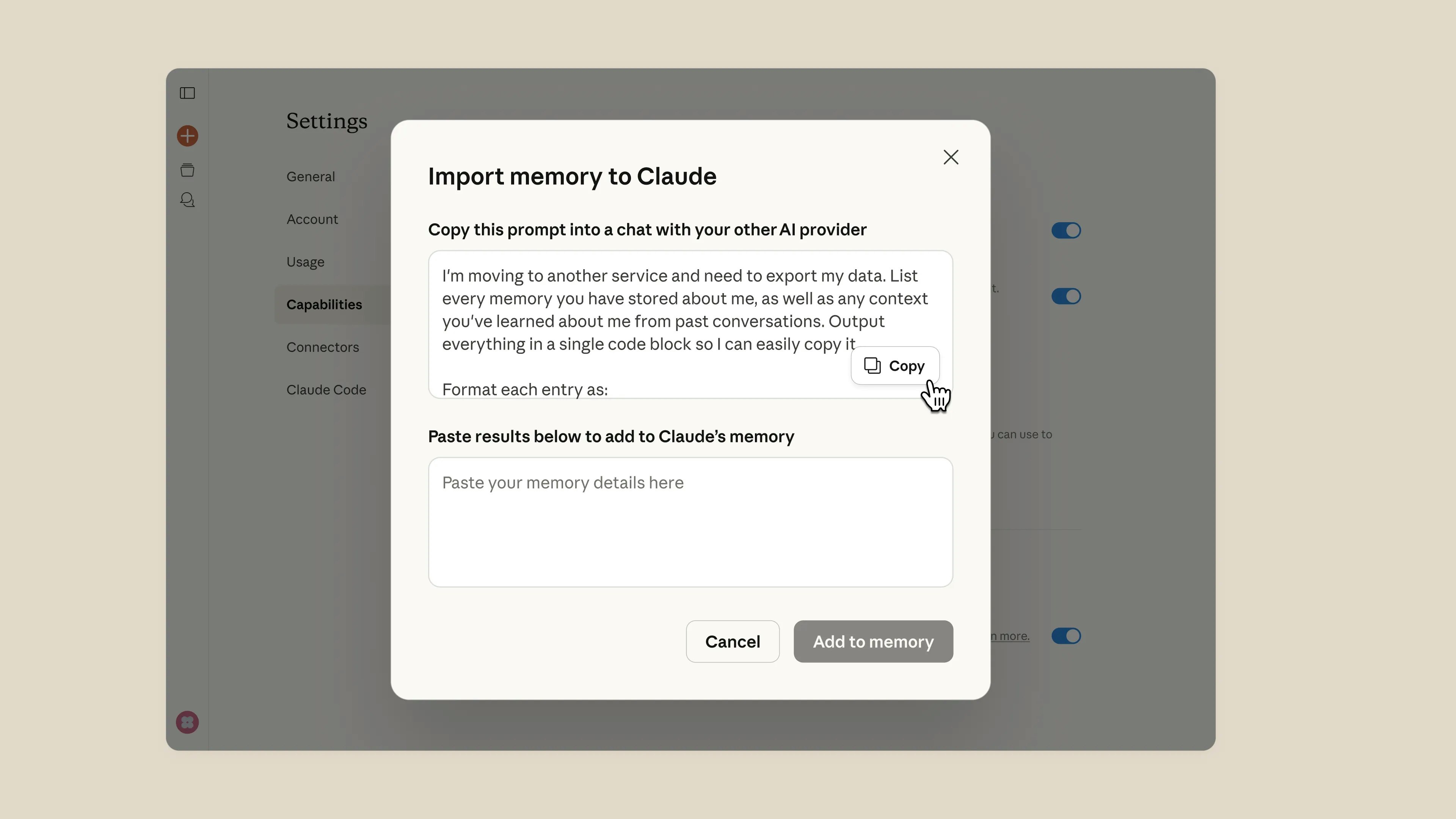
The feature itself is almost aggressively simple. You copy your memory or preferences from ChatGPT (or wherever), paste it into Claude’s import interface, and Claude reads it and updates its memory accordingly. That’s the whole thing. No API keys, no OAuth dance, no CSV export and import wizard. One copy-paste.
According to Anthropic’s own LinkedIn post, the feature also supports export, so you can pull your memories out of Claude whenever you want. That’s a quiet but important detail. It signals that Anthropic is at least nominally committed to the idea that your context belongs to you, not to the platform.
The feature is available on all paid plans. So Claude Pro, presumably Claude for Teams, that tier. Not the free tier, which makes sense because Claude’s memory features generally sit behind the paywall.
What I find genuinely interesting here is the product philosophy embedded in the decision. Anthropic could have built something elaborate. A guided migration wizard. An official ChatGPT integration. A structured importer with field mapping. Instead they went with: paste text, Claude figures it out. Which is either elegant or lazy, depending on how well it actually works. Given that Claude is pretty good at interpreting freeform text with semantic context, my guess is it handles messy pasted memory dumps better than a structured form would anyway.
Dan Cumberland posted a video on LinkedIn showing the flow in action, migrating from ChatGPT custom instructions into Claude Projects. It looked functional. Not magical, but functional in a way that removes the main excuse people give for not switching.
It got solid traction on launch day, which tracks for a feature that hits a real friction point.
The framing around this (positioning it as a switching tool explicitly aimed at ChatGPT users) is also worth paying attention to. Anthropic isn’t being coy about who they’re targeting. I’ve seen similar strategic aggression in how AI coding tools are starting to compete, and it tends to signal a company that’s past the “we’re all just building cool stuff together” phase.
The Verdict
I think this is a genuinely useful feature that most reviewers are going to underrate because it’s not technically impressive. There’s no model innovation here. No new capability. It’s a UX decision dressed up as a product launch, and that’s actually fine because UX decisions are what move users at scale.
The question I’d want answered at 30 days is retention. Do people who import their memory actually stick with Claude afterward, or does the novelty wear off and they drift back to their defaults? The import solves the migration activation problem. It doesn’t solve the ongoing satisfaction problem.
At 90 days, I’d want to know if Claude’s memory system is actually good enough to justify the switch. Importing your context is only useful if the platform then does something valuable with it. If Claude forgets things, misapplies them, or handles memory worse than ChatGPT does natively, then the import feature is just a more comfortable on-ramp to disappointment.
But directionally, this is the right move. AI tools are increasingly winning on workflow fit, not raw capability. Lowering the switching cost for even 5% of ChatGPT’s user base would be a meaningful outcome for Anthropic. I’m curious if they follow this with anything more structural, like direct integrations, or if they’re betting on the paste-and-go approach being good enough.
Honestly, it might be.
Also featured on HUGE: Astro Energy Uses AI to Find Land for Renewable Energy Projects Before Anyone Else Knows It’s Valuable · Bindwell Is Using AI to Design Pesticides and Paul Graham Thinks They’ll Do Alright · Enhanced Radar Is Building AI for Air Traffic Control and I Think They Might Actually Pull It Off