














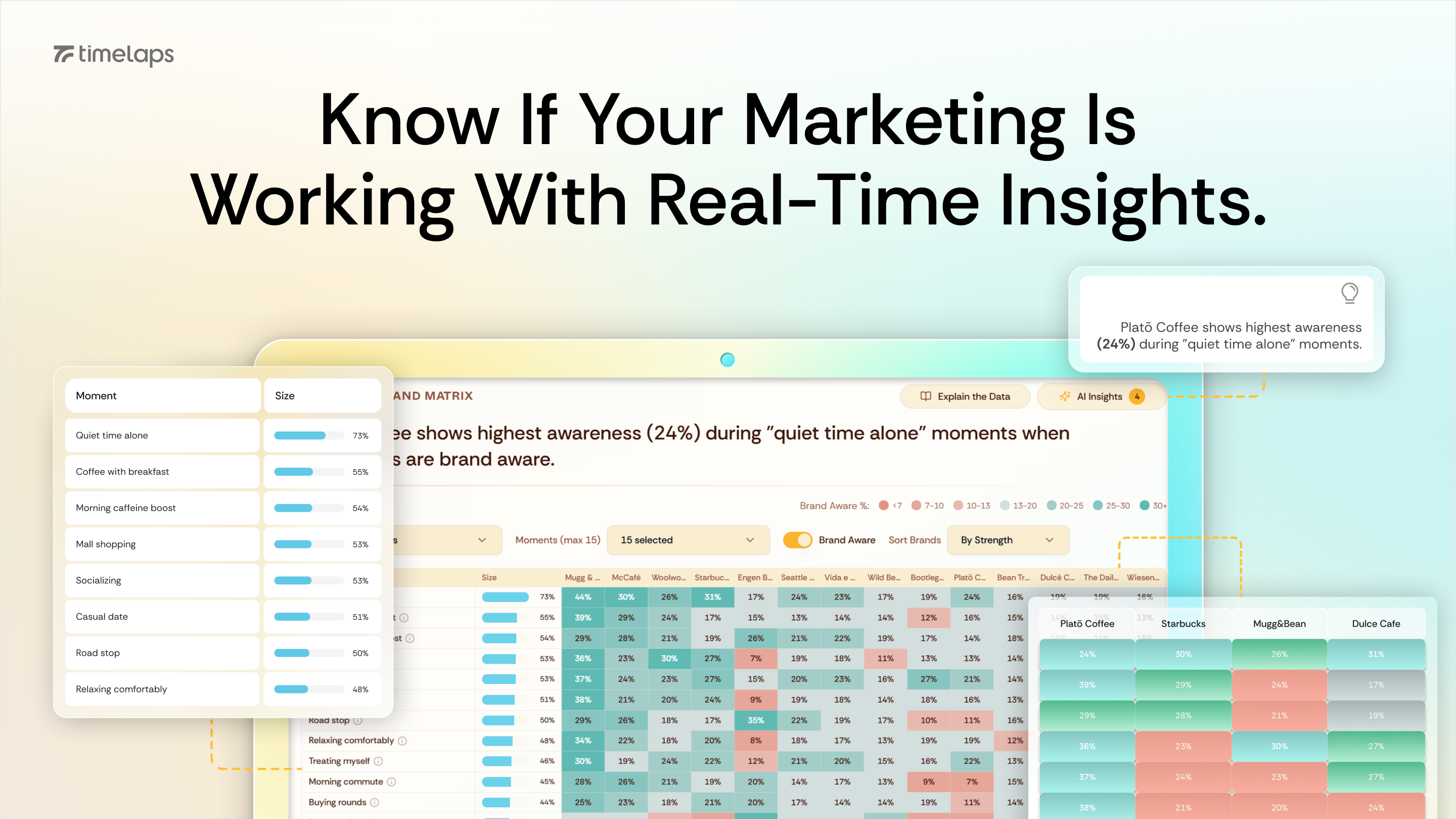
{ “headline”: “Brand Tracking Has Been a Rich Person’s Game. Timelaps Wants to Change the Math.”, “excerpt”: “Most marketing teams are flying blind on whether their brand actually means anything to anyone, and the tools that could tell them cost more than their entire headcount.”, “body”: ”## The Macro: Brand Measurement Is Broken and Everyone Knows It\n\nHere’s the thing about brand marketing that nobody in a boardroom wants to say out loud: most companies have no idea if it’s working. They spend the budget, run the campaign, watch some impressions tick up, and then… guess. The feedback loop is either a $200K agency retainer with quarterly PDF decks, or vibes.\n\nTraditional brand trackers exist, obviously. Nielsen, Kantar, Ipsos. These are the big names that Fortune 500 companies have been writing enormous checks to for decades. The problem is that those tools were built for enterprises with dedicated insights teams, six-figure research budgets, and the patience to wait three months for a report that tells you what happened last spring.\n\nSmaller brands and mid-market companies are priced out of that entirely.\n\nAnd the irony is real. High-growth firms are devoting roughly 12% of revenue to marketing, according to data from Marketing Charts, compared to 5% for no-growth firms. The companies that most need to know if their brand spend is landing are often the ones with the least infrastructure to measure it. They’re running campaigns, hiring influencers, doing all the stuff you’re supposed to do, and operating on instinct.\n\nThis is the gap Timelaps is trying to occupy. Not the performance marketing space (that’s crowded and honestly fine, Google and Meta will tell you if your ad converted). The brand marketing space, which is fuzzier, longer-cycle, and historically much harder to quantify. Whether people recognize you, consider you, associate the right things with you. That’s the harder measurement problem, and it’s the one that’s been stuck behind expensive gates.\n\nThe branding agency market is reportedly valued at around $115.5 billion in 2025, according to one LinkedIn analysis. Even if Timelaps is going after a slice of the research and tracking portion of that, the addressable opportunity is not small.\n\n## The Micro: 4,000 Consumers, Continuous, and Actually Readable\n\nTimelaps describes itself as a continuous, research-grade brand tracker. The core mechanism: they collect responses from 4,000-plus real consumers in your target demographic, on an ongoing basis, and surface it in a dashboard that doesn’t require a research degree to interpret.\n\nThat “continuous” part is doing a lot of work here. The traditional model gives you a snapshot. You commission a study, wait, get a report. Timelaps is claiming a live feed. Your brand awareness number updates. Your competitive comparison updates. You can theoretically watch what happens to perception after you run a campaign, not six months after.\n\nThe dashboard tracks awareness, consideration, purchase intent, and loyalty. It also maps out what associations consumers connect with your brand versus competitors, and apparently surfaces the buying situations where you’re winning or losing. That “buying situations” framing is interesting to me because it’s more granular than the usual brand funnel metrics. It’s asking not just “do people know you” but “do people think of you when they’re actually about to spend money.”\n\nThe pricing angle is their loudest claim: 5x more affordable than traditional trackers. They don’t publish specific numbers on the website, so I can’t validate the math, but the direction is clearly aimed at brand teams who’ve been told the good tools are out of reach.\n\nCo-founders Henk Pretorius and Harry Zhang have relevant credentials here. Pretorius previously co-founded Columinate, which was acquired, and his LinkedIn indicates two decades designing brand trackers for large companies. That background matters. A dashboard selling research credibility without actual research experience behind it would be a red flag. This looks like people who know the old system and built a version they actually wanted to use.\n\nIt launched and got solid traction on Product Hunt, hitting the top spot on launch day with 129 comments, which for a B2B research tool is not nothing.\n\nIf you’re curious what a consumer-signal-driven approach looks like in adjacent contexts, the SEO Spider That Lives on Your Machine piece we ran is worth a look. Different category, same general instinct: bring enterprise-grade data tools down to earth.\n\n## The Verdict\n\nI’m genuinely interested in this one, with some real questions still open.\n\nThe product thesis is correct. Brand tracking is too slow, too expensive, and too inaccessible for the majority of companies that actually need it. The founders have the background to credibly claim they’ve fixed the methodology. The dashboard-first, continuous-update approach is the right direction.\n\nWhat I’d want to know at 30 days: who is actually paying for this, and at what price point. The “5x more affordable” claim is compelling but abstract. If the baseline they’re comparing against is a $300K Kantar study, then “5x cheaper” still means $60K, which is not accessible for a Series A startup. The target customer definition matters a lot here.\n\nAt 60 days: are the insights actually actionable, or do they surface interesting data and leave teams to figure out what to do with it. The website copy gestures at recommendations but I’d want to see that in practice.\n\nThe thing that would make this stick long-term is if the 4,000-consumer panel is genuinely high quality and demographically precise. Research-grade is a claim you can make on a landing page and lose on delivery. That’s where the real moat is, or isn’t.\n\nFor marketers who’ve been told brand tracking is just not in the budget, this is worth a demo. I’d take them up on the free brand consult and ask hard questions about the panel methodology. That answer will tell you most of what you need to know.” }
Also featured on HUGE: One Guy, One Prompt, and a $50K ARR Argument Against the Entire Stock Footage Industry · Nobody Likes Filling Out Forms. This Open-Source Project Wants You to Talk Instead. · Anthropic Just Put a Slide Jockey Inside PowerPoint. That’s Actually the Interesting Part.