














picsart-persona-storyline
Design your AI influencer and create any story with it.
Picsart Wants to Be the Casting Director, Set Designer, and Writer's Room for Your Faceless Channel
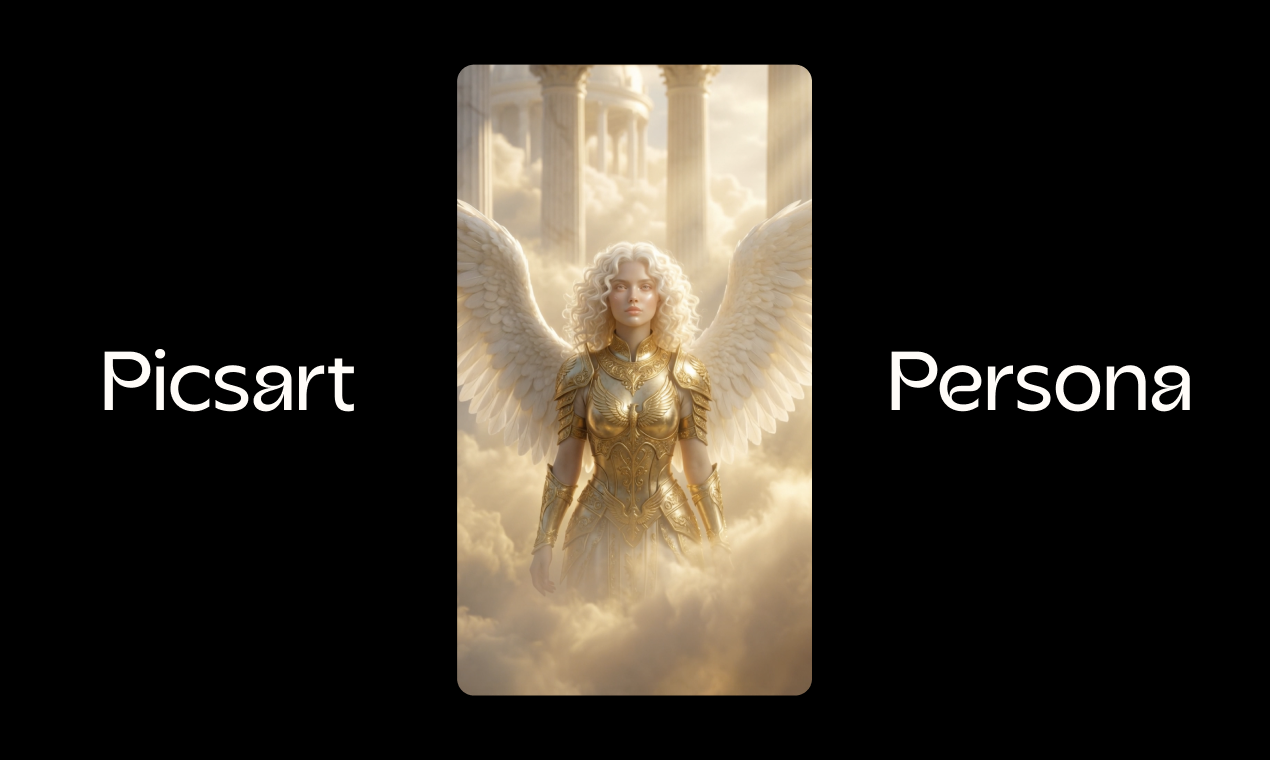
The Macro: Everyone Wants to Make Content, Nobody Wants to Be on Camera
The number of people who want an audience but refuse to show their face is genuinely massive. Faceless YouTube channels, anonymous TikTok accounts, virtual influencers with millions of followers. This is not a niche. It’s a whole mode of being online that the tooling has only recently started to catch up with.
The AI-powered design tools market is growing fast. Multiple research reports put it somewhere between $5.5 billion and $8.4 billion in 2025, with CAGRs hovering in the high teens to low twenties depending on who you ask. The numbers vary enough that I’d treat the specific figures as directional rather than precise, but the direction is not in question. Money is flowing into this category.
The more interesting pressure is coming from the creator side. Tools like Midjourney, Runway, and HeyGen have each carved out specific parts of the content pipeline. Generate an image here. Animate it there. Clone a voice somewhere else. What nobody has really nailed is consistency across a whole narrative. You can make a beautiful AI character in one tool, then completely lose them the moment you try to generate the next scene. Same vibe, different face. That’s the actual problem.
Canva is adjacent to this with its AI features, and Anima is working on consistency problems in a different part of the design stack, but the faceless-content-creator workflow specifically has been weirdly underserved given how many people are doing it. Picsart, which according to TechCrunch was founded in 2011 by Hovhannes Avoyan, Artavazd Mehrabyan, and Mikayel Vardanyan, has been quietly building toward this moment for a while. They claim 150 million creators on the platform. That’s a distribution advantage that pure-play AI startups don’t have.
The Micro: One Character, Infinite Scenes, Zero Excuses
Here’s how Persona and Storyline actually work, as far as I can tell from the product pages.
Persona is the character builder. You design an AI character, and the options are broader than the typical “realistic human avatar” pitch. Human, pet, mascot, or fictional. That last category matters more than it sounds. A lot of brand content runs on mascots, not human faces, and building a consistent non-human character across dozens of pieces of content has historically required either a skilled illustrator or a miserable afternoon fighting image generation prompts.
Once you have your character, Storyline is where you actually use them. Short-form clips, episodic series, or full narrative arcs. The core promise is that the same character shows up in every single scene without you having to re-describe them from scratch or do manual inpainting to fix the face drift problem. That character consistency is genuinely the hard part. Anyone who has tried to build a multi-scene story in standard image generators knows how fast it falls apart.
The tools sit inside Picsart’s broader platform, which also integrates things like VEO3 for animation and GPT Image. So the workflow is meant to be contained. Design your character, drop them into scenes, animate if you want, export. No camera required, as they say. Built explicitly for faceless YouTube and TikTok.
It did well when it launched, picking up solid traction on launch day.
The product decisions I find genuinely interesting: the mascot option (smart for B2B and brand use cases), the episodic series framing (most tools think in single assets, not serialized content), and the fact that this is shipping as a feature inside a platform with an existing user base rather than as a standalone app begging for signups.
What I can’t tell yet is how good the character consistency actually is in practice. The promise is easy to make.
The Verdict
I think this is a real product solving a real problem. The faceless creator workflow is not a gimmick. It’s how a non-trivial percentage of successful YouTube channels actually operate, and the tooling has been janky enough that most people are duct-taping three or four separate apps together to get there.
Picsart’s advantage is the existing user base and the platform integration. If you’re already using Picsart for design work, adopting Persona and Storyline is low friction. That matters more than people give it credit for.
What I’d want to know at 30 days: does the character actually stay consistent across twenty scenes, or does it drift after five? At 60 days: are creators actually finishing episodic series, or is everyone making one clip and stopping? At 90 days: is there any signal from brand and marketing teams using the mascot feature, because that could be a much bigger business than the individual creator angle.
The comparison I keep coming back to is how AI tools are sneaking into professional workflows sideways. Not as the main event, but as the feature inside the tool you already use. That’s exactly what Picsart is doing here. If the output quality is genuinely there, this has a real shot. That’s the only thing left to prove.
Also featured on HUGE: One Guy, One Prompt, and a $50K ARR Argument Against the Entire Stock Footage Industry · Nobody Likes Filling Out Forms. This Open-Source Project Wants You to Talk Instead. · Anthropic Just Put a Slide Jockey Inside PowerPoint. That’s Actually the Interesting Part.