














gojiberryai
AI agents turning high-intent leads into booked demos
Gojiberry Thinks the Cold Email Is Dead. It Built an AI Agent for What Comes Next.
The Macro: Why B2B Outreach Is Breaking Under Its Own Weight
Somewhere around 2022, cold outreach broke. Not all at once. Gradually, then completely. Inboxes got filters, LinkedIn got noise, and the average SDR started sending hundreds of templated messages a week just to get two replies. The math never really worked, but the tooling made it easy enough to ignore that.
Now the math is impossible to ignore. Response rates on cold email are in the low single digits across most B2B categories. LinkedIn connection requests with generic pitches get ignored or reported. Buyers have developed a kind of immune response to the format itself, where the moment a message feels automated, it gets deleted without a second read.
The industry has responded by building more automation, which is a strange choice.
Actually, not entirely strange. The smarter bet is to stop automating volume and start automating relevance. That’s the thesis behind intent-based outreach, a category that’s been building quietly for a few years. The idea is that instead of blasting a cold list, you identify signals that suggest someone is actively looking for what you sell. A company posting a job for a new VP of Sales. A founder engaging with competitor content. A business that just raised a round. These are warmer signals than demographic targeting alone, and tools like Apollo.io and ZoomInfo have been selling intent data as an add-on feature for years now.
Where it gets interesting is what you do with that signal. Identifying intent is step one. Automating a relevant, personalized response to it, at scale, without sounding like a robot, is the harder problem. That’s the gap a newer generation of tools is trying to close. Helply’s approach to reducing support load through AI automation is a useful parallel here: the same underlying logic applies, train the model on your specific context, then let it act.
Gojiberry is operating squarely in this space, competing with Trigify, Crono, and the intent-data features baked into larger platforms like Apollo and ZoomInfo.
The Micro: An AI Agent That Reads the Room Before It Sends the Message
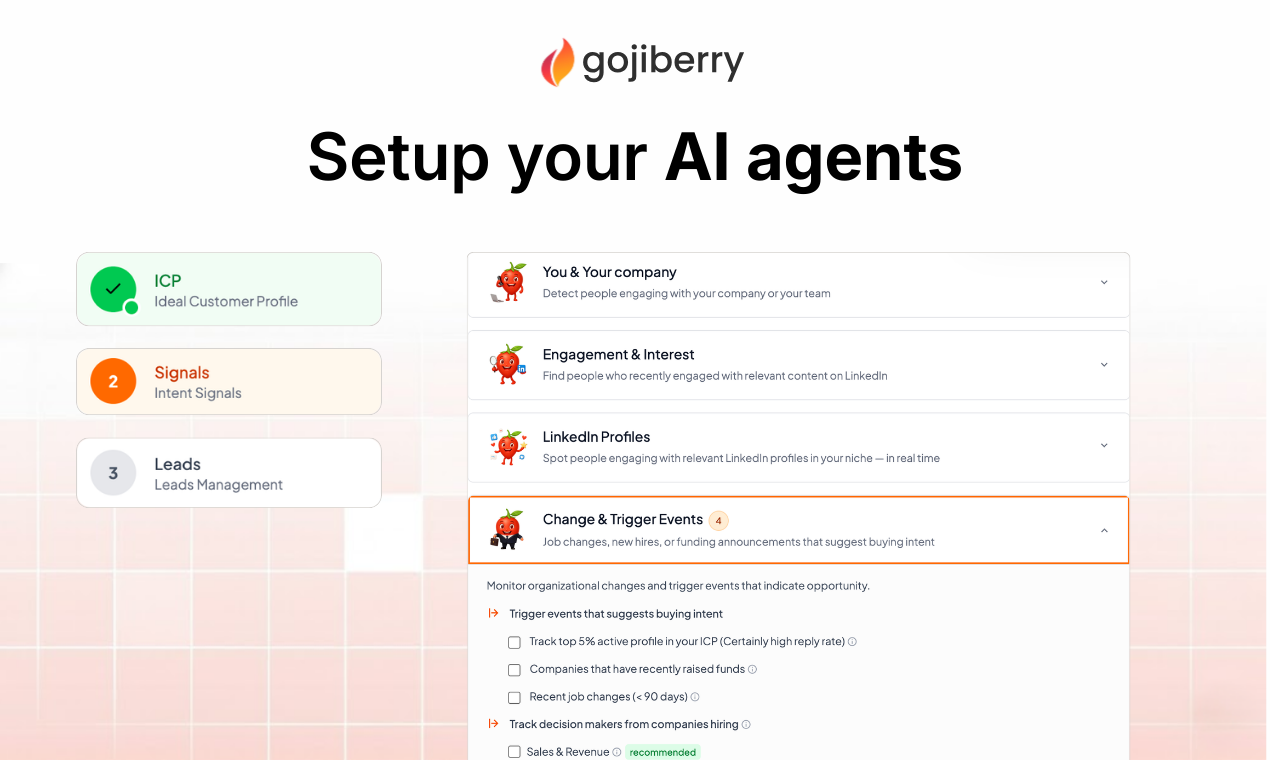
Gojiberry’s core loop is straightforward to describe, even if the execution is the hard part. You tell it what your ideal customer looks like. It watches for intent signals across LinkedIn, including job changes, competitor engagement, fundraising activity, and relevant posting behavior. When it spots a match, it scores the prospect, drafts a personalized outreach message, and sends it through LinkedIn on your behalf. The goal is a booked demo, not just an open.
The personalization angle is where they’re making a real bet. Generic AI outreach at scale is already a problem, and Gojiberry knows it. Their framing is that the agent reads the specific signal it detected before composing the message, so the outreach references something real. Whether that holds up in practice at volume is worth scrutinizing.
According to their website, the platform is trusted by 500-plus small sales teams and B2B founders. That’s a self-reported number, but it’s a meaningful claim if accurate. The target user is clearly the founder-led sales motion: early-stage B2B company, no dedicated SDR team, trying to fill a pipeline without hiring.
The free tier to start is a smart acquisition move. Low friction entry matters when you’re asking someone to connect an AI agent to their LinkedIn account, which is a real ask. LinkedIn’s terms of service have historically been aggressive about automated activity, and any buyer should think carefully about that risk before deploying.
It launched and got solid traction on day one, which tracks with the problem being genuinely felt.
The product positioning against Trigify specifically, as seen in their own blog content, is interesting. They frame themselves as more than a scraper. The claim is autonomous agent behavior, not just data delivery. That’s a meaningful distinction if the execution is there. Tools like SuperX, which built a data layer for X creators, show how niche signal-reading products can find real traction when the targeting is precise.
The interface, from what’s publicly visible, is clean and focused. No sprawling feature set. That’s a deliberate choice and probably the right one for the audience.
The Verdict
Gojiberry is solving a real problem with a credible approach. Intent-based outreach is not a new idea, but the autonomous agent layer on top of it is the interesting part, and the focused positioning toward small B2B teams gives them a wedge that Apollo and ZoomInfo, with their enterprise pricing and feature bloat, can’t easily close.
The risks are clear. LinkedIn’s tolerance for AI-automated outreach is unpredictable. If the personalization layer doesn’t actually hold up at scale, they’re just another blast tool with better framing. And the 500-plus customer claim needs to convert into retention numbers before the story gets interesting.
What I’d want to know at 30 days is whether response rates on Gojiberry-sent messages are meaningfully better than industry baseline, not just whether demos get booked. At 60 days, whether LinkedIn accounts using the tool are seeing any friction with the platform. At 90 days, whether founders are still using it or whether the novelty wore off when results plateaued.
The pitch is clean. The market is real. The execution is the question, as it always is with AI tools promising to replace a human workflow. I’d try the free tier before committing to anything.
Also featured on HUGE: OpenIntake Turns Missed Law Firm Calls Into Signed Clients · Ergo Wants to Be the AI That Actually Updates Your CRM · Verbiflow Built a Sales Pipeline That Runs Itself, and I Almost Believe Them