














lessie-ai-2
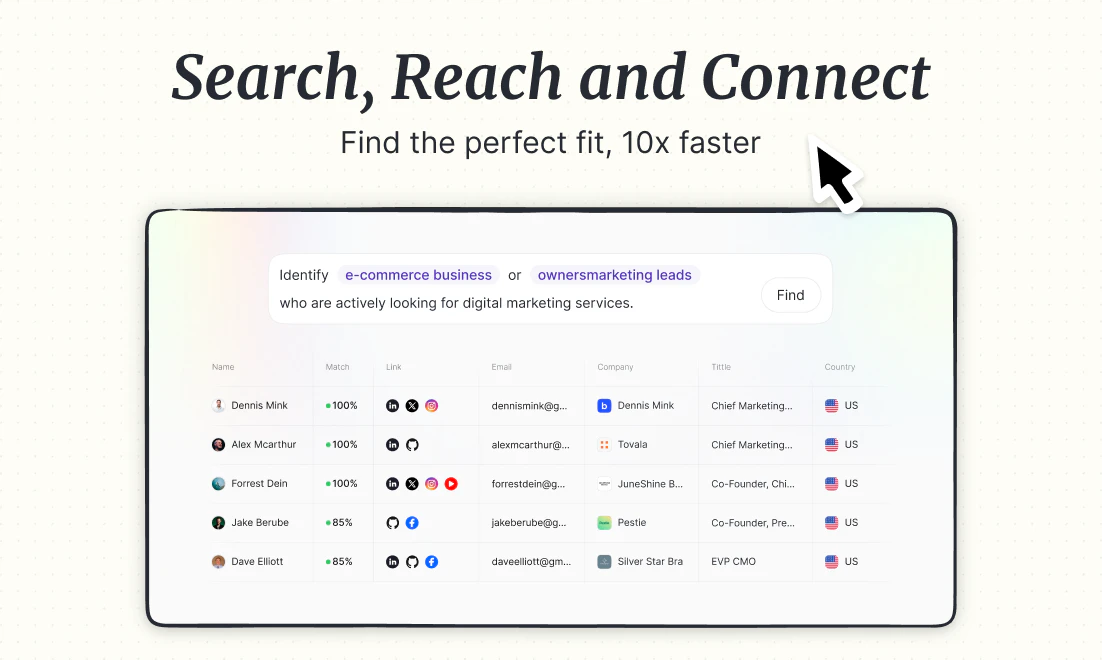
Search, Reach and Connect - Find the perfect fit, 10x faster
Lessie AI Wants to Kill the Boolean Search. The Real Question Is Whether Sales Teams Will Let It.
The Macro: The Dirty Secret of B2B Prospecting
Everyone in sales knows the joke. You spend three hours building a prospect list, another two verifying emails, and by the time you actually send a message, half the contacts have changed jobs. The tools that were supposed to fix this, LinkedIn Sales Navigator, Apollo, ZoomInfo, mostly just made the same manual process slightly faster and considerably more expensive.
The problem isn’t access to data. It’s the gap between what a salesperson or recruiter actually knows about who they want and what a database can return when you’re forced to express that knowledge through dropdown filters and keyword strings.
Describe someone in natural language and most tools break. “A founder who’s raised a seed round, cares about sustainability, and is active on LinkedIn” is not a query. It’s a thought. And until very recently, there was no good way to hand that thought to software and get useful results back.
The market for lead generation and outreach tooling is enormous and genuinely crowded. Clay has built a serious following among growth engineers who want enrichment workflows with real flexibility. Apollo dominates the budget-conscious end. There are influencer-specific platforms, recruiter-specific platforms, investor databases. The category is fragmented because the use cases actually are different from each other, even if the underlying need, find a person, contact that person, is identical.
AI agents are now being thrown at this problem from every direction. Some, like Cardinal, are building opinionated outbound systems that treat spray-and-pray as a solved-and-discarded problem. Others, like Fern, are inserting AI into the conversation layer rather than the prospecting layer. Lessie is trying to own the discovery and outreach pipeline end to end, starting before you even know who you’re looking for.
That’s a big swing.
The Micro: Describe Your Target, Get a Shortlist With Emails Already Written
Here’s how Lessie actually works, as best I can tell from the product and site. You describe the type of person you want in plain language. Lessie runs that description through what it calls an AI agent, searches across the web, and returns a ranked list of matches. It then automates personalized outreach and follow-ups based on those profiles.
No boolean logic. No filter menus. You just explain who you’re looking for and it finds them.
The use cases listed on the site are genuinely broad: finding influencers for a campaign, sourcing clients, identifying investors, recruiting talent, locating partners, discovering coaches, finding distributors, pulling property leads. That’s eight distinct verticals on the homepage, which is either a sign that the underlying engine is flexible enough to handle all of them, or that the team hasn’t decided who they’re actually building for yet. Probably both.
The free tools are interesting. Lessie has built out a real suite alongside the core agent: fake follower checkers for Instagram, TikTok, and YouTube, engagement calculators, email verification, an email permutator, a cold email generator, a subject line tester. These aren’t gimmicks. A fake follower checker with a real database is genuinely useful for anyone doing influencer sourcing, and it’s a smart acquisition funnel for the core product.
It got solid traction when it launched, landing in the top two on Product Hunt with over a hundred comments, which suggests real curiosity from the market rather than just a coordinated push.
Co-founder Yanjun Lin describes himself as a serial entrepreneur on LinkedIn. The company is based in Singapore, per their LinkedIn presence.
The thing I keep coming back to is the outreach automation. Finding people is one hard problem. Writing personalized messages at scale without sounding like a robot is a different hard problem. Lessie is claiming to solve both in one product. Lightfield is working on adjacent AI reasoning problems and has run into the same tension: capability claims are easy, consistent quality at scale is where products either earn trust or lose it fast.
The Verdict
Lessie is building something that addresses a real and persistent frustration. The Boolean search problem is not imaginary. Anyone who has used Sales Navigator for more than a week has felt it.
What I can’t evaluate from here is how good the matches actually are. Natural language search sounds great until the agent returns twelve people who are technically related to your query but not actually what you meant. The quality of the underlying retrieval model is everything, and that’s not something you can assess from a homepage.
The breadth of verticals is my main concern at thirty days. Eight use cases is a positioning problem in disguise. Clay picked growth engineers and won them. If Lessie tries to be the people-finding tool for everyone simultaneously, it risks resonating with no one deeply enough to build the word-of-mouth that tools like this need.
At sixty days I’d want to know retention numbers among users who completed their first search and outreach sequence. At ninety days I’d want to know which of those eight verticals is converting to paid at the highest rate, because that’s the real product.
If the match quality holds up in real use, this is worth watching. If it doesn’t, it’s a very well-designed front door to a mediocre database.