





















prompturls
Turn any prompt into a shareable URL for ChatGPT, Claude
PromptURLs Wants to Be the Shortest Distance Between a Thought and an AI
The Macro: Everyone Is Using AI, Nobody Has a Good Way to Share It
Here is the friction point nobody talks about enough. You write a genuinely useful prompt. Something that took you twenty minutes to refine. And then you paste it into a Slack message, or a Notion doc, or a tweet, and whoever gets it still has to manually open ChatGPT, paste the text, and run it themselves. The prompt is the work. The handoff is the mess.
The AI productivity tools market was valued at roughly $8.8 billion in 2024, according to Grand View Research, and is projected to reach nearly $36.4 billion by 2033. That is a 15.9% annual growth rate. Grand View’s numbers align directionally with what Precedence Research is tracking in the broader productivity software space, which they expect to nearly quadruple between 2024 and 2034. The category is clearly growing. What is less clear is which specific workflow problems the market is actually solving versus which ones it is just declaring solved.
Prompt sharing sits in a peculiar gap. Browser extensions like the research assistant tools we have covered before tend to solve for a single platform. Power users who live across ChatGPT, Claude, Gemini, and Perplexity are constantly context-switching. There is no clean standard for what a “shareable prompt” even looks like.
This is the space PromptURLs is building into. It is not a large-market swing. It is a workflow fix that a specific kind of person will find immediately obvious and useful. The question is whether that person shows up in large enough numbers to matter.
The Micro: One Prompt, Five Links, Zero Sign-Up Required
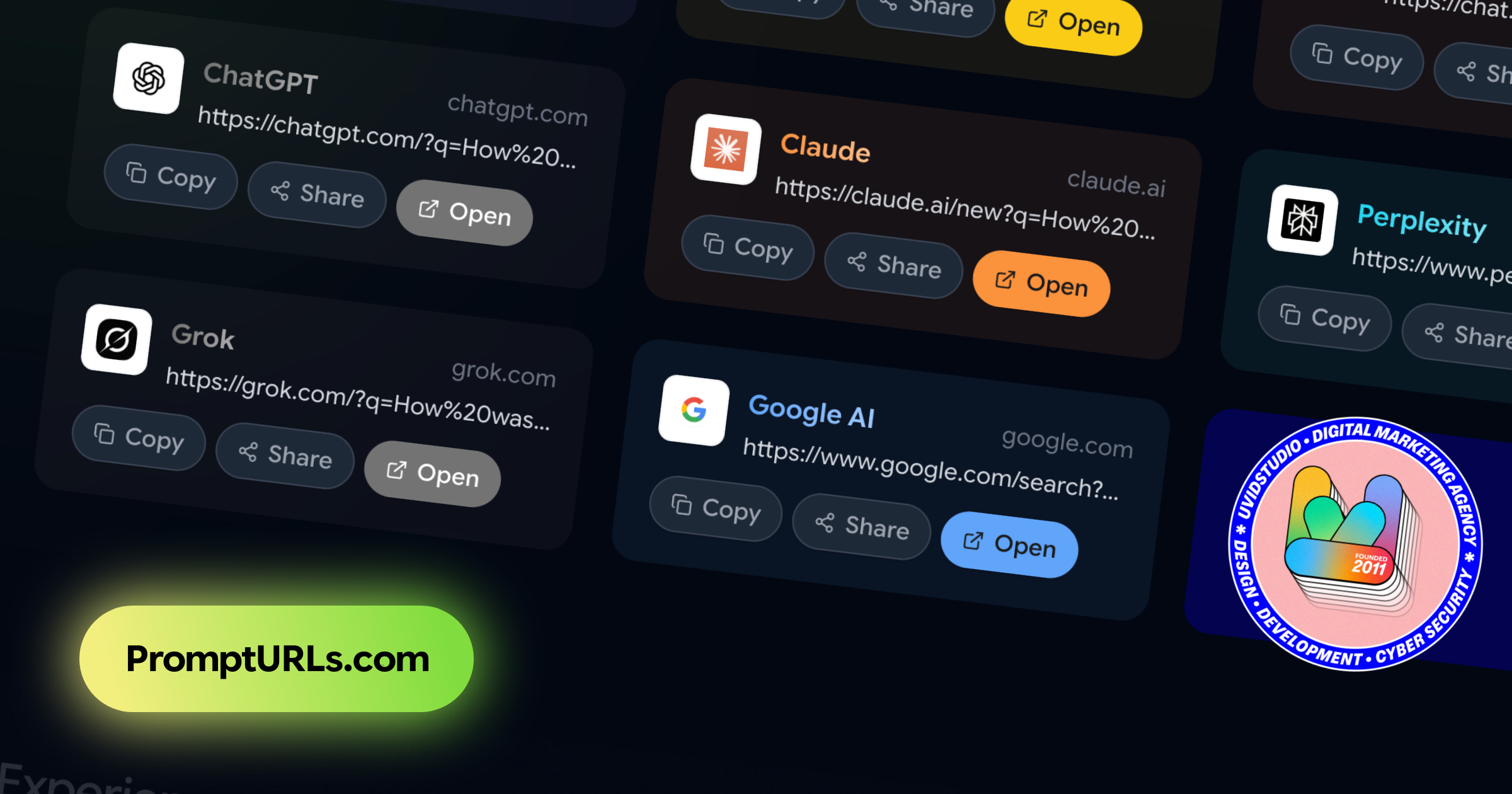
The premise is exactly what it says. You type a prompt. PromptURLs generates shareable URLs, each pre-filled and ready to run, for ChatGPT, Claude, Gemini, Perplexity, and Grok. According to a listing on ProductCool, the tool supports eight or more AI platforms concurrently, though the main branding leads with the five most prominent names. No installation. No account. No data stored.
That last part is doing real work here. “Free, private, no sign-up” is a product decision, not just a marketing line. It removes every barrier between the idea and the output. You land on the page, type, and get links. The entire interaction probably takes under thirty seconds.
What makes the product decisions interesting is what they chose not to build. No user accounts means no saved prompt history, no analytics on which links got clicked, no team features, no upsell funnel. For a startup, that reads either as principled restraint or as an MVP that has not figured out its business model yet. Possibly both.
The cross-platform angle is the real differentiation. When I looked at tools in this category, most of them are single-platform. A Chrome extension that deep-links into ChatGPT. A bookmarklet for Claude. PromptURLs generates all the links simultaneously, which means the person receiving the link gets to choose their preferred model. That is a genuinely thoughtful design call. It respects the fact that the AI market is not winner-take-all yet.
It got solid traction when it launched, landing in the top ten on Product Hunt the day it went live.
I would want to see the actual URL structure, because the usefulness of this tool lives or dies on whether those links remain stable. If a shared prompt URL breaks when ChatGPT updates its interface, the whole value proposition evaporates.
The Verdict
PromptURLs is solving a real problem. A small one, but real. The people who will love this immediately are the ones already doing the manual version: copying prompts into docs, writing “paste this into Claude” in their messages, building little prompt libraries for their teams. For that person, this is obviously useful.
I am less certain about the ceiling. The tool has no account layer, which makes it frictionless to start and nearly impossible to retain. There is no reason to come back unless someone sends you a link. That is a strange distribution model, more like a utility than a product, and utilities are hard to build businesses around unless they eventually add a layer that people pay for.
Thirty days from now I would want to know how the links hold up across platform updates. Sixty days, whether they have seen any organic word-of-mouth pull or whether growth is entirely launch-driven. Ninety days, whether there is a team or enterprise tier coming, because that is probably the only place real revenue lives.
The comparison that keeps occurring to me is Claudebin, which carved out a similar niche of making AI workflows more portable. Small tools solving specific annoyances. Not every startup needs to be a platform.
PromptURLs might be exactly as useful as it appears, and no bigger. That is not a criticism. It is just worth being honest about what kind of product this is.