






























epismo-skills
Everything your agent needs to run reliably
Epismo Skills Wants to Be the Workflow Layer Your AI Agent Actually Trusts
The Macro: The Agent Reliability Gap Nobody Wants to Talk About
Everyone is shipping agents. Almost nobody is shipping reliable agents.
That’s the honest state of AI productivity tooling in 2025. The market numbers are real enough: the AI productivity tools segment sat at roughly $8.8 billion in 2024 and is projected to grow at nearly 16% annually through 2033, according to Grand View Research. The broader productivity software market tells a similar story across multiple forecasts, with figures ranging from $62.5 billion to well over $200 billion depending on how broadly you draw the category. There is no shortage of investment, interest, or hype here.
What there is a shortage of is operationalized knowledge. Getting an agent to complete a task is a solved problem in many narrow contexts. Getting an agent to complete a task the way your team actually does it, with the right sequence, the right guardrails, the right edge-case handling, is a different problem entirely. That gap is where a whole cluster of startups are quietly building.
The competitors worth watching aren’t necessarily the obvious ones. Tools like Cline, which I covered when Cline pushed its CLI 2.0 toward deep pipeline integration, are attacking agent reliability from the developer tooling side. Memory and context persistence is another angle, which is what something like Claudebin is trying to solve for Claude Code specifically. Epismo is approaching from a different direction: not the agent itself, not the memory layer, but the workflow knowledge that gets fed into both.
The analogy I keep reaching for is runbooks. Operations teams have used runbooks for decades to encode how things should get done when the person who knows everything is not in the room. Epismo is betting that agents need the same thing, and that no single company will build the canonical set of them.
The Micro: Community Runbooks for the Agent Era
Epismo Skills is, in its simplest form, a marketplace and execution layer for agent workflows.
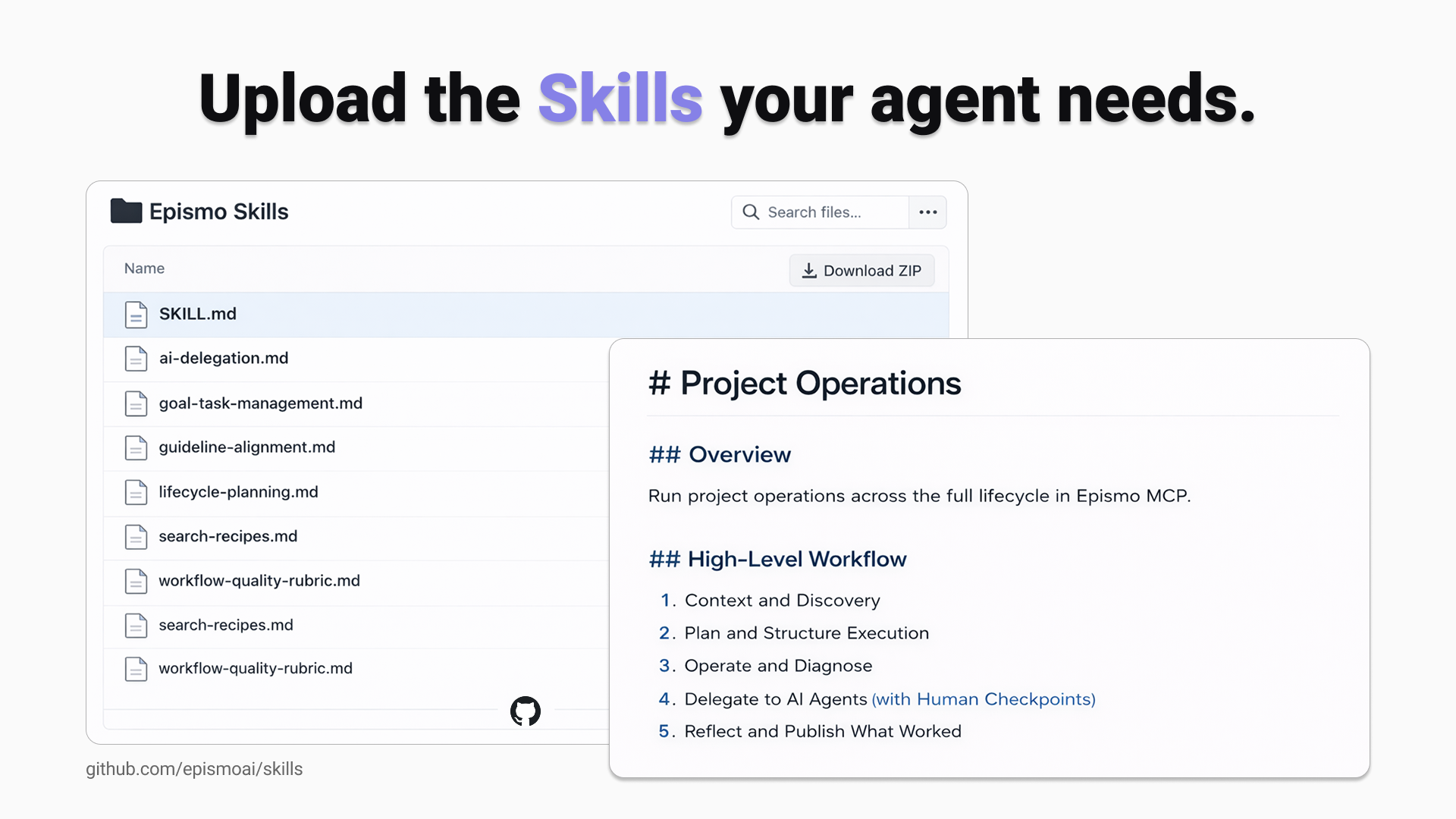
Here is how it actually works. You find a workflow built by someone in the community, something like a proven sequence for handling a GitHub PR review cycle or managing a recurring reporting task. You import it into your project. Your agent then uses that workflow as a behavioral template when it operates. The idea is that instead of prompting from scratch every time and hoping the agent figures out your preferences, you hand it a structured, tested set of best practices that it can follow.
The three-step structure Epismo describes is find, capture, operate. Find community workflows that match your use case. Capture your own expertise as reusable workflows you can share or keep private. Then connect those workflows to live projects and manage execution as ongoing tracked tasks, not one-off prompts you forget about.
The GitHub integration is doing real work here. Connecting workflow management to where developers already track work is a smart friction-reduction move. It’s the same logic behind why Base44’s backend approach got attention: meeting developers in existing infrastructure rather than asking them to adopt a parallel system.
The community angle is interesting and also the biggest open question. Workflow marketplaces are only as good as their contributor base, and the cold-start problem for community content is brutal. Epismo got solid traction on launch day, which suggests genuine curiosity from early adopters. Whether those people become contributors who build the library out is a different bet.
According to founder Hiroki Yn’s LinkedIn, the focus is specifically on harnessing and managing multiple AI agents to supercharge productivity. He studied at Tokyo Institute of Technology and is based in Singapore. The company appears to be early stage and founder-led.
What I find genuinely interesting is the framing of workflows as portable objects rather than platform-specific configurations. That portability is what makes a marketplace possible at all.
The Verdict
Epismo Skills is solving a real problem. The question is whether it can solve it at the right layer.
Agent reliability is not a UX problem. It is a knowledge encoding problem. If your agent keeps doing things slightly wrong, the fix is not a better prompt, it is a structured description of exactly how the task should be done. Epismo’s bet is that communities of practitioners can build and share that structured knowledge, the same way open-source communities share code.
That bet could work. It could also collapse if the community never reaches the density needed to make the marketplace feel like a resource rather than a ghost town.
At 30 days, I would want to know how many community workflows exist and whether any are genuinely specific enough to be useful rather than generic enough to be safe. At 60 days, I would want to see retention data on whether people who import a workflow actually run it as an ongoing project or treat it as a one-time experiment. At 90 days, the critical signal is contributor growth, specifically whether the ratio of consumers to contributors is moving in the right direction.
The infrastructure thesis here is sound. The execution risk is social, not technical. I would watch this one carefully.