





























magine
Spawn vision-enabled AI agents autonomously browsing the web
Magine Wants to Replace You With a Cloud of Cats
The Macro: Everyone Is Building the Bot That Browses So You Don’t Have To
The browser automation space has gotten genuinely crowded in the last eighteen months. You’ve got Manus AI, OpenClaw (which I wrote about tangentially when covering Donely’s hosting tax play), and a dozen quieter projects all chasing the same core idea: what if the agent just… used the internet the way a person does? Click, scroll, read, act.
The underlying bet is that vision-capable models have finally crossed a threshold where you can point a headless browser at a webpage, screenshot it, feed that to a multimodal model, and get back something useful. That bet is probably right. The question is whether any given team can build the orchestration layer on top of it that actually holds together at scale.
Agent orchestration as a category is attracting serious money and serious engineering talent right now. Agent 37 is going after the cost angle. CoChat is going after the team-workflow angle. Everyone has a slightly different framing for what is essentially the same core primitive: autonomous agents doing computer work without a human in the loop.
The productivity software market is genuinely enormous. Multiple sources peg the broader productivity software market well above $60 billion in 2024 and growing fast. Web automation is a slice of that, but it’s a slice that touches almost every knowledge worker workflow that involves pulling data, monitoring pages, or filling forms.
The honest problem is that most of these tools are brittle. Websites change. CAPTCHAs exist. Session state is weird. Vision-based approaches sidestep some of the fragility of CSS-selector scraping, but they introduce their own failure modes. Anyone claiming zero-human-interference at scale is either sandbagging the edge cases or hasn’t hit them yet.
The Micro: ASCII Clouds and Agent Swarms, Somehow Both in the Same Product
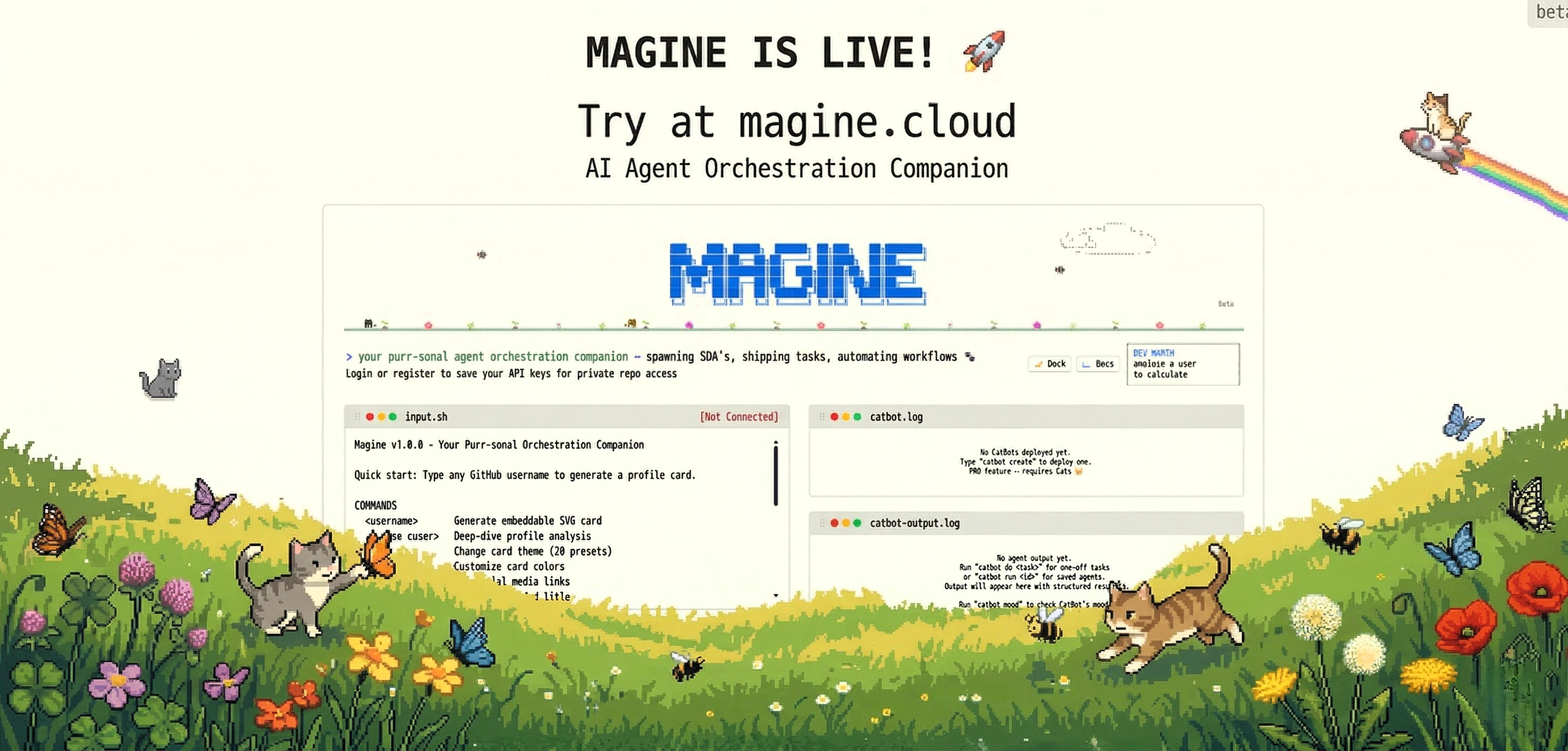
Okay so. The Magine website is something. You land on a terminal-style interface full of ASCII art clouds, bee emojis, and flower borders. The product calls itself your “purr-sonal agent orchestration companion.” The mascot situation involves cats. This is a real product that is trying to sell you on autonomous AI agents, and it has decided the vibe is cozy cottagecore hacker.
I actually don’t hate this as a choice. It’s memorable.
What Magine actually does, underneath the aesthetic: it spins up what it calls vision-enabled AI agents in the cloud, and those agents browse the web autonomously. The pitch is zero human interference. The agents can see pages (not just parse HTML), which matters for modern web apps that render content dynamically. They’re positioned at the developer-tools end of the market, not the no-code end.
The terminal interface on the website is functional, not just decorative. You can type commands. The current demo defaults to GitHub profile analysis, where you feed it a username and it generates an embeddable SVG card. That’s a narrow, concrete use case, which is either a sign they’ve scoped the MVP sensibly or a sign the broader agent functionality is further out than the tagline implies.
The token economy is interesting. You buy “Cats” ($5 gets you one Cat, which equals 5 million tokens, according to the site). The “CatBot agents” feature is gated to PRO. There’s an API key system and webhook support, which signals this is meant to be embedded in other people’s workflows, not used directly.
It got solid traction on launch day, which tracks for a dev-tools product with a distinct visual identity.
The part I’d want someone to explain to me: the tagline says “the internet will be for bots, humans are the watchers.” That’s either a philosophical statement about where AI is headed or a marketing line that sounds cooler than it is. Probably both.
The Verdict
Magine is doing something real, but the gap between the vision (autonomous agents, zero human interference, the internet is for bots now) and the current demo (GitHub profile cards) is wide enough that I’d want to see a lot more before I took the big claims seriously.
The developer-tools angle is the right call. Developers will tolerate rough edges if the underlying capability is genuine. The token pricing model is legible. The API and webhook support suggests they’re thinking about how this gets used programmatically, which is good.
What would make this work at 30 days: a clearer showcase of the actual agent browsing capability beyond the GitHub demo. Show me an agent completing a multi-step task on a site it’s never seen.
What would make this fail: if the vision-browsing is a wrapper around an existing API with minimal proprietary orchestration on top. That’s a crowded and commoditizing position to be in. Superset’s approach of building the coordination layer rather than the agent itself is instructive here. The differentiation question matters a lot.
The cat thing is genuinely charming and I say that as someone who is not usually susceptible to mascot-driven developer marketing. Whether charm converts to retention is the actual question.
