













agent-37
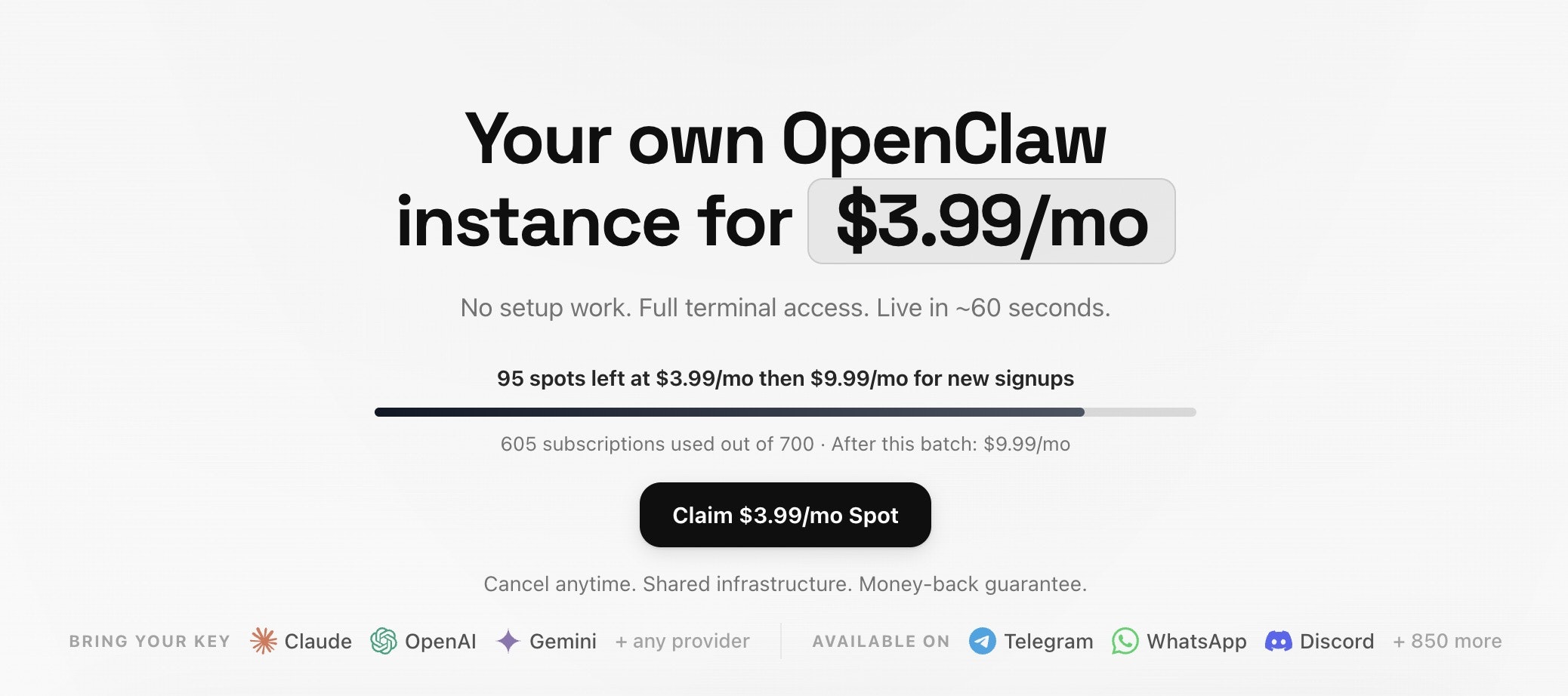
Your own OpenClaw instance for $3.99/mo
Agent 37 Is Betting You'll Pay $4 for the Same Thing You're Paying $20 For
The Macro: The $20 Problem Nobody Talks About
Here’s the thing about the current AI agent moment. Everyone is racing to build agents, pipe them into APIs, connect them to Notion and Slack and seventeen other tools, and keep them running 24/7. The actual hard part isn’t the AI. It’s the hosting.
If you’ve tried to run a persistent agent, you know the tax. You either spin up your own VPS and babysit it (fun for about one weekend), or you pay whatever managed hosting platform is charging, which tends to start around $20 a month for something barely more than a container with a UI slapped on it. For indie devs, solo founders, and the increasingly large group of people who are technically literate but not trying to manage their own infrastructure, that price floor is quietly a real barrier.
The productivity software market is enormous and growing fast. Multiple sources peg it anywhere from $62 billion in 2024 to a projected $264 billion by 2034, depending on how broadly you draw the category. That kind of growth tends to attract a lot of premium-tier tooling and not enough affordable entry points.
What’s interesting is the parallel pressure from AI agent frameworks themselves. OpenClaw is one of several open-source agent runtimes that have gotten genuinely usable in the past year. The framework is free. The hosting is where the margin gets extracted. That gap, free software sitting on top of expensive infrastructure, is exactly where Agent 37 is trying to live.
I’ve been watching a few startups try to solve adjacent problems. CoChat is attacking the team coordination layer for AI agents, and Superset is building orchestration tooling for coding agents specifically. Agent 37 is not trying to do any of that. It is, deliberately, just the floor.
The Micro: One Container, Thirty Seconds, Four Dollars
Agent 37 does one thing. It spins up a managed, isolated OpenClaw container for you at $3.99 a month. The specs: 1 vCPU, 4GB RAM, full terminal access, background task support. You’re live in 30 seconds, according to the product page.
The 850+ app integrations are the connective tissue. Gmail, Slack, and a long tail of other services are supported out of the box through what I’d assume is a Zapier-style or Make-style connector layer (the product page doesn’t go deeper on the plumbing, so I’m inferring from the count). That part matters a lot if the target user is someone who wants to wire up a market scanner or an email workflow without writing any infrastructure code themselves.
The terminal access is the detail I keep coming back to. A lot of managed agent hosting products sandbox you pretty aggressively. Full shell access means you can actually install things, run scripts, poke around when something breaks. That’s a meaningful call for developers, even if it’s not a big deal for someone who just wants their agent to forward emails.
According to a post from one of the founders on X, the origin story is the straightforward kind: OpenClaw hosting was expensive, so they built their own setup and decided to sell it. That kind of scratching-your-own-itch origin tends to produce products with coherent defaults, because the builder was the first user.
It got solid traction when it launched, hitting the top spot on Product Hunt.
The pricing math is pretty legible. If competitors are charging $20 and the DevOps work is done, $3.99 is a sustainable undercut or it’s a loss-leader. I genuinely can’t tell which from the outside, and that’s probably the most important unknown about this product right now.
The Verdict
I think Agent 37 is probably a real product solving a real annoyance. The price is the entire pitch and the price is actually good. For anyone running a side project, a personal agent workflow, or an early prototype, $3.99/month clears the mental “is this worth it” bar almost automatically.
The risks are specific. OpenClaw as a framework needs to stay relevant. If the developer community drifts toward a different open-source agent runtime in the next 12 months, Agent 37 needs to either follow or have built enough lock-in through integrations and UX to hold users. A single-framework bet is a real bet.
I’d also want to know more about how the isolation actually works at that price point. “Isolated container” is doing a lot of work in the marketing copy. At $3.99, the economics only function if the infra is very dense, which is fine until a noisy neighbor becomes your problem.
The 30-day question is whether anyone churns after the first week when they realize they still have to think about agent design, because the hosting was never actually the hard part for most people. The 90-day question is whether $3.99 is a floor or a tease.
If it’s real, this is the kind of unglamorous infrastructure product that just quietly gets used a lot. PinMe pulled off a similar “remove the friction entirely” move in deployment and it worked. Agent 37 is trying the same trick one layer down the stack.
Also featured on HUGE: PinMe Wants You to Deploy a Website Before You Even Remember to Make an Account · Superset Wants to Be the Air Traffic Controller for Your AI Coding Agents · CoChat Wants to Give Your Whole Team the AI Agent Stack You’ve Been Running on One MacBook Under a Desk