














pinme-2
Zero-config frontend deployment with no servers or setup
PinMe Wants You to Deploy a Website Before You Even Remember to Make an Account
The Macro: Vercel Ate the World and Now Everyone Wants a Bite
Frontend deployment has a weird paradox at its center: the tools that made it easier also made it more complicated. Vercel, Netlify, Cloudflare Pages are genuinely good, but they all assume you want a relationship. You’re signing up for accounts, connecting GitHub repos, navigating dashboards, configuring build pipelines. For a lot of use cases, that’s exactly the right trade-off. For a lot of others, it’s forty-five minutes of overhead to share a proof-of-concept with someone who will look at it for thirty seconds.
The timing matters here.
The AI coding agent wave, Cursor, Claude, Windsurf, whatever you’re currently living inside of, has produced a new class of frontend artifact: the quickly-generated, probably-throwaway HTML/JS page that someone needs to show someone else right now. These things need a URL. They do not need a CI/CD pipeline. The existing deployment platforms weren’t built for this workflow, and it shows in every unnecessary click.
The broader productivity software market is enormous, with projections ranging anywhere from $62.5 billion to $264 billion depending on how you draw the category lines and which analyst you’re reading. But that framing doesn’t quite capture what PinMe is doing. The more relevant competitive surface is the instant static hosting niche, where the incumbents have since grown into something much bigger than that original promise. There’s a legitimate gap where old-school simplicity used to live. IPFS-based deployment tools have been circling this space for a while, mostly attracting the decentralization-minded crowd. PinMe seems to be making a play for a broader audience: people who just want a link, not a philosophy.
The Micro: Drag, Drop, Done (And There’s a CLI If You’re That Kind of Person)
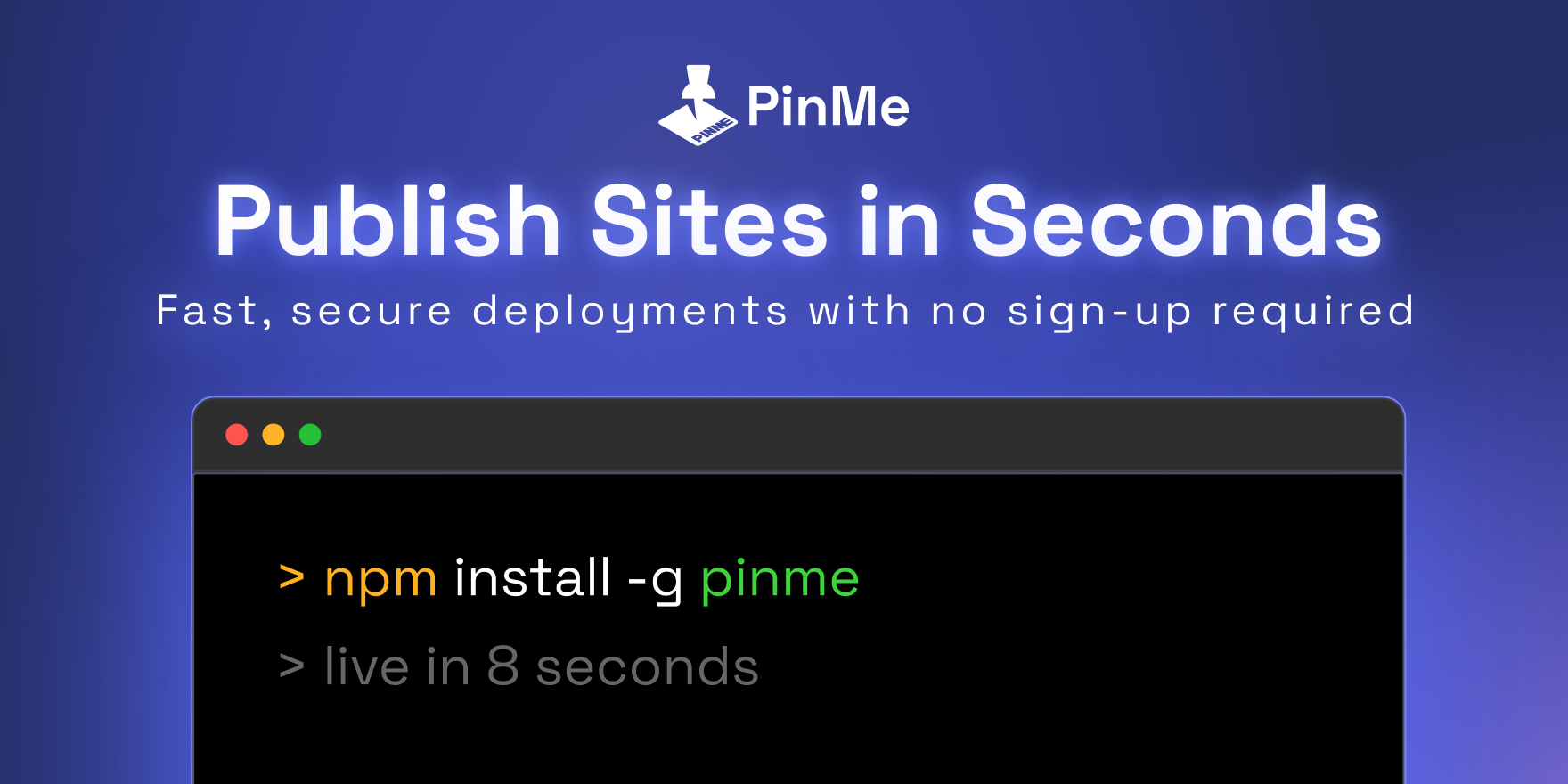
The product is genuinely simple to describe. You have a static site, HTML, CSS, JS, whatever your AI agent just produced. You either drag it into a browser window or run pinme upload <folder> from your terminal after a one-time npm install -g pinme. You get a link. You share it. That’s the whole thing.
What’s underneath is more interesting than the UX suggests.
According to the product website, deployments are cryptographically verified. Content integrity is checked, making them tamper-resistant. The .eth.limo domain in the product’s own URL is a tell: this is IPFS-based hosting, which means your content is addressed by its hash, not by a server location. That’s the mechanism behind both the “no server” claim and the “secure and verifiable” pitch. It’s a real technical property, not marketing copy. It also explains the custom domain support, since you can point your own domain at the IPFS content hash.
The no-account-required angle is the loudest feature, and it earns that position. History isn’t saved unless you log in, which is an honest trade-off they surface upfront rather than burying in fine print. There are optional upgrades mentioned, so a paid tier presumably exists, though the specifics aren’t public from what’s available.
It got solid traction on launch day. The listing tags it under Artificial Intelligence alongside Developer Tools and Productivity, which is a savvy move given that the AI-agent-generated-page use case is probably the most compelling wedge right now. Several sources independently flag this framing. It showed up in an AI coding agents newsletter and in GitHub lists of tools compatible with agents like Claude.
The Verdict
PinMe is solving a real problem with admirable restraint. The temptation for any deployment tool is to become a platform: add auth, add analytics, add team features, add billing, add a dashboard, and in doing so recreate the exact complexity that was the original problem. PinMe has, at least at launch, resisted that. That’s harder than it sounds.
The thirty-day question is retention mechanics.
No-account tools live and die by whether people remember they used them. If you deployed something last Tuesday and need to update it, do you remember the URL? Can you find it? The login-to-save-history model is a reasonable answer, but it reintroduces the friction PinMe is built to eliminate.
The sixty-day question is the IPFS reliability story. Decentralized storage is genuinely good at some things and genuinely less predictable at others. Load times, gateway availability, link permanence. These matter a lot if PinMe wants to move beyond throwaway demos into anything someone actually depends on.
My read: this is probably the right tool for someone who generates a lot of quick prototypes and needs a frictionless way to share them. It is probably not the right tool for anyone who needs to confidently update, manage, or revisit deployments over time without logging in. Those are different users with different needs, and I think PinMe is currently built for the first one.
The ninety-day question is whether the AI agent workflow integration deepens. That’s the most defensible position here, not just easy for humans but trivially callable by agents. If Cursor or similar tools can deploy via PinMe with zero human interaction, that’s a distinct product. Right now it’s an interesting launch. That would be something else entirely.
Also featured on HUGE: Superset Wants to Be the Air Traffic Controller for Your AI Coding Agents · CoChat Wants to Give Your Whole Team the AI Agent Stack You’ve Been Running on One MacBook Under a Desk · Agent 37 Is Betting You’ll Pay $4 for the Same Thing You’re Paying $20 For