











video-forms
Embed questionnaires in videos to create interactive forms
The Form Was Always in the Wrong Place
The Macro: Nobody Likes Switching Tabs to Tell You Your Demo Was Confusing
Here’s what keeps happening in product and UX research: someone records a demo, ships it next to a Typeform or Google Form, and then wonders why response rates are terrible and the feedback they get back is useless. The video lives in one tab. The form lives in another. The mental context breaks completely between them. Once you see the friction, you can’t unsee it.
The UX research market is growing fast. Multiple analyst reports put it somewhere between $5 billion and $14 billion right now, with projections pointing up through the early 2030s. The exact figures vary enough between sources that I’d treat any specific number as a rough direction, not a hard fact. What stays consistent across those reports is strong double-digit CAGRs, which means real money is flowing toward tools that help teams understand what users are actually doing.
Interactive video already has established players. VideoAsk, Typeform’s async video product, is probably the most recognizable name here, though its model is built around video as the question medium rather than questions embedded inside existing video content. Mindstamp and Tolstoy both do in-video interactivity with different leans toward lead capture versus feedback. Videobot shows up in the alternatives conversation too. The field is not empty.
Most of these tools share a bias toward video-native flows. You’re building new content inside their platforms. The angle of taking a YouTube video you already have and layering a questionnaire onto its timeline is a different frame entirely. Less “make a video chatbot,” more “annotate your existing video with questions at the exact moment the context actually lives.” That distinction matters a lot depending on the use case.
The Micro: Questions at Timestamp 0:47, Where the Confusion Actually Happened
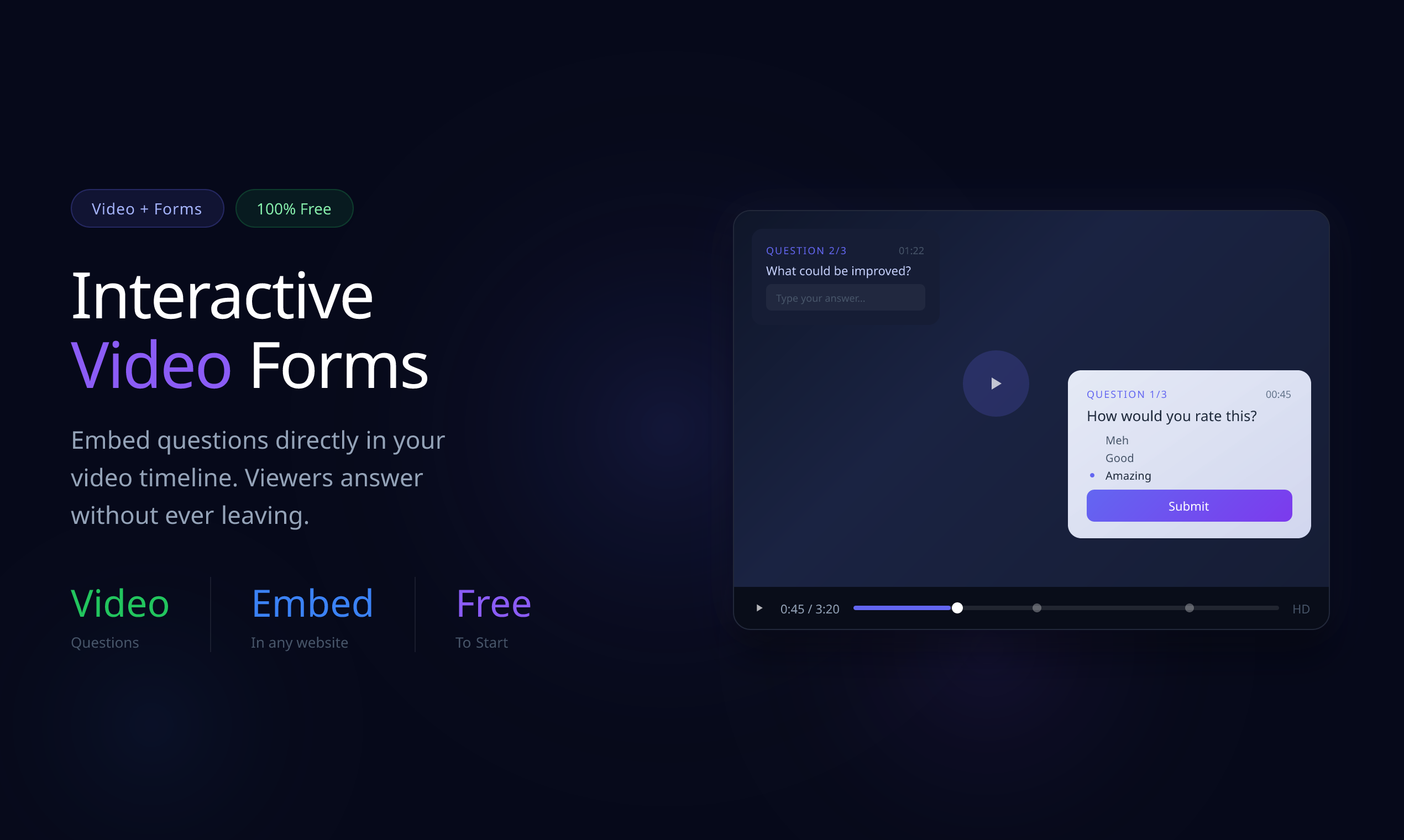
VForms is straightforward to describe. You paste a YouTube URL, place questions at specific timestamps along the video timeline, and share a link or iframe embed. Viewers watch, hit a question when the playhead reaches that point, answer it, and keep going. Branching logic lets viewers skip forward based on their responses. Answers aggregate somewhere you can actually look at them.
The product site shows a live embeddable demo, which is the right call.
It’s the kind of thing that makes more sense experienced than explained. The embed is a standard iframe, so it drops into basically any page builder or HTML template without friction. The free tier is currently unlimited, which reads as either a generous early-adopter move or a pricing model still being figured out. Probably both.
The founder’s origin story on the site is the clearest version you can get: they had a product video they wanted feedback on, embedded it in a Google Form, and thought, why isn’t this the other way around? That’s a genuine itch, not a market-research-derived hypothesis. Those tend to produce tighter initial products than the alternative.
It got solid traction on launch day, which tracks. The problem is immediately recognizable to anyone who’s tried to collect feedback on a video before.
The YouTube dependency is the thing I keep coming back to. Right now the product is entirely downstream of YouTube’s embed infrastructure. That’s fast to build on and covers a massive percentage of video content. But it’s a ceiling if someone wants to use Loom recordings, Vimeo, or self-hosted files. Whether that expands is probably the most important near-term product question.
The Verdict
VForms is solving a real, specific annoyance. Anyone who has done video-based user research or product feedback collection has felt it. The implementation is clean, the concept lands immediately, and the free-to-start positioning removes the excuse not to try it.
The 30-day question is retention. Does anyone come back after the first form, or is this a “oh neat, I made one” situation? The 60-day question is whether the YouTube-only constraint starts costing users who need to embed a Loom or a private recording. The 90-day question is pricing, because free forever is not a business, and how they handle that will say a lot about where this actually goes.
I think this works best as a UX research supplement. Teams who want to collect timestamped reactions on a demo video, or run lightweight user interviews against existing content, have a genuinely useful tool here. I’m more skeptical about onboarding flows, where the video content is usually controlled enough that you’d want more than YouTube hosting. That feels like a stretch use case.
What would make this succeed is a sticky workflow that keeps teams coming back repeatedly, not just once. What would make it stall is staying YouTube-only too long, or not building enough response analytics to justify replacing the video-plus-Google-Form setup it’s trying to make obsolete.
I’d want to see response completion rates compared to standalone forms before fully buying the core claim. But the direction is right, the problem is real, and the product works today. That’s a better starting position than most launches manage.