














termsy
Scans terms and conditions for you
Nobody Reads the Terms. Termsy Is Betting That's Actually a Product Opportunity.
The Macro: The ToS Is a Consent Theater Problem
The average terms of service agreement runs somewhere between 5,000 and 10,000 words. The average person spends zero seconds reading them before clicking “I Agree.”
This isn’t laziness. It’s rational behavior. Refusing to agree to Spotify’s terms means not having Spotify. Researchers at Carnegie Mellon estimated years ago that actually reading every privacy policy you encounter in a year would take roughly 76 work days. Nothing meaningful has changed since then.
What has changed is the browser extension market. Depending on which market research firm you trust, it’s somewhere between a $2.5 billion and $7.8 billion industry in 2024, growing at double-digit rates annually. The AI-flavored slice is growing faster, with multiple reports pointing to CAGRs north of 13% through the early 2030s. Chrome holds around 65% of global browser market share, which means extensions targeting Chrome are fishing in a very large pond.
The terms-summarization niche has a few established names. ToS;DR has been doing crowdsourced ToS analysis since 2012. It’s a nonprofit, community-driven, and covers a finite set of major services. Summarize.tech, various ChatGPT wrapper tools, and general-purpose AI summarizers can all handle a pasted terms document if you’re motivated enough to paste it. The gap these tools leave is friction: you have to go find them, initiate the process, and already have decided you care. Termsy’s thesis is that the intervention needs to happen in context, automatically, at the moment you’re about to click agree. Not after.
That’s a reasonable thesis. Whether execution lives up to it is the actual question.
The Micro: A Sidebar That Does the Reading For You
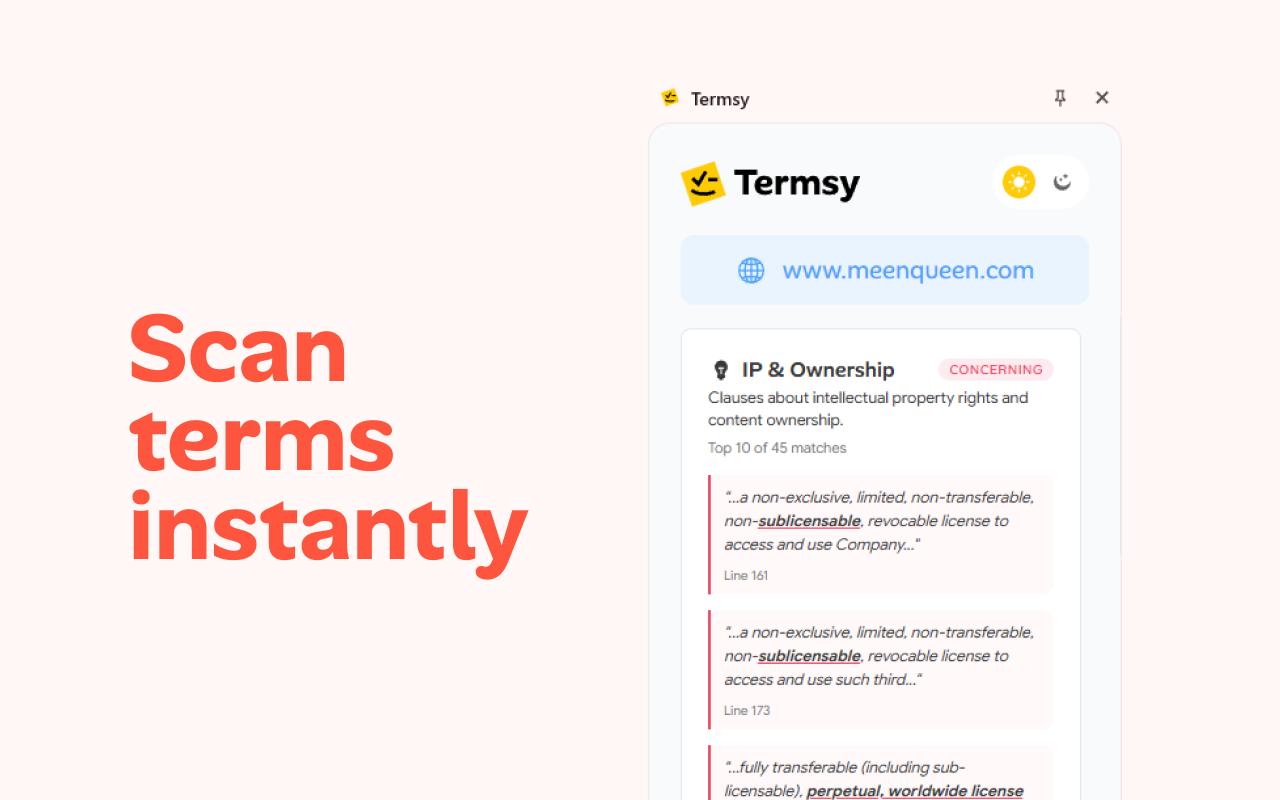
Termsy is a Chrome extension. It detects when you’re on a Terms of Service or Privacy Policy page, scans the document automatically, surfaces critical clauses in a sidebar, and gets out of the way.
Light and dark modes are included. Small thing, but extensions that ignore dark mode in 2025 produce a specific kind of annoyance disproportionate to their sin.
The core product decision here is passivity: you don’t invoke Termsy, it invokes itself. That’s the right call. A tool you have to remember to use for a task you already hate is a tool you won’t use. Making it automatic handles the cold-start problem of habit formation. The extension has to earn your trust by being correct before you’ll rely on it for anything that actually matters, and it can’t earn that trust if you never remember to open it.
What I don’t know from available sources is the quality of the clause detection. “Critical clauses” is doing some heavy lifting in the product description. The hard problem isn’t finding text. It’s knowing which sentences in a 7,000-word document are the ones a reasonable person would want flagged before signing up for a meal-kit subscription versus before connecting a third-party app to their bank account. Context sensitivity at that level requires either very good heuristics, solid underlying AI, or both.
The Chrome Web Store showed 105 users at time of writing, which is essentially a pre-launch number. It got solid traction on launch day. Enough signal to say the concept resonates, not enough to say much about retention.
Founder Paula Skrzypecka appears to have genuine background interest in ToS analysis. Her LinkedIn posts show repeated, detailed engagement with terms from Anthropic, Manus AI, Midjourney, and Google’s Veo. That’s at least circumstantial evidence that this isn’t a product built by someone who finds the subject area boring.
The Verdict
Termsy is solving a real problem with a sensible delivery mechanism.
The automatic sidebar approach is the right UX instinct. Meeting users at the moment of decision rather than asking them to remember an extra step. The competition from ToS;DR is more complementary than threatening, given the entirely different model, and general-purpose AI summarizers aren’t optimized for this workflow the way a dedicated extension can be.
What would make this work at 90 days: retention data showing that users who install it leave it installed. Uninstall rate is the number that matters most for extensions in this category. What would sink it: clause detection that’s either too noisy, flagging everything as critical, or too quiet, missing the clause where you waive your right to a class action. Trust is the entire product here, and trust is fragile.
I’d want to know how the clause prioritization actually works under the hood, and whether it handles edge cases gracefully. Short cookie notices versus full enterprise SaaS agreements, for instance. I think this is probably a genuinely useful tool for everyday consumers who install it and forget it’s there doing its job. I’m less convinced it’s ready for anyone whose stakes are high enough to actually care about the nuances. The idea is solid. The execution is unverified at scale. That’s just where a 105-user extension with a fresh launch lives on the certainty spectrum. Worth watching.
Also featured on HUGE: Caseflood.ai Is Betting That Law Firm Intake Is Broken Enough to Fix With AI · OpenIntake Turns Missed Law Firm Calls Into Signed Clients · Tire Swing Brings AI to Affordable Housing Compliance So Tenants Don’t Lose Their Homes