























unenhanced
Take photos without iPhone auto-enhance
The iPhone Lies to You About What Your Photos Look Like. One App Is Done Pretending That's Fine.
The Macro: Your Phone’s Camera Is a Liar (and You Probably Like It)
There’s a specific kind of frustration that lives in the gap between what you saw with your eyes and what your phone decided to show you instead. You took a photo of a moody overcast afternoon and your iPhone handed you back something that looks like a tourism ad. Brighter, sharper, more saturated. Not wrong exactly. Just not what was there.
This is the computational photography tradeoff that nobody really agreed to. Every major smartphone manufacturer is doing it. Apple’s camera pipeline runs serious post-processing on every shot before it even hits your camera roll. Google’s Pixel cameras are arguably worse about this, famously aggressive with HDR and sky enhancement. The result is photos that consistently look “good” in an algorithmic sense while looking less and less like the actual moment.
The photography industry is genuinely large and growing. According to multiple sources, the global photography market is projected to climb toward $161.8 billion by 2030. Photographic services in North America alone sit at an estimated $15 billion in 2025. The market is not hurting. But those numbers mostly reflect professional services, hardware, and software, not the daily casual shooter who just wants their phone to stop making creative decisions on their behalf.
The alternatives that exist are kind of annoying to use. You can shoot RAW on an iPhone, technically, but RAW files are huge, require editing software, and presume you want to grade your photos like a cinematographer. I’ve written before about how Apple tends to keep its hardware interesting while making third-party workflows feel like an afterthought. The Apple Watch has always been a closed garden, and the camera isn’t much different. ProRAW exists, but it’s not for the person who just wants a less processed JPEG.
That’s the gap Unenhanced is trying to sit in.
The Micro: Less Camera, On Purpose
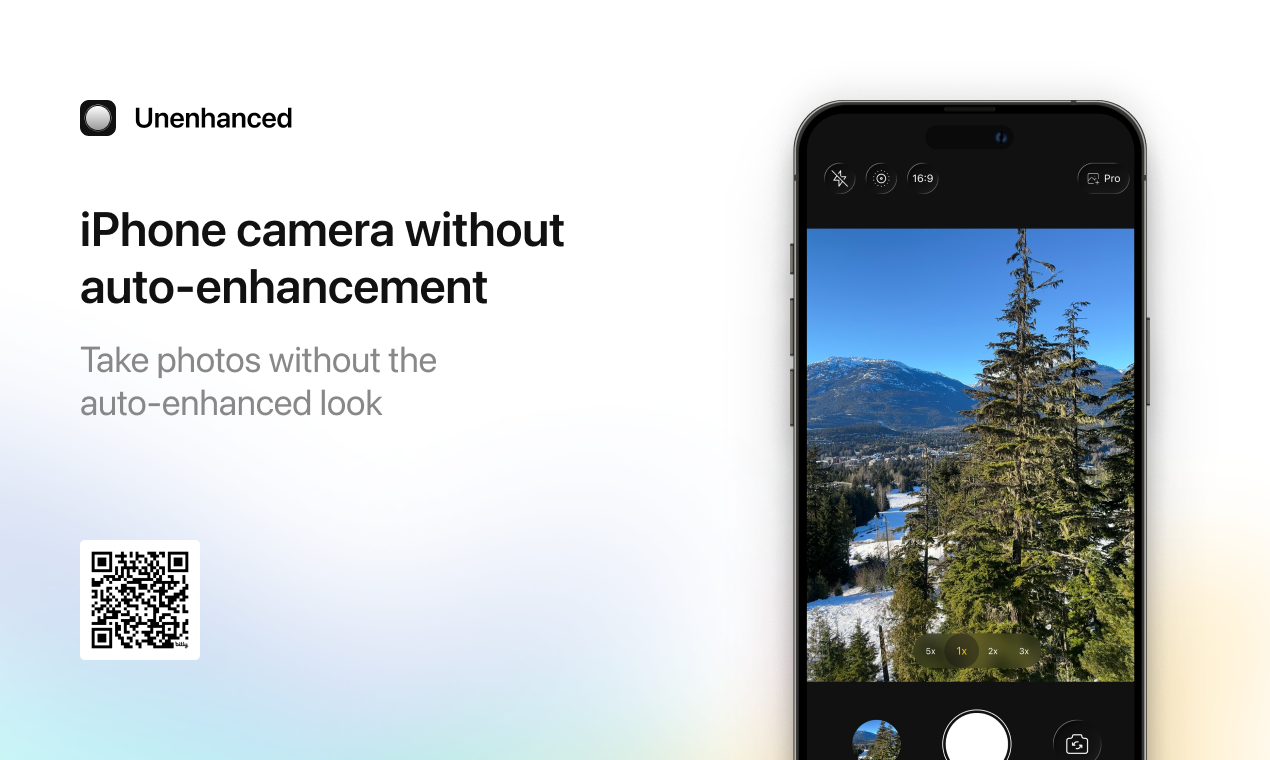
Unenhanced is a camera app for iPhone that does one thing. It takes photos that look like what you see in the preview before you tap the shutter button.
That sounds trivially simple, and in some ways it is. The core problem it’s solving is the disconnect between the live viewfinder (which shows something close to reality) and the processed image the default camera app actually saves. Apple’s post-processing kicks in at capture time, bumping sharpness, contrast, and color correction. Unenhanced bypasses or reduces that pipeline so what you save matches what you saw.
No RAW files. No editing. Just a more literal capture.
The website is minimal to the point of being almost a joke (in a good way, I think). There’s a tagline, two sentences of explanation, and a download button. No feature grid, no testimonials, no pricing page. It’s a free app, or at least appears to be based on the product listing, with no indication of a paywall mentioned anywhere in the available information.
The product decisions here are interesting because the whole pitch is subtraction. They’re not adding a filter, not adding AI, not adding anything. The bet is that users will pay attention to the difference between preview and output often enough to care about closing that gap. I’m skeptical that most people do notice, honestly. But the people who do notice tend to really notice, and they’ve been complaining about it on photography forums for years.
It did fine when it launched, picking up solid early traction. Nothing viral, but the audience it’s targeting (people who have already formed an opinion about computational photography) is a fairly self-selecting and vocal one.
For people who’ve been shooting on film cameras or who’ve spent time thinking about how much control a photographer actually needs, this app is an easy yes. For everyone else it requires a kind of aesthetic sensibility that not everyone has developed yet.
The Verdict
I like what Unenhanced is doing philosophically. It’s a direct response to a real complaint, and it takes a position instead of trying to please everyone.
The risk is that the audience is small and niche. People who care about unprocessed photos already have workflows. Shooting ProRAW and batch processing is annoying, sure, but the type of person who cares enough to seek out Unenhanced is often also the type of person who’s already tolerating some annoying workflow.
At 30 days, I’d want to know if the app is actually retaining users or if it’s a novelty download. At 60 days, whether the team is building anything around it, some light editing tools maybe, or staying committed to pure minimalism. At 90 days, whether the share of photos taken with it gets any distribution boost from the aesthetic difference being visible and discussable on social.
The honest version: this is a good app for a specific person who already knows they need it. Whether enough of those people exist to sustain a product is the actual question. I hope they find them, because someone should be making this argument.