














stish-from-start-to-finish
Manage campaigns across all major platforms
The Agency Tab Graveyard Has a New Janitor
The Macro: Everyone Has a Pixel Problem
Every digital agency I’ve ever talked to has the same problem: client assets living in Slack threads, random Google Docs, and someone’s brain who just quit. You need to find the GTM container ID for a client whose account manager left six months ago. Good luck. Enjoy your afternoon.
The productivity software market is genuinely massive and getting more crowded. According to multiple market reports, the global business productivity software segment sat somewhere between $62 billion and $110 billion in revenue depending on what you’re measuring and who’s measuring it, with projections pointing aggressively upward through the early 2030s. AI-flavored productivity tools specifically are projected to grow at around 15.9% CAGR through 2033, per Grand View Research. That’s a lot of runway, but it also means a lot of companies chasing the same “we fixed your workflow” pitch.
The agency ops corner of that market is interesting because it’s genuinely underserved relative to its chaos level. Most agencies are running on some frankenstein stack. Notion for docs, Asana or Monday for tasks, a spreadsheet for client credentials, another spreadsheet to track that spreadsheet. The tools that exist either serve creative teams (think Figma, Canva) or paid media buyers (think platform-native tools), but almost nothing bridges the operational layer that connects them.
That’s the gap Stish is aiming at. Not the creative work itself, not the media buying itself, but the connective tissue between the team, the client, and the fifteen platforms they’re all touching at once. I’ve seen a few attempts at this, and they usually end up being either too lightweight to replace the spreadsheet or too heavy to actually get adopted. The bar to clear is real.
The Micro: One Source of Truth Is Doing a Lot of Work Here
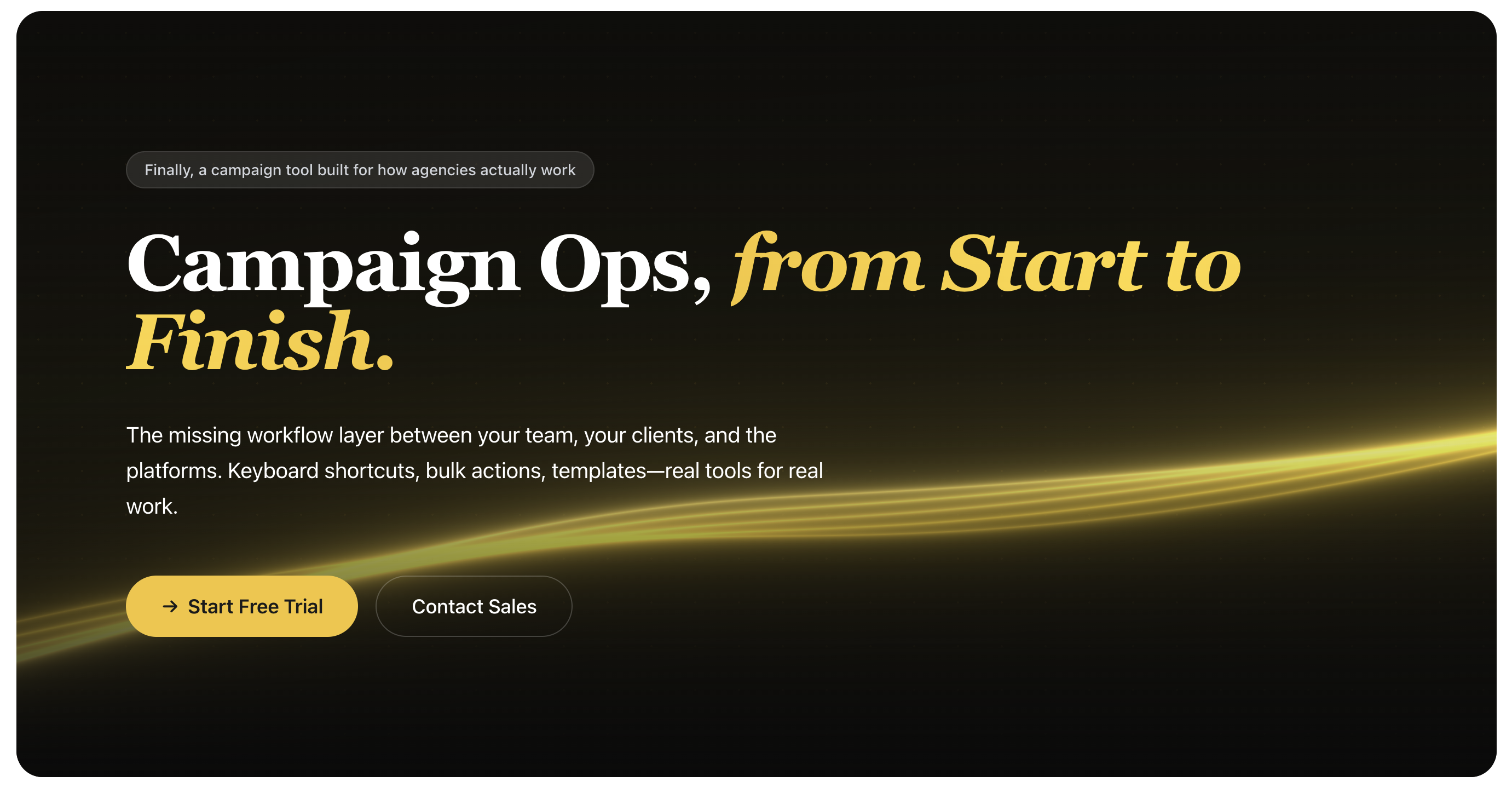
Stish describes itself as the “missing workflow layer” between your team, your clients, and the platforms. That framing is doing real work. It’s not trying to be a full project management suite and it’s not trying to be a media buying tool. It’s the operational glue layer, specifically for agencies managing multi-platform campaigns.
The core feature set breaks into three pieces. First, client asset tracking: pixels, GTM containers, hosting credentials, CMS access, and reportedly over 20 integrations per client. That’s the “where is the pixel” problem, addressed directly. Second, campaign and project management with built-in tasks and collaboration, so you’re not bouncing between Stish and another tool just to assign work. Third, an AI search layer that lets you ask natural language questions like “does Acme have a pixel set up” and get an actual answer instead of clicking through five tabs.
The AI search piece is the one I find most interesting, honestly. It’s a small surface area but it’s exactly the right question to ask. The institutional knowledge problem at agencies is brutal. Someone quits or goes on leave and suddenly nobody knows the login situation for a mid-tier client. If the AI actually learns your team’s patterns over time as they claim, that’s genuinely useful. If it’s a fancy search bar, less so.
They’ve also built in platform specs for ad creatives, so you know dimension requirements before your designer starts working. That’s a quiet feature but I know from talking to people building similar tools that spec management alone causes an absurd amount of rework.
Supported platforms include Google Ads, Meta, Instagram, LinkedIn, TikTok, YouTube, Microsoft Ads, Reddit Ads, Pinterest, and Viber. That’s solid coverage. It got decent traction on launch day, which at minimum means the problem resonates.
There’s a free trial available. No pricing details surfaced in my research, which means either it’s sales-led or they haven’t published it publicly yet.
The Verdict
I think the underlying problem is real. Agency operational chaos is not a manufactured pain point, it’s a daily tax that compounds. The specific angle of “single source of truth for client assets across platforms” is a tighter pitch than most tools in this category manage. Most go broad and lose focus. Stish seems to know what it is, at least for now.
The thing that will make or break this at 30 days is onboarding. Getting an agency to actually migrate their client asset data into a new tool is a significant ask. If the import experience is painful, it dies in pilot. At 60 days, the question is whether the AI search is genuinely useful or just demo-ware. That feature is the most differentiated thing here, and if it doesn’t hold up in real use it’s just a slightly nicer spreadsheet. At 90 days, retention will depend on whether it actually replaces existing tools or just adds to the stack.
I’d want to know the pricing structure, specifically whether it’s per seat or per client or some combination. I’d also want to know how the collaboration features compare to what teams are already using. Tools that try to replace parts of existing workflows have to clear a high bar, and “good enough to switch” is a harder argument than it looks.
If the AI layer is real, this is worth a trial. That’s my honest read.
Also featured on HUGE: OpenClaw for Humans: EasyClaw Bets the Hard Part Was Always the Setup · TamLabs Thinks AI Can Redesign Knowledge Work and They’re Starting with Professional Services · Cuckoo Puts a Real-Time AI Translator in Your Zoom Call, and Snowflake Is Already Using It