













sway-15
Turn spoken thoughts into clear structure.
Sway Thinks You Talk Too Much — In the Best Possible Way
The Macro: Everyone Is Selling You a Second Brain; Nobody Is Selling You a First Draft
The AI productivity tools market sat at roughly $8.8 billion in 2024 and is projected to reach $36.4 billion by 2033, a compound annual growth rate of about 15.9%, according to Grand View Research. That’s a big number, and like most big numbers in market forecasting, it contains a lot of wishful thinking alongside legitimate signal. The legitimate signal: people are genuinely willing to pay for tools that reduce cognitive overhead, and voice is increasingly how they want to do it.
The voice memo space has gotten crowded in a way that’s almost impressive. Otter.ai has been transcribing meetings since 2016. Notion AI now summarizes your own notes back to you. Apple’s native transcription landed in iOS 17 and immediately made a dozen apps mildly redundant. Then there’s ChatGPT’s voice mode, which will do more or less anything if you ask it patiently. The honest competitive picture for Sway isn’t a few plucky startups. It’s three or four trillion-dollar companies who added voice features to products people already have open.
What hasn’t been solved cleanly is the gap between “I said a thing” and “I know what I meant.”
Transcription is a commodity. Structured synthesis is harder and marginally more interesting. The question is whether a standalone app can own that wedge before the incumbents decide it’s worth a sprint. Based on how fast Notion, Google Docs, and even Bear have shipped AI features in the last eighteen months, that sprint timeline is probably shorter than any seed-stage founder would prefer.
The Micro: Speak Messy, Get Tidy, The Technical Bet Buried in the UX
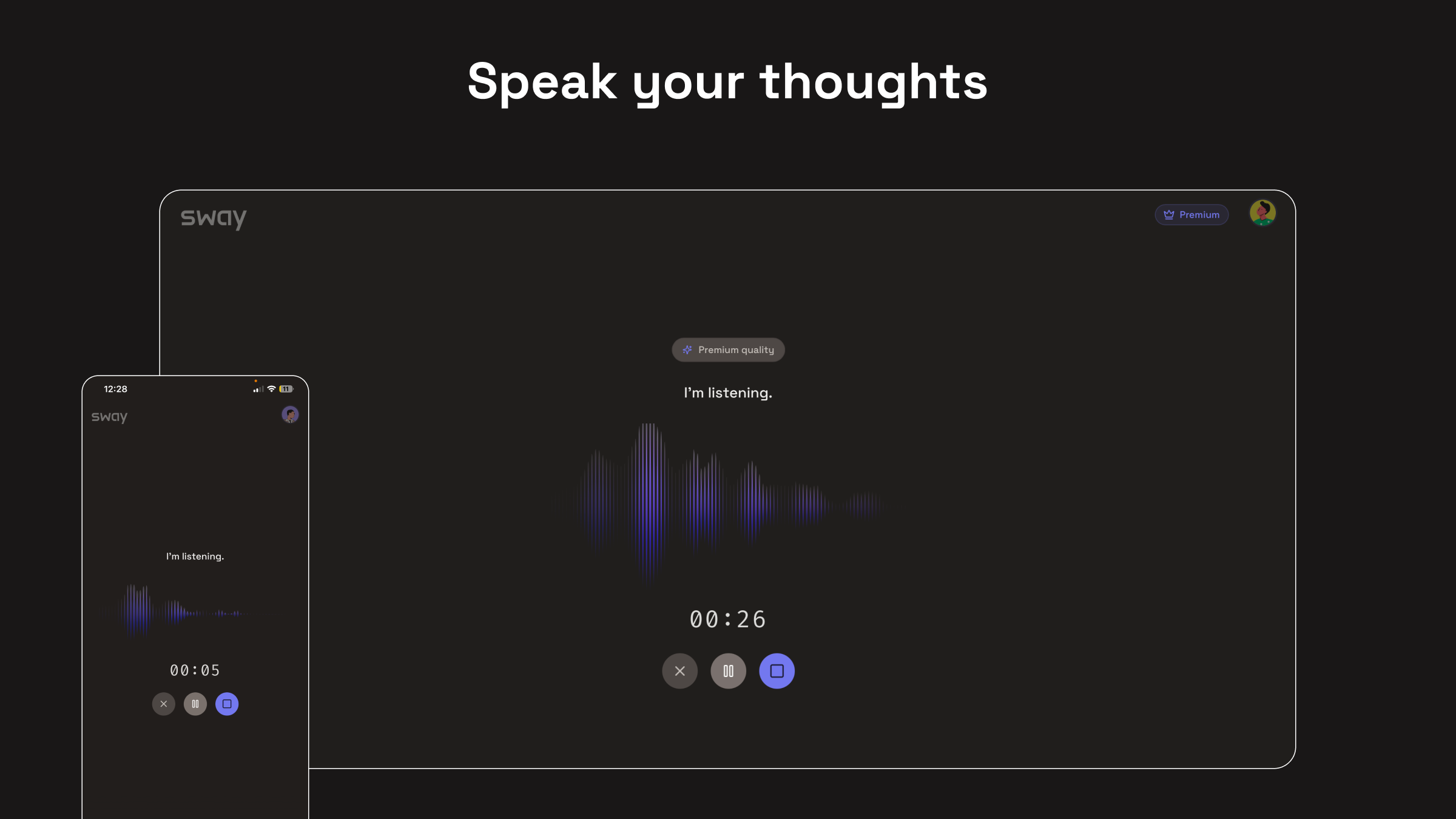
Sway’s core loop is simple enough to explain in one sentence: you speak, it structures. No templates to choose, no prompts to write, no categories to assign. You get a summary, key points, action steps, and a title.
The product website claims no signup is required to try it. That’s a small but meaningful friction-reduction choice, and it suggests someone on the team has spent real time staring at activation funnels.
The interesting product decision here isn’t the output format. Summaries and action items are table stakes. It’s the explicit positioning against transcription. Sway is betting that users don’t want a verbatim record of their own rambling. They want something to have listened and extracted the load-bearing ideas. That’s a higher-order task than speech-to-text, and it’s where the actual AI work lives. Whether the models backing it do that reliably across different speaking styles, accents, and subject matters is a question that launch-day traction on Product Hunt can’t answer.
The testimonial on the site, “Feels like talking to someone who really listened” from a copywriter named Wisdom Ojieh, is the kind of specific, slightly odd feedback that tends to come from actual use rather than a swapped-in placeholder. I’d rather see ten of those than a hundred generic five-star lines.
The use cases Sway targets, post-call capture, walking, driving, late-night idea dumps, are all real moments where people currently either forget the thought entirely or open a notes app and write three words before giving up. That’s a genuine problem. The question I keep coming back to is execution density. How good is the synthesis when the thoughts are genuinely nonlinear?
The Verdict
Sway is making a focused bet in a space where focus is genuinely hard to maintain. The positioning is clean, the friction is low, and the problem is real. Those three things together are not as common as they sound.
What would make this work at 90 days: retention among users who try it more than once, evidence that synthesis quality holds up on messy real-world audio, and some signal that people are reaching for it habitually rather than experimentally. Habit formation in voice tools is notoriously difficult. The product has to be faster than typing and better than forgetting, every single time.
What would make this fail is simpler. If the AI output is merely adequate, it’s done.
Adequate summaries of your own thoughts are easy to dismiss. The bar isn’t “did it capture the words.” It’s “did it understand what I was actually trying to think through.” That’s a bar most tools quietly lower when you’re not looking.
The founder search returned ambiguous results, multiple people named Sway or associated with companies called Sway across different industries, so I can’t tell you much about who built this or why. That’s an information gap I’d want to fill before making a strong call either way. For now: interesting problem, plausible approach, needs more reps in the wild.
Also featured on HUGE: Your AI Keeps Living in a Tab. TexTab Wants to Put It in Your Fingers. · Voicr Wants to Be the Translator Between Your Brain and Your Keyboard · TamLabs Thinks AI Can Redesign Knowledge Work and They’re Starting with Professional Services