
















clawi-ai
OpenClaw in the Cloud with Zero Setup and on 24/7
Claude Without the Setup: Clawi Bets the Cloud Is Enough
The Macro: Everyone is racing to be the API layer you don’t have to think about
Every major model company is quietly converging on the same goal: make deploying an AI agent feel like subscribing to a streaming service. Anthropic has Claude on the web and the API. OpenAI has custom GPTs (which are, charitably, a work in progress). Google has Gemini Gems. The signal from model providers is consistent — infrastructure is our problem, you bring the use case.
What’s less solved is the layer below that: the always-on personal AI assistant that lives where you already are. Not in a new browser tab you have to remember exists, not in a dedicated app with its own onboarding flow, but inside WhatsApp, Telegram, or Discord — the applications already running in your notification center, already being checked reflexively at 11pm because you can’t help yourself. The platforms where communication actually happens for most people.
This is a real gap. The managed AI connector category is still early, and the distribution problem it’s solving — getting AI into the channel people already live in, without requiring server management at 2am when something breaks — is genuinely worth solving. It’s less technically impressive than building the model and more commercially important than most of the things getting funded right now, which is very on-brand for infrastructure-adjacent product work.
The Micro: WhatsApp, Telegram, and Discord. Five minutes. Someone else’s server.
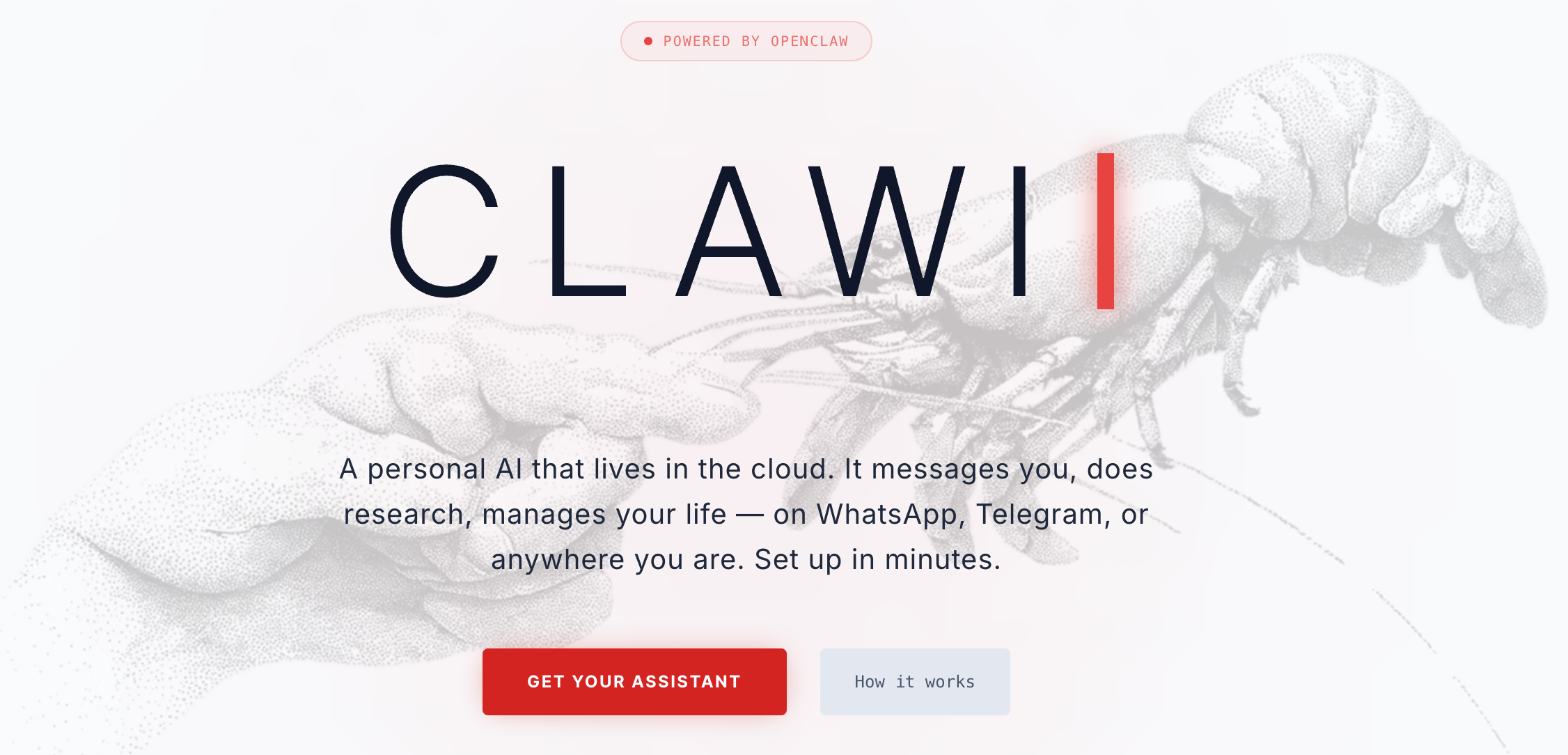
Clawi is exactly what it says: a managed, cloud-hosted AI assistant built on Claude (Anthropic’s model, for what it’s worth — not a fine-tune, not a wrapper around GPT-3.5 because it’s cheaper), delivered to WhatsApp, Telegram, and Discord. You connect your accounts, set preferences, and you have a functional AI assistant waiting in your existing messaging apps — always on, no infrastructure to maintain.
The five-minute setup claim is plausible because OAuth flows for these platforms are well-documented and the heavy lifting (model serving, uptime management, API rate limiting, billing reconciliation) sits entirely on Clawi’s infrastructure. The user gets the output without touching any of the implementation. This is the correct product philosophy for this category.
What makes this something other than a parlor trick is the persistence angle. A Claude conversation in the browser is ephemeral — close the tab, lose the context, start over. An always-on assistant in a messaging app can maintain memory, receive messages asynchronously, integrate into how you actually work across a day. That’s meaningfully different from “Claude but in WhatsApp.” Whether Clawi’s implementation actually delivers on the memory and context side is the part I’d want to test before recommending it unconditionally.
The 390 upvotes for what is, at its core, a hosting and connector play rather than a novel AI capability is notable. It suggests the demand for friction removal is real — and that a lot of people have tried to self-host or API-wire their own AI assistants and have opinions about how annoying that is.
The Verdict
Clawi is well-positioned in a trend that isn’t reversing. The friction of running your own AI infrastructure is real. The appetite for always-on assistants in native messaging apps is real. The model quality available via Claude is real. Clawi’s job is to glue those three things together cleanly and keep them working.
The low comment count (15 vs. 390 upvotes) is worth noting — it could mean the value prop is immediately legible, or it could mean people liked the idea before trying it. Those are different things. The 30- and 60-day retention numbers will tell you which one it is.
The structural risk is commoditization. A hosting and connector layer can be replicated. If Anthropic or another model provider decides to ship native WhatsApp and Telegram connectors (which they absolutely could), Clawi’s core differentiator narrows fast. The durable value will come from product depth — memory management, multi-bot support, usage analytics, workflow integrations — not from the connector itself. The connector is a front door, not a moat.
For now: it solves a genuine problem, simply. That’s a fine place to start.