

















bunny-database
Like SQLite, but for the web
Bunny.net Wants to Be Your Whole Stack — Starting With the Database
The Macro: The SQLite-at-the-Edge Gold Rush Is Already Crowded
Sometime in the last three years, the developer tools world collectively decided that SQLite — a file-based database originally designed for embedded systems and local apps — was actually the correct answer for a surprising number of web workloads. The logic holds up: it’s fast, it’s simple, it has zero infrastructure overhead, and most applications don’t have write patterns that demand the complexity of Postgres or MySQL. The problem was always “but how do you put that on the internet, distributed, without it falling apart?”
Several companies have been working on exactly that answer. Cloudflare D1, Turso, and Fly.io’s LiteFS are the most prominent names in the SQLite-compatible-but-actually-web-native category. Turso, built on libSQL (a fork of SQLite), has made the most aggressive play for developer mindshare — embedded replicas, per-tenant databases, the works. Cloudflare D1 benefits from sitting inside an ecosystem that already owns a large chunk of edge infrastructure. These are not weak competitors.
The broader developer tools market gives some sense of the tailwinds here. According to Mordor Intelligence, the software development tools market is expected to grow from around $6.41 billion in 2025 to $7.44 billion in 2026 — modest but steady. The more interesting pressure is architectural: the shift toward edge computing means latency isn’t just a performance metric anymore, it’s a product decision. When your users are in São Paulo and your database is in us-east-1, someone notices.
The “why now” for Bunny specifically is less about market timing and more about product expansion logic. Bunny.net already runs CDN, storage, edge scripting, and video delivery. Adding a database isn’t a pivot — it’s the next obvious node in the graph. The question is whether developers will consolidate around a single platform’s version of each primitive, or keep stitching best-of-breed solutions together. That question doesn’t have a clean answer yet.
The Micro: One Network, One Write Lock, and a Bet on Read-Heavy Apps
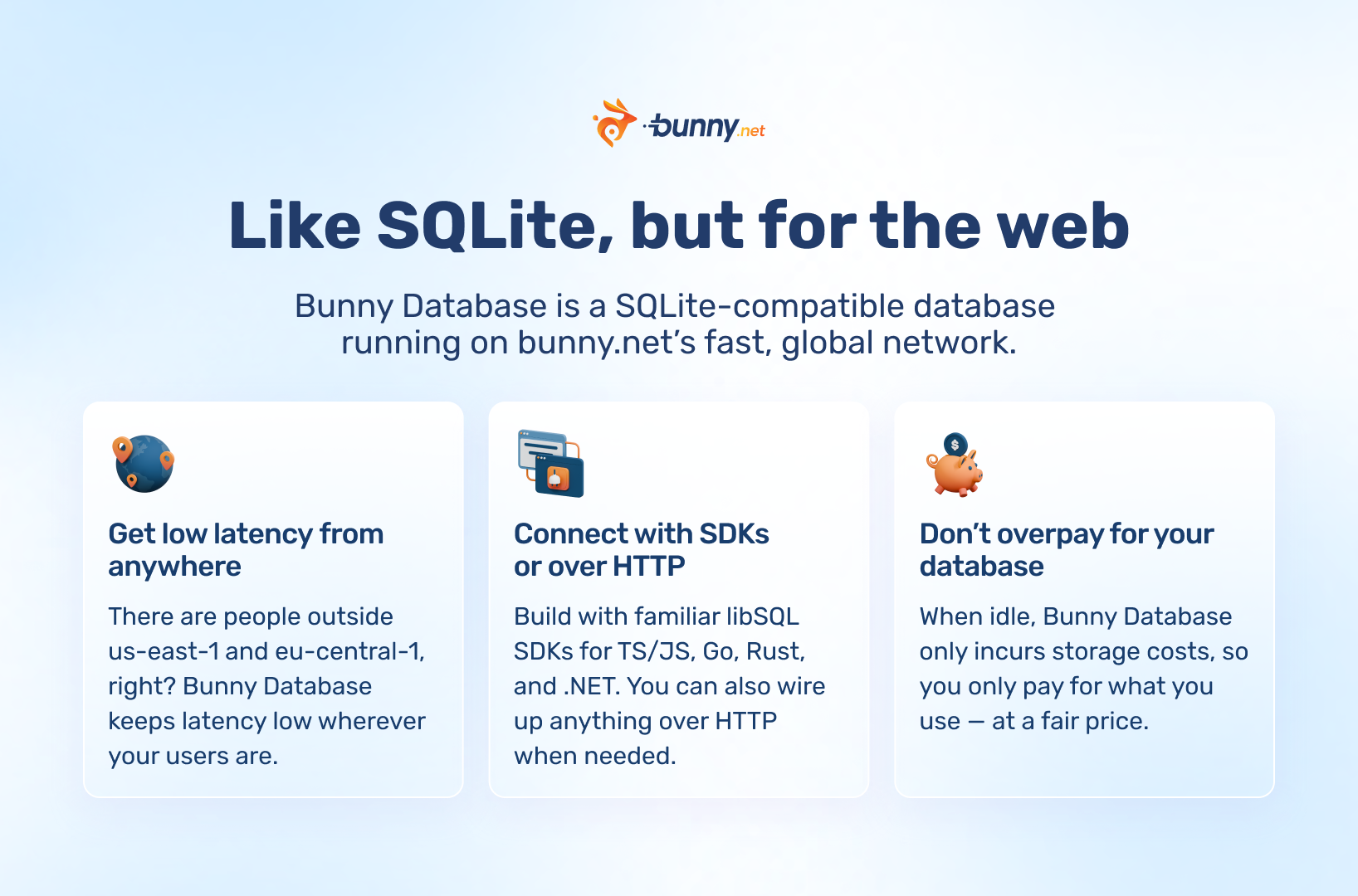
Bunny Database is a managed, globally distributed database service that’s compatible with SQLite’s query interface but designed to run over HTTP — accessible from anywhere without the file-system assumptions SQLite normally requires. It spins down when idle (which keeps costs low for low-traffic projects) and lets you add geographic regions incrementally, without rearchitecting your schema or your application code. That last part is doing real work: one of the consistent pain points with distributed databases is that you often have to plan for global distribution from day one, or face a painful migration later.
The technical foundation, according to a Hacker News thread on the launch, is libSQL — the same open-source SQLite fork that Turso uses. That’s not a knock; libSQL is solid and actively maintained. But it does mean Bunny’s differentiation isn’t at the database engine level. It’s at the infrastructure and experience level, which brings us back to their CDN roots. Bunny already operates a global network with points of presence in many regions. A database product built on top of that network has a plausible low-latency story without needing to build the physical infrastructure from scratch.
The single-writer model is the honest limitation here. Bunny’s own documentation (per that same HN thread) notes the product “works best for read-heavy use cases with fewer concurrent writes.” That’s not a flaw so much as a SQLite-inheritance — single-writer is baked into how SQLite works. For a lot of real applications — blogs, marketing sites, internal tools, read-heavy APIs — this is fine. For anything with serious write concurrency, it’s a ceiling.
The Product Hunt launch landed at #4 for the day with 253 upvotes and 17 comments. That’s a respectable number for a developer infrastructure launch — not viral, but not ignored. The comment volume is low enough that it’s hard to read much community sentiment from it. This looks more like an announcement to an existing user base than a cold acquisition play.
The Verdict
Bunny Database is a competent, well-positioned product from a company that has already demonstrated it can run global infrastructure reliably. The SQLite-over-HTTP pattern is proven, the edge distribution story is genuinely useful, and the incremental-region model is a thoughtful UX decision that removes a real friction point.
What it isn’t — yet — is obviously better than Turso or Cloudflare D1 for a developer starting fresh. The differentiation case at 30 days is “you might already be using Bunny for CDN or storage, and consolidation has real value.” That’s a reasonable pitch. It’s not a reason for someone with no Bunny.net account to switch.
At 60 to 90 days, the question is whether the developer experience holds up under real workloads — specifically around the regional replication behavior and write-conflict handling. The single-writer model is fine until it isn’t, and how gracefully the product fails or communicates those constraints matters a lot.
What we’d want to know before a full endorsement: pricing relative to Turso’s free tier (which is genuinely generous), actual latency benchmarks across regions, and whether the HTTP-based access model introduces meaningful overhead for write-heavy bursts. None of those are disqualifying questions — they’re just unanswered ones. Bunny is a real company with real infrastructure making a real product. That’s a better starting position than most launches that hit Product Hunt this week.