














stamp-0802b86f-b2bc-46d4-a2e6-20d571757638
The AI Secretary that thinks, writes, and works like you
Stamp Wants to Be Your AI Secretary. The Real Question Is Whether It Can Actually Learn You.
The Macro: Everyone Wants to Fix Email. Nobody Has.
Email is the cockroach of productivity software. It should have died a dozen times by now. Slack was going to kill it. Teams was going to kill it. Every new async communication tool launched with a quiet premise that the inbox was finally toast. And yet here we are, in 2025, still drowning in threads.
The market numbers are all over the place depending on which research firm you ask, but the directional signal is consistent: email software is growing fast. According to multiple market reports, the segment is projected to grow at somewhere between 10 and 16 percent annually through the early 2030s, with valuations ranging from $12 to $35 billion depending on how broadly you draw the category. The exact figure matters less than what it signals. Nobody is abandoning email. The money is moving toward making it less awful.
The current wave of AI tools has split into two broad camps. One camp automates the outbound side, writing and scheduling marketing emails at scale. The other camp, smaller and more interesting, is trying to handle your personal inbox. Your actual correspondence. The stuff that requires judgment.
That second camp is crowded enough to matter. Slashy has been pushing toward inbox destruction as a design philosophy. Revo is taking a more direct run at auto-replies. Microsoft Copilot is baked into Outlook for anyone on an enterprise plan. Google is doing its own version inside Workspace. The giants have distribution. The startups have to win on depth.
The specific problem nobody has fully cracked is voice. Your writing style is not generic. The way you open emails to your boss versus a client versus a vendor is different in ways that are almost impossible to articulate but immediately obvious when someone gets it wrong. That gap, between generic AI output and something that actually sounds like a specific human, is exactly where the opportunity lives.
The Micro: An AI Secretary That’s Supposed to Sound Like You, Not Just Anyone
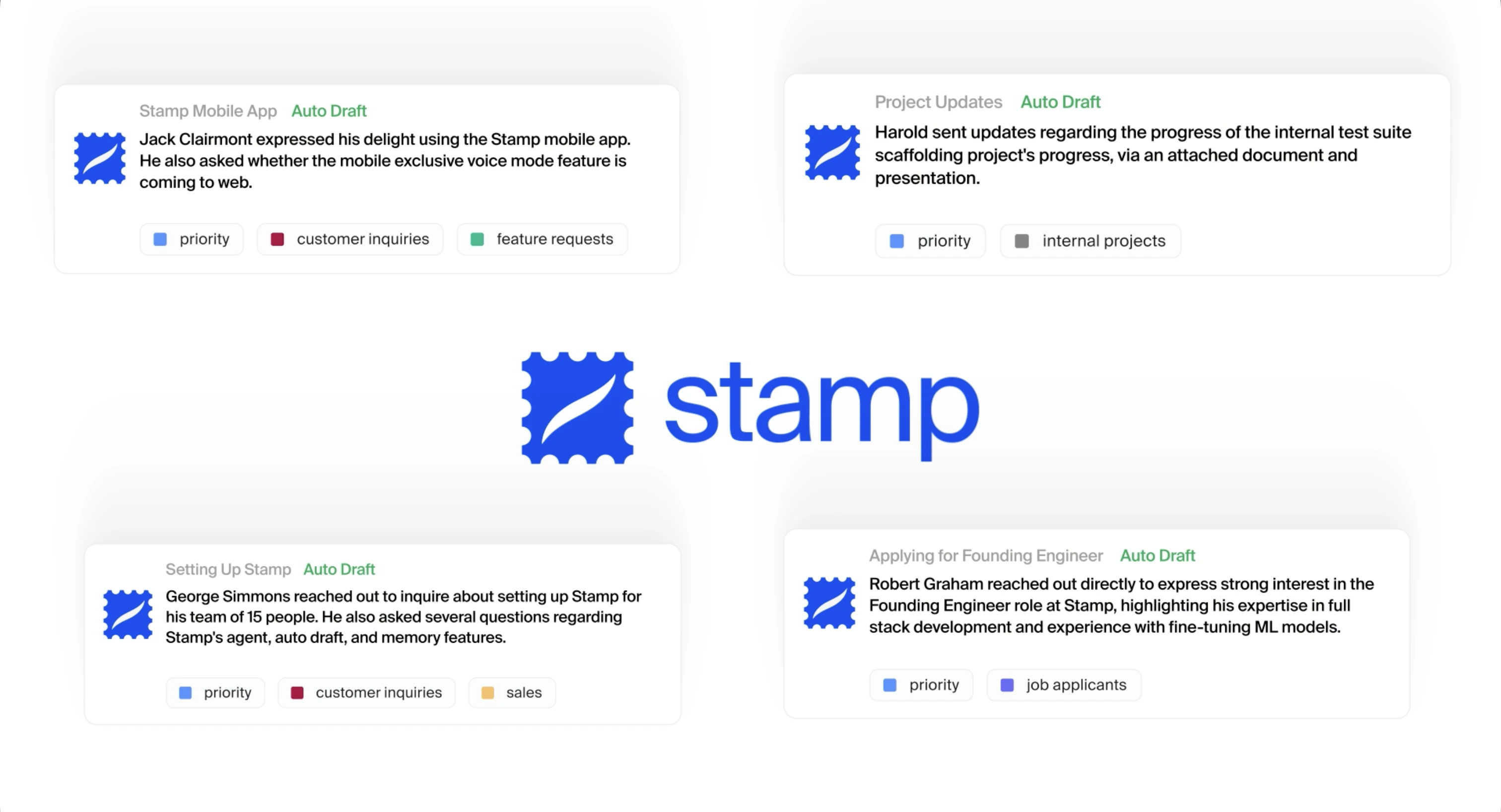
Stamp’s pitch is direct. It calls itself an AI Secretary that thinks, writes, and works like you. The product handles email and calendar together, which is already a more ambitious surface area than most competitors attempt. It claims to learn your preferences, adopt your style, and operate with your context over time.
The calendar angle connects to a broader idea that scheduling and communication are really one problem. Cal.com has been building toward scheduling as the layer that AI runs on, and Stamp seems to be approaching a similar premise from the inbox side outward.
What Stamp is describing, learning a user’s communication style and applying it autonomously, is technically hard. The obvious risk is that the output settles into a competent but generic register that feels like the user on a bad day. Archit Mehta, who appears to be on the team based on his LinkedIn activity, flagged exactly this concern in a public post, asking how Stamp trains on someone’s tone and context over time without it feeling robotic. That question appearing in their own orbit suggests they’re at least thinking about it seriously. Whether they’ve solved it is another thing.
The product is free to start and available across email clients, which is the right call for early distribution. Friction at signup kills these tools before users ever experience the value.
It did well when it launched, picking up solid traction on day one. The comments were light, which could mean the product is self-explanatory or could mean the audience hasn’t pushed it hard yet.
The honest reality is that without access to the live product, I can’t verify how the style learning actually works in practice. What I can say is that the concept is sound, the problem is real, and the positioning is tight enough to be legible.
The Verdict
Stamp is entering a fight where the winners will be determined almost entirely by one thing: does the output actually sound like the user, or does it sound like AI doing an impression of the user? Those are very different experiences and users will know the difference within a week.
The calendar plus email combination is smart. Treating them as separate products has always been slightly absurd, since most of what happens in email is either a result of something on your calendar or leads to something going on it.
At 30 days, I’d want to know what the retention curve looks like among people who got through setup. At 60 days, whether the style model improves meaningfully with more data or plateaus early. At 90 days, whether the AI Secretary framing holds up when users try to do something edge-case and the system fails visibly.
The founder research here was murky enough that I can’t say much with confidence about who built this or what their background is. That matters for a product where trust is load-bearing.
If the learning model is genuinely good, Stamp has a real shot. If it’s decent but generic, it becomes another tool people try for two weeks and quietly stop using. I’d put it on my list to check back on in ninety days.