














krisp-accent-converter-for-youtube
YouTube, but you clearly understand everyone
Krisp Wants to Fix the Accent Problem YouTube Has Always Pretended Wasn't One
The Macro: The Comprehension Gap Nobody in Big Tech Wanted to Own
Here’s what’s strange about the caption wars of the last decade. Every major platform poured resources into making video text-searchable, legally defensible, and accessibility-compliant. YouTube added auto-captions. Then translations. Then chapters and summaries. All useful. None of them solving the thing that actually makes people rewind a video three times at 2am trying to understand a technical walkthrough from a creator in Bangalore or Lagos or Manila.
Accent comprehension is not a character flaw. It’s a cognitive load problem. When your brain is already working hard to parse new information, decoding an unfamiliar phonetic pattern on top of that is a real and documented cost. The weird part is that the audio AI tools to address it have existed in some form for a while. Krisp itself has been in the noise-cancellation and voice-enhancement space for years, with a focus on real-time call audio. The accent conversion feature for live calls reportedly launched in early 2025, according to TechCrunch. The YouTube extension feels like a natural next move from that base.
The broader market backdrop here is genuinely large. The AI-powered Chrome extension category was valued somewhere between $2.8 billion and $4.25 billion in 2025, depending on which analyst you ask, and multiple projections have it growing aggressively through the early 2030s. That growth is real, though the valuations floating around feel like they’re pricing in a lot of futures that won’t arrive on schedule.
What most people get wrong about this category is that they treat it as an extension market. It’s not. It’s a content accessibility market that happens to live in Chrome. The competitors worth watching aren’t other extensions. They’re the platforms themselves. If YouTube decides tomorrow that on-device accent normalization belongs in their accessibility settings, Krisp’s moat gets very small very fast. That’s the structural risk the whole category shares. I’ve watched browser-based productivity tools bet on platform indifference before, and it’s a bet with a real expiration date.
Timing, though, looks decent. The AI is mature enough. The use case is obvious. And YouTube has shown zero urgency on this front.
The Micro: One Toggle, On-Device, and the Bet That Privacy Is a Feature
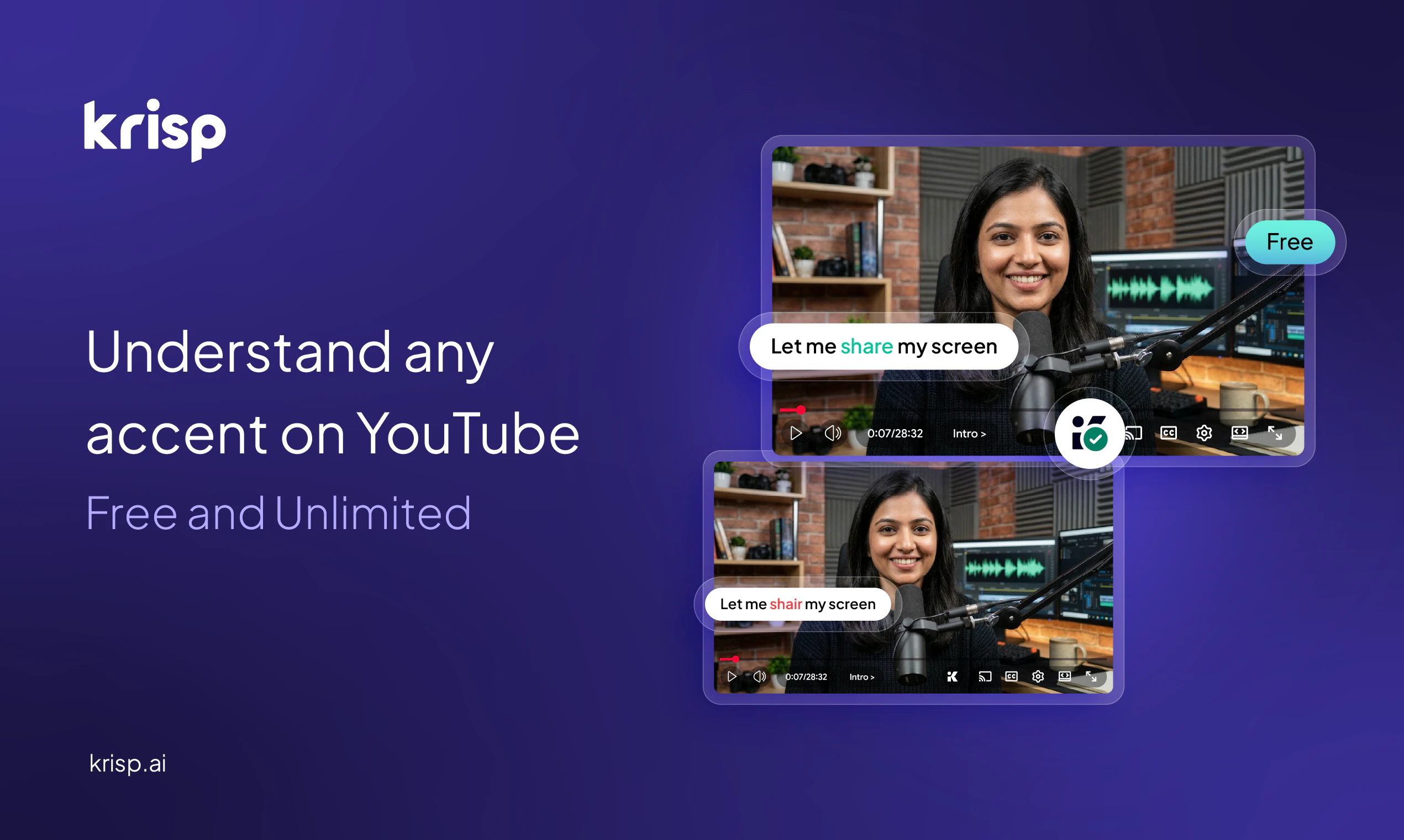
The product is a free Chrome extension. You install it, you get a toggle. When you’re watching a YouTube video with accented English that your brain is working overtime to parse, you flip it on and the audio gets processed through Krisp’s on-device AI to produce a more neutralized English output in real time.
On-device processing is the smartest decision they made here.
It keeps latency low enough to be usable on video without the audio drifting behind the picture. It also means your audio isn’t hitting a server somewhere, which matters to a non-trivial portion of the people who install productivity extensions. The privacy pitch writes itself, and Krisp doesn’t have to stretch to make it.
The product scope is deliberately narrow. It does one thing. It does it in YouTube. There’s no settings panel with seventeen sliders. You toggle it on or you don’t. For a category where most tools try to justify themselves with feature lists, that restraint is notable. It launched and got solid traction early, which suggests the use case was legible immediately to a broad audience.
The riskiest bet is the framing. Converting accents is a genuinely sensitive product decision, and the line between accessibility tool and something that implies certain voices need fixing is not always obvious. Krisp has navigated this before with their call product, but at YouTube scale, with a much wider and more vocal user base, the conversation will happen louder. How they handle that framing publicly will matter.
What I’d change: I’d want a way to toggle per-channel or per-video rather than globally. Right now the binary on/off means you’re either always processing or never, which isn’t how people actually watch YouTube. Some creators you follow closely and parse easily. Some you don’t. Granular defaults would reduce the sense that you’re doing something to a creator’s voice without thinking about it.
The Monologue team faced something adjacent when building voice-layer tools: the product decisions that feel purely technical almost always carry social weight too.
The Verdict: Useful Right Now, Fragile in Two Years If YouTube Wakes Up
I think Krisp built the right thing. The comprehension gap is real, the solution is technically sound, the privacy architecture is smart, and the distribution via free Chrome extension is the correct call for building initial density fast.
What I’m less sure about is whether this is a company or a feature.
Krisp has the advantage of being an actual audio AI lab with years of investment in this specific technical problem. Arto Minasyan’s LinkedIn posts position Krisp’s Voice AI Lab as a serious research operation, not a thin wrapper on someone else’s model. That technical depth is their real moat, not the extension itself.
But if YouTube ships a native version of this inside accessibility settings in the next 18 months, the extension becomes a curiosity. That’s the scenario that keeps this product from being a long-term standalone business. The more productive path is probably B2B: sell the underlying conversion capability to platforms, learning management systems, corporate training tools. Somewhere that needs accent normalization baked in rather than bolted on.
My prediction: the consumer extension builds Krisp meaningful brand recognition and a useful dataset. The real revenue story is licensing the technology to platforms that can’t or won’t build it themselves. If they execute that pivot before YouTube closes the gap, they have something durable. If they stay consumer-only, they’ll face the same ceiling that most single-feature Chrome extensions eventually hit.