













keeby
Mechanical keyboard sounds for your Mac
Keeby Turns Your MacBook's Butterfly-Keyboard Trauma Into a $4.99 Therapy Session
The Macro: The MacBook Keyboard Has a Feelings Problem
Apple spent years making its keyboards quieter, flatter, and more forgettable. The butterfly switch era was a disaster by any measure, and even the Magic Keyboard that followed, for all its reliability, sounds like typing on a slightly damp napkin. The mechanical keyboard hobby exploded in part as a direct response to this. Enthusiasts spending hundreds of dollars on switches, lubing stabilizers at 2am, posting ASMR typing videos with millions of views. That market is real and vocal and a little obsessive.
But here’s what most people writing about this space miss: it’s not just a hobbyist thing anymore. It’s a sensory preference that has crossed over into mainstream productivity culture. The people who care about how their keyboard sounds are not all switch-lube nerds. Some of them are just people who spend ten hours a day typing and want the experience to feel less hollow.
Mac’s position in this conversation matters. According to data from Counterpoint Research, Apple’s revenue hit record levels in late 2025. Mac growth hit 11.2% in 2025 against an industry average of 3.3%, per Computerworld. That’s a lot of people sitting at MacBooks who are not going to buy a mechanical keyboard because they work from coffee shops, or open offices, or because they travel, or because they simply can’t justify the desk real estate. The software workaround is logical. It was always going to exist.
The question is whether the software version of a mechanical keyboard sound is satisfying enough to matter, or whether it’s the audio equivalent of a phone wallpaper that looks like a bookshelf. Adjacent Mac utility apps like NotchPad’s clipboard manager and Zzzappy’s wrist-break reminders show that small, opinionated menu bar tools with tight use cases can find real audiences. Keeby is betting it belongs in that same drawer.
I think it does. Barely, but genuinely.
The Micro: Eleven Switches, One Surprisingly Smart Architecture
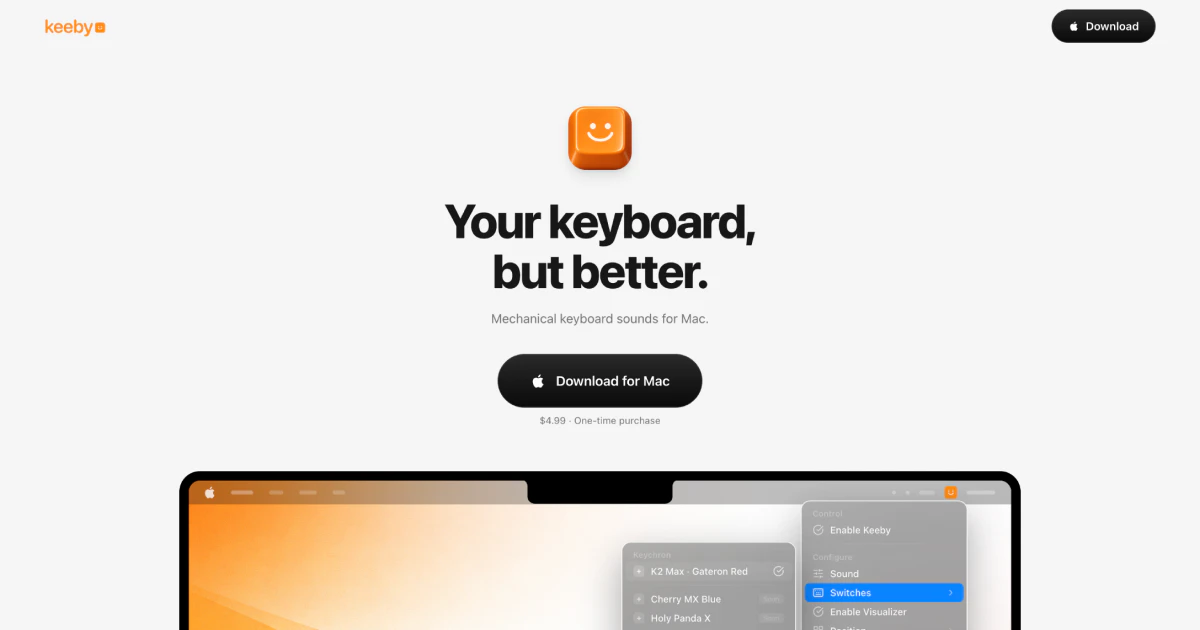
Keeby is a menu bar app for Mac that plays mechanical keyboard sounds as you type. That’s the sentence. It requires macOS 13 or later and costs $4.99, one time, no subscription. Those last four words are doing a lot of work in a market where everything wants to be $8 a month forever.
The technical decisions are more interesting than the premise suggests. The sounds are recorded from actual switches, not synthesized. That matters because synthesized click sounds tend to feel flat in a way you notice immediately. The library includes 11 profiles: Gateron Red, Holy Panda, Alps Blue, Box Navy, among others. Each one has a distinct character for anyone who’s spent time with real switches.
Spatial audio is the feature I keep coming back to. Left-hand keys play from your left speaker, right-hand keys from your right. It’s a small thing. It’s also the thing that separates “cute novelty” from “this actually feels like something.” The low-latency engine uses a 128-frame buffer, which is the kind of detail that means nothing until you notice an app lagging on keystrokes and you realize that’s why this one doesn’t.
The tone control is a 2D pad that lets you drag between thock and clack. Randomized pitch variation means no two keystrokes sound identical. There are separate sounds for key press and key release. Fully offline, no data collected.
The riskiest bet is the completeness of it. Keeby is trying to be the definitive version of this idea, not the scrappy first attempt. That means more to build, more to maintain, and a higher bar to meet for the listener who actually knows what a Holy Panda sounds like.
It reportedly hit the number one spot in the Top Paid Mac App Store chart around launch, and got solid traction on Product Hunt.
If I were building this, I’d want a way to set per-app profiles. Thocky switches when I’m in a text editor, off entirely when I’m on a video call. That’s table stakes for version two.
The Verdict: Small App, Real Niche, Dangerous Ceiling
Keeby is a well-built, specific, honest product. It does one thing and has clearly thought hard about doing it right. The spatial audio is not a gimmick. The real recordings are not a marketing line. At $4.99 with no recurring revenue model, it is priced to convert curious people rather than extract from committed ones.
That pricing is also the ceiling. There’s no clear path to meaningful scale without moving toward subscriptions, expansion packs, or an entirely different distribution strategy. A one-time utility app with a narrow audience is a solid small business. It is not a venture story. I don’t think Keeby is trying to be a venture story, which is actually why I find it more credible than most things I look at.
The comparison that matters is with audio-adjacent productivity tools that found sustainable niches. Monologue’s approach to voice and productivity is a useful contrast: broader ambition, more complex product, harder sell. Keeby has the inverse problem. The sell is easy. The ambition is contained. Whether that’s wisdom or a limitation depends on what the people building it actually want.
My concrete prediction: Keeby exists in two years. It probably has a small, loyal user base that quietly renews their recommendation every time someone complains about their MacBook keyboard in a Slack channel. It does not become a platform. It does not raise a round. It is a good, small, permanent thing. In 2025, that outcome is rarer and harder to achieve than it sounds.