














velo-10
Share anything as video messages
Velo Wants to Make Your Screen Recordings Not Embarrassing
The Macro: Everyone Is Recording Screens, Nobody Is Watching Them
Here’s the thing about async video. The promise of it has always been slightly ahead of the execution. Tools like Loom normalized the idea that you could replace a meeting with a video message, and that was genuinely useful for about one specific use case: explaining something complicated to a teammate who’s in a different timezone. Beyond that, the recordings people actually send are rough. Unedited. Meandering. The kind of thing you watch at 1.5x speed while half-reading Slack.
The screen recording category didn’t fail because people don’t want async video. It failed because the gap between “I recorded something” and “I made something watchable” is enormous, and almost nobody bridges it. Most people don’t have the time or the editing instincts to close that gap themselves.
The productivity software market is big and getting bigger. According to multiple sources, the global business productivity software segment is projected to grow from around $62.5 billion in 2024 toward well over $100 billion by the early 2030s. Productivity apps specifically are expected to roughly double in market size over the next decade. The numbers are huge, though I’ll be honest: big market figures mostly tell you that a lot of companies will try things here, not that any specific one will win.
What’s actually interesting right now is the AI editing angle. We’ve seen AI writing assistants mature to the point where rough drafts become acceptable outputs. The same pressure is arriving for video. Tools that help non-editors make non-embarrassing videos have real traction with B2B teams, specifically because those teams are drowning in screen recordings they feel vaguely guilty about sending. Knowlify is trying something adjacent in the docs space, arguing that structured knowledge deserves better presentation. Velo is making a similar argument, just for video.
The honest risk in this category is that Loom already captured a lot of mindshare, and Notion, Google, and others keep absorbing adjacent workflows. Velo needs a wedge, not just parity.
The Micro: Raw Input, Polished Output, and an Agentic Twist
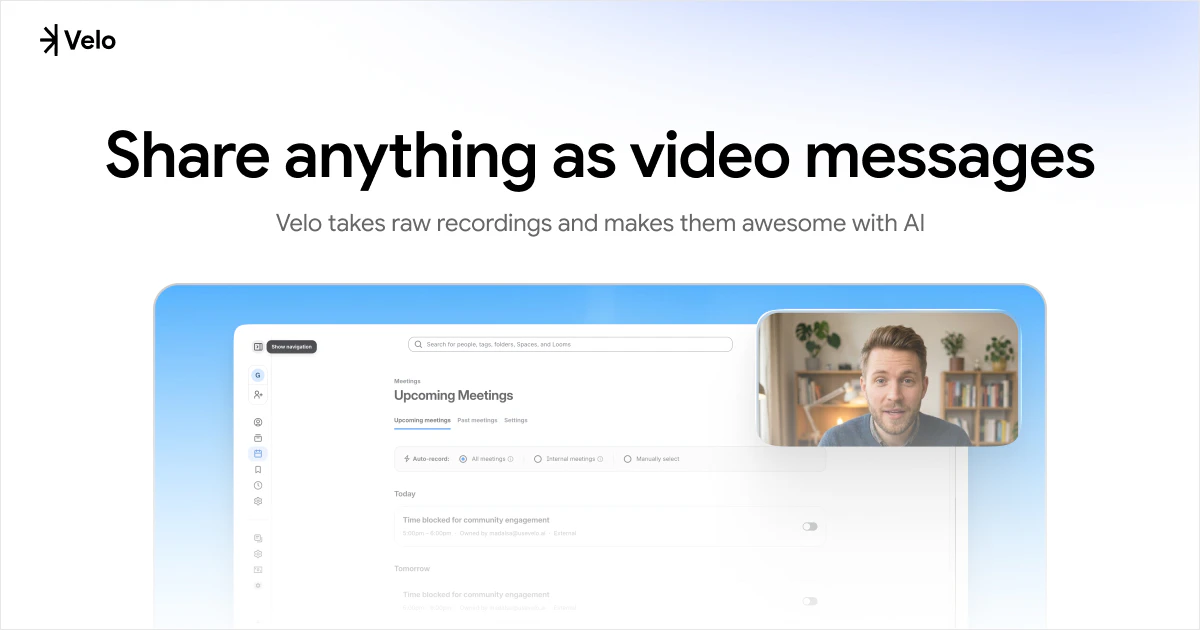
Velo’s core pitch is simple: you record your screen doing whatever, and Velo uses AI to turn that raw recording into something that looks intentional. The tagline is “share anything as video messages” and the product page frames it as the gap between without-Velo and with-Velo, which is exactly the right way to show this kind of tool. Before and after is the whole argument.
The more interesting detail is on their blog, where they’re writing about what they’re calling “agentic screen recording.” I’d want to know a lot more about what that actually means in practice, because agentic is one of those words that can mean genuinely autonomous or it can mean “we added a button that does the next step for you.” Either way, the fact that they’re moving in that direction signals they’re not just building a polish layer. They’re thinking about recording as a workflow, not just a file format.
The customer logos on their site include Instawork, Sanas, Signeasy, Mavenir, and Vectara, among others. That’s a reasonably varied set of B2B teams, which tells me the use case is landing across different company types, not just one niche. That’s a decent early signal.
According to Crunchbase, Ari Efron is the founder and CEO. LinkedIn also shows Sourav S. as a co-founder and CEO, with a YC W22 background. YC W22 is worth flagging just because it tells you the company has been around for a few years and presumably iterated on the concept before landing on this version.
It did well on launch day, which tracks. The product is visually demonstrable in about ten seconds, which is a significant advantage on platforms where attention is the whole game.
The smartest decision they made is keeping the entry point frictionless. You record, you send, it’s better. The riskiest bet is that “better-looking video” is enough of a value prop to drive retention. Aesthetics wear off. Workflow stickiness is what keeps tools alive.
The Verdict: The YC Pedigree Helps, But Retention Is the Real Boss
I think Velo is solving a real problem. The screen recording space genuinely has a quality gap, and AI-assisted polish is a reasonable way to close it. The B2B customer list suggests some product-market fit is already there, not just enthusiasm from people who like new tools.
But here’s my actual concern. The tools that have survived in async video didn’t win because their output looked better. They won because they got embedded in the workflow at the moment of recording. Loom’s real moat isn’t video quality, it’s that people open it by reflex. Velo needs to become that reflex, not just the thing you run your Loom recording through afterward.
The agentic angle is the most interesting thread. If Velo can make the recording itself smarter, not just the output, that’s a different product than what exists today. Flint is doing something similar on the landing page side, removing the human bottleneck from a process people assumed required judgment. If Velo can pull that off for screen recordings, the ceiling is higher than it looks.
The founders have YC behind them and real customers. That’s not nothing.
My prediction: Velo survives and grows modestly if they stay focused on B2B teams with high async video volume. They break out if the agentic recording piece turns out to be genuinely autonomous in a way that saves people meaningful time per recording, not just cosmetic time. The next twelve months will depend entirely on which of those two products they actually ship.