














remodex-2
Control Codex on your iPhone
Your Mac Is the Server Now. Your iPhone Is the Terminal.
The Macro: AI Coding Agents Needed a Remote Control
Something shifted in the last year with how developers actually interact with AI coding tools. It stopped being about autocomplete and started being about agents. Long-running, multi-step, “go handle this whole feature” agents. Codex is the clearest example of that shift from OpenAI: you point it at a repo, give it a task, and it works through the problem while you theoretically do other things.
The problem is “do other things” still meant staying at your desk. Or at least staying near your laptop. The agent is running on your machine, your terminal is the only window into what it’s doing, and if you walk away you’re flying blind.
This is not a niche annoyance. Any developer who has kicked off a long Codex run and then needed to leave the house knows exactly what I’m talking about. You’re either babysitting your computer or you’re accepting that something might go sideways with no way to intervene.
There’s broader context here too. Apple had a record-breaking 2025 by basically every metric, according to their own reporting and Counterpoint Research data. iPhone install base keeps climbing. Developers are already carrying powerful computers in their pockets constantly. The tooling just hasn’t caught up to that reality, at least not for the agentic coding workflow.
Claude Code exists and is doing interesting things in the same general space. There are various terminal wrappers and remote SSH setups people cobble together. But nothing I’ve seen treats the iPhone as a genuine first-class interface for steering an AI coding agent mid-run. The memory and context management problems that tools like ByteRover are tackling point at the same underlying issue: agents are getting more capable but the control surfaces haven’t kept pace.
The Micro: One QR Code and Your Phone Is the Cockpit
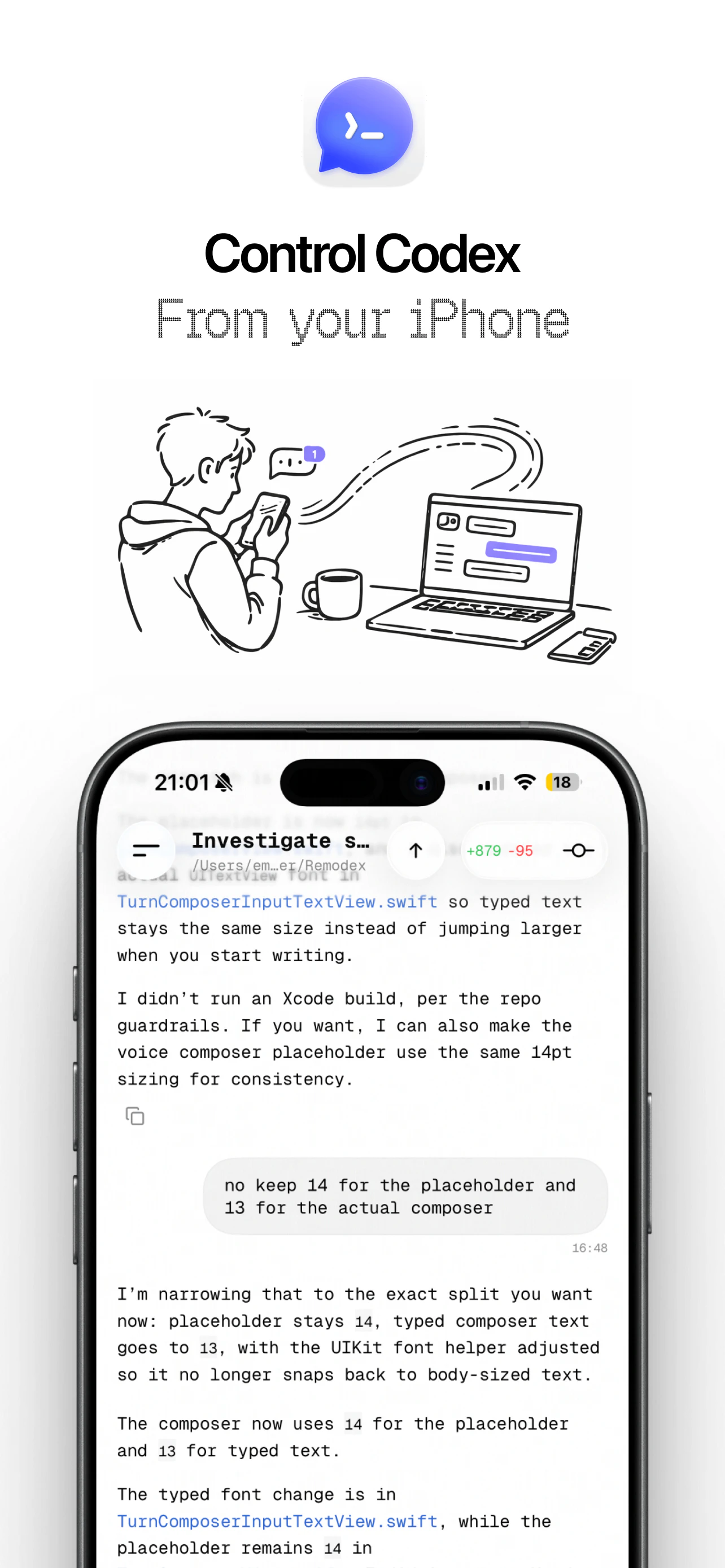
Remodex is an open-source iOS app that acts as a remote control for Codex running on your Mac. The setup is blunt and straightforward in a way I appreciate. You install the relay via npm (npm i -g remodex@latest), scan a QR code once to pair your phone, and that’s the whole onboarding. After that, your iPhone reconnects automatically.
From the app you can create threads, run subagents, push git commits, use skills and slash commands. The git stuff is actually the detail that made me sit up. Commit, push, pull, branch, stash, inspect diffs, all from the phone interface. That’s not “remote view” functionality. That’s a full workflow surface.
The encryption story is handled well. End-to-end encrypted, the relay never sees your prompts. If you don’t trust even that, you can self-host the relay entirely. Open source on GitHub (1,893 stars at time of writing) means you can audit all of it. For a tool touching your codebase and your API keys, that matters.
There are two modes: Fast mode and Plan mode. You can steer active runs and queue follow-up prompts without restarting anything. That last part is the part that makes this feel like it was built by someone who actually uses Codex. The ability to queue a follow-up without killing the current run is the kind of quality-of-life detail that’s easy to skip and really annoying when it’s missing.
It did well on launch day, landing in the top ten on Product Hunt, which for a developer tool with a fairly specific audience is a decent signal.
The comparison that kept coming to mind while I was looking at this: OpenUI’s push to give AI interfaces a visual layer is solving a similar problem from the other direction. Remodex isn’t trying to reimagine the interface. It’s trying to take the existing interface and make it available everywhere you already are.
The Verdict
I think this is genuinely useful for a real and growing group of people. If you use Codex regularly and you’ve ever felt tethered to your desk by it, Remodex is the obvious thing to download. The QR pairing is clean, the git integration is more complete than I expected, and the open-source plus self-hostable relay is the right call for something touching active development environments.
The honest question at 30 days is adoption curve. Codex users are a specific slice of the developer population, and within that slice, the ones motivated enough to install a relay and pair a second device are a smaller slice still. That’s not a fatal problem. Niche tools can be very sticky. But the ceiling is real.
At 60 days I’d want to know if the reconnection reliability holds up across different network conditions. Auto-reconnect is a promise that gets tested by hotel wifi and cellular handoffs, not by demo environments.
At 90 days the question is whether OpenAI ships anything that makes a third-party remote control redundant. That’s the risk every Codex-adjacent tool carries right now. Knowing what your actual AI tooling costs is getting more complex by the week, and the platforms themselves keep expanding what they offer natively.
Right now though, for what it is, Remodex works and it fills a gap that nobody else has cleanly filled.