













panorama
AI that finds your team’s workflows and hidden structures
Panorama Wants to Watch Your Team Work So You Don't Have To
The Macro: Everyone Wants to Fix Work. Nobody Agrees on What’s Broken.
Here’s the thing about the productivity software category right now. It’s enormous and getting more enormous. According to multiple market research reports, the global productivity software market sits somewhere north of $60 billion in 2024 and is on track to roughly double by the early 2030s. Productivity apps alone pulled in over $30 billion in revenue last year, up more than 17% year over year. The numbers are big. They are also kind of meaningless, because almost everyone using Slack, Notion, and Asana together still feels like they are drowning.
The real problem isn’t a lack of tools. It’s that the tools don’t talk to each other in a way that reflects how teams actually operate. Every team has its own informal logic. The way the design team hands off to eng, the three-step Slack ritual before a doc gets reviewed, the spreadsheet that nobody made but everybody uses. None of that gets captured anywhere.
That gap is what a whole wave of AI workflow startups is trying to close right now. Notion is pushing into it from the docs side, trying to make itself the connective tissue for AI agents. Others are attacking task creation specifically, like PopTask’s approach to reducing the friction of writing a task at all. The approaches are all slightly different, and they’re all betting that the answer is more intelligence layered on top of existing work, not a new place to do the work.
Panorama’s angle is more observational than most. It’s not asking your team to change how they work and then automating the new thing. It’s watching what you already do and automating that. That’s a meaningfully different starting point.
The Micro: AI That Audits Your Chaos Before It Fixes It
The core premise of Panorama is that it connects to your workplace data and analyzes it to surface what the team calls “hidden structures.” Meaning: the recurring patterns in how your team actually operates, not how your org chart says it operates. Then it recommends AI workflows your team can run together based on what it found.
According to the product description, nobody has time to manually audit everything their team does and figure out which parts are automatable. Panorama does that audit for you. It watches, finds the repetitive parts, and offers to take them over.
The tagline is “making space for your creativity,” which is classic productivity tool framing, but the mechanism they’re describing is a bit more interesting than the slogan suggests. Most automation tools require you to know what you want to automate before you use them. You have to walk in with a hypothesis. Panorama is pitching something closer to discovery, where you plug it in and it tells you what’s worth automating. That’s a harder problem to solve, and I’d want to see exactly how it works in practice before believing it fully.
According to his LinkedIn, Jingwei Hao is the Founder and CEO, with an a16z speedrun connection noted in his profile. That’s about all the founder context I can confirm from available research.
It launched recently and got solid traction on Product Hunt, landing the number two spot for the day.
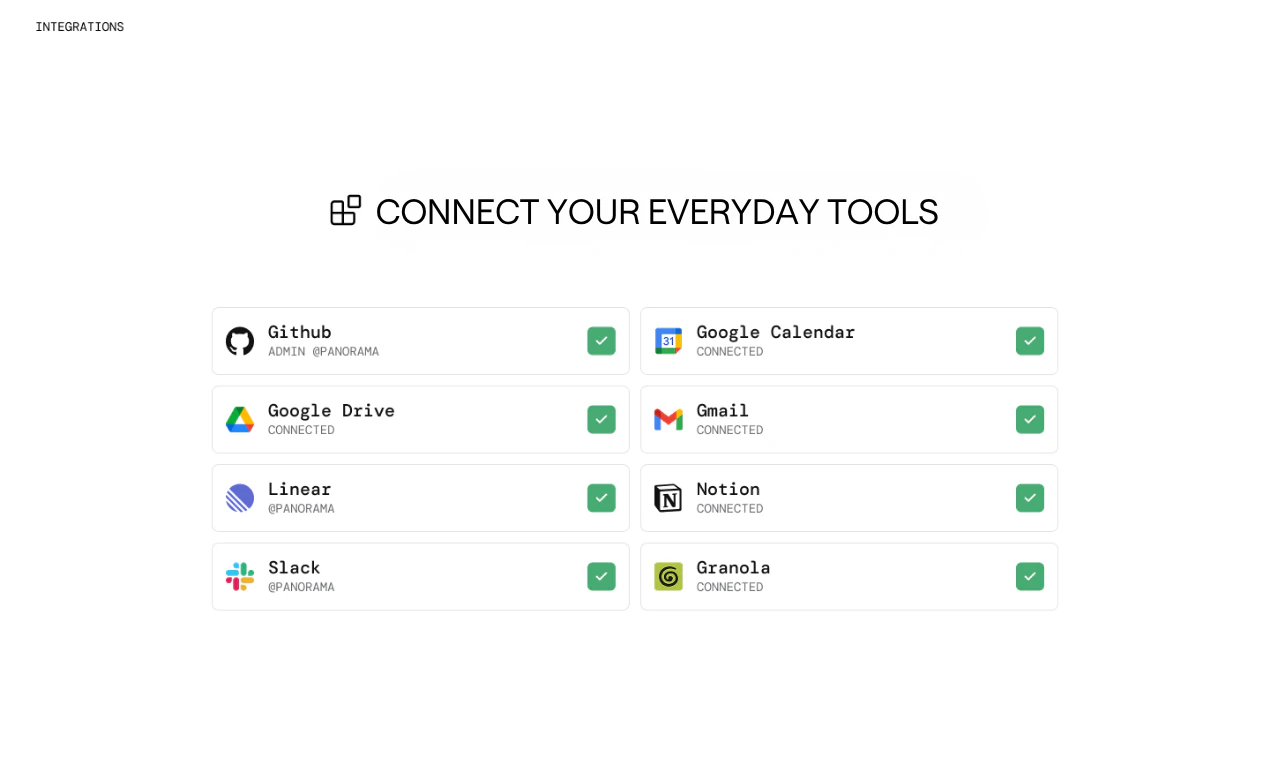
What I’d actually want to know is what data sources it connects to, and how it handles the inevitable messiness of real workplace data. Slack threads and shared drives are notoriously hard to make sense of even for humans. The question isn’t whether the concept is appealing. It is. The question is whether the model can actually parse what’s signal and what’s noise in a real team’s daily chaos.
The Verdict
I think this concept is genuinely interesting and I’m cautiously suspicious of it in equal measure.
The observation-first approach is smart. The single biggest failure mode for workflow automation tools is that they require too much upfront configuration, and most teams just don’t do it. If Panorama can skip that step and show you what’s already automatable, that’s a real unlock. It’s also the kind of thing that, if it works, makes people feel like the product is magic. Which is how you get retention.
But the trust problem is real. Asking a team to let an AI watch everything they do is a different ask than asking them to use a new task manager. There will be employees who are uncomfortable with it, and managers who oversell what it can do. Both of those things will create friction.
At thirty days, I’d want to know: are the recommended workflows actually getting adopted, or are people just looking at the suggestions and closing the tab? At sixty, I’d want to see whether it’s working for teams with genuinely messy data or just teams that are already well-organized. At ninety, churn rate tells the whole story.
The category is real. The problem is real. Panorama’s specific bet, that surfacing hidden structure is more useful than giving people another place to build structure, is one I’m curious to see stress-tested at scale.