














music-marketplace-by-eleven-labs
Create a track. Publish it. Earn when it is used.
ElevenLabs Wants to Do for Music What It Already Did for Voice. That's a Bigger Bet Than It Sounds.
The Macro: Music Licensing Is Broken, But ‘Broken’ Has Been the Pitch for a Decade
Here’s the thing about the music licensing problem: everyone who has ever tried to put a track in a YouTube video, a short film, or a product demo knows it’s a nightmare. Sync fees, rights clearances, per-use negotiations that can take weeks. The whole structure was built for a world where music moved slowly and deals happened in offices. It did not survive the internet intact.
But I want to be careful here, because “music licensing is broken” has been the founding thesis of a lot of startups that did not make it. Platforms promising royalty-free libraries, subscription access to stem files, AI-generated background music. Some of them are fine. Most of them are background noise in a Spotify playlist nobody asked for. Riffle took a swing at this from the creation angle, arguing that the problem starts even earlier, before licensing, at the moment a creator realizes they can’t afford to make the kind of track they actually want. Different entry point, same broken system.
What makes this moment genuinely interesting is not that the problem got worse. It’s that the tools to generate credible, usable music got dramatically better, fast. The question the market is sorting out right now is whether AI-generated music can be licensed in a way that feels fair to the people who made it, not just cheap to the people who use it.
The AI-powered design tools category, which this product sits adjacent to, is reportedly valued somewhere between $6.1 billion and $8.4 billion in 2025 depending on which analyst you ask, with projections pointing steeply upward. I’d treat those numbers loosely. What they do confirm is that there’s serious capital conviction behind AI creative tools right now, which means ElevenLabs is not swimming upstream on the funding side. The timing, at least, is not the problem.
The real question is whether a voice AI company can build the same trust infrastructure for music that it built for audio. That’s not obvious.
The Micro: The $11M Number Is Doing a Lot of Heavy Lifting Here
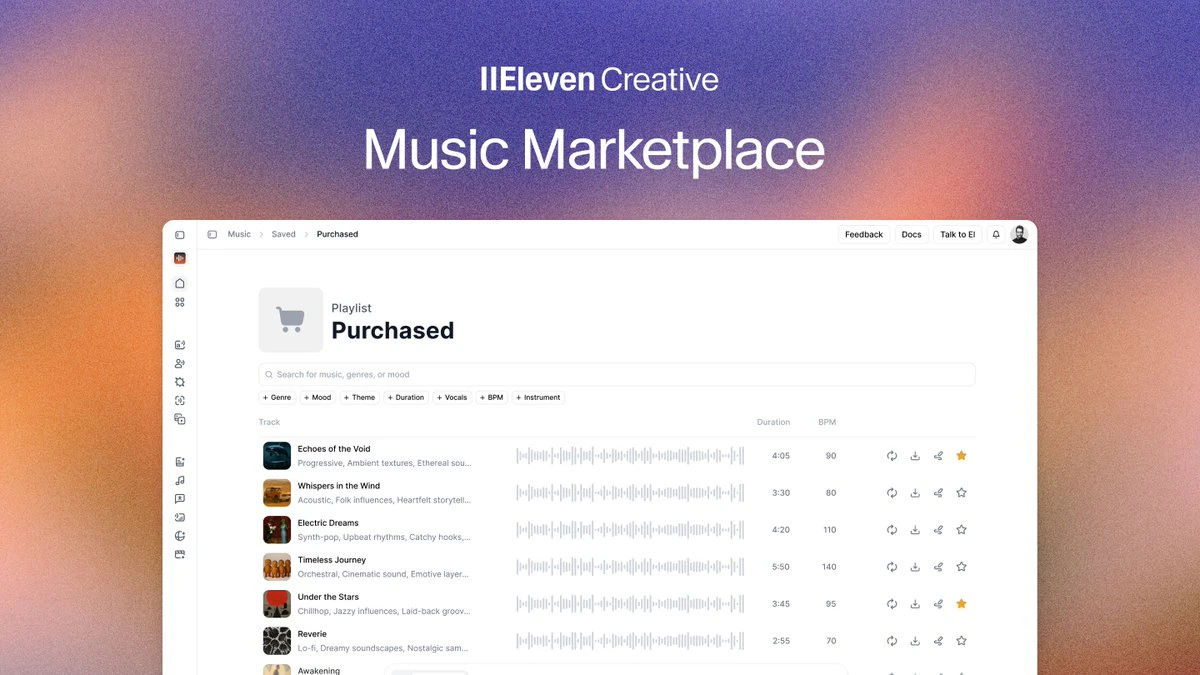
The pitch is clean. Generate a track, publish it to the marketplace, earn every time someone downloads it or remixes it. ElevenLabs already runs this model for voice creators, and according to the product’s own description, they’ve paid out $11M to those creators. Now they’re extending the same engine to music.
That $11M figure is smart positioning. It’s not a projection. It’s a proof of behavior, evidence that people will actually pay for generated content through this platform and that the payout infrastructure already exists. That’s a real advantage over a competitor starting from scratch.
It got solid traction on launch day, landing at number three across all of Product Hunt.
The product decision I find most interesting is the remix earning model. Most licensing platforms stop at download. You pay once, you use it, done. If ElevenLabs is building a structure where remixes also generate revenue for the original creator, that’s a fundamentally different value proposition. It’s closer to how music publishing actually works, where derivative uses matter, than it is to the flat-rate stock music model most people are used to.
The riskiest bet is also obvious: they’re asking creators to generate tracks on their platform, publish through their platform, and trust their platform to track and distribute earnings fairly. That’s a lot of centralized trust for a category where creators have historically gotten burned by opaque royalty systems. The scraping of the product website didn’t give me enough to see the actual payout mechanics, and that detail matters enormously.
If I were building this, I’d make the royalty dashboard the loudest feature in the product. Not the generation tools. Creators need to see the money moving in real time or they will not believe it’s moving at all.
The design tools angle listed in the topics is a stretch. This is a music monetization play wearing a design tools hat for discoverability. Which, look, I get it. But let’s call it what it is.
The Verdict: The Voice Playbook Works, Until Music’s Complexity Proves It Doesn’t
I think ElevenLabs is genuinely well-positioned to make this work, and I also think they’re underestimating how different the music problem is from the voice problem.
Voice cloning and voice generation exist in a relatively new legal and cultural space. Music has decades of copyright law, union agreements, and creator expectations built around it. The moment a track generated on ElevenLabs sounds close enough to a real artist’s style, you’re in a dispute. The platform doesn’t have to be doing anything wrong for that to become a crisis.
What will determine whether this product exists in two years is not the generation quality. That will keep improving regardless. It’s whether ElevenLabs can build a creator community that trusts the payout model enough to publish their best work here instead of treating the marketplace as a dumping ground for throwaway tracks. Low-quality inventory is the death of any content marketplace. The voice creator network they’ve built is real leverage, but music creators are a different constituency with different expectations.
I’d also want to understand how this competes with what developers are already embedding directly into their pipelines. Tools like those being built around Onlook and adjacent creative infrastructure suggest that the “generate and deploy” workflow is moving fast, and a marketplace model assumes creators want a storefront, not just an API.
My prediction: this becomes a real revenue line for ElevenLabs within 18 months if they publish transparent, real-time creator earnings data in the first 90 days. If they treat payouts like a black box, it stalls.