














jupid
File your taxes with Claude Code
Jupid Thinks the Problem With AI Taxes Isn't the AI. It's the Memory.
The Macro: The Accounting Stack Has a Context Problem
Here’s the thing about AI and small business finance: we’ve been watching the same demo loop for two years now. Someone screenshots their bank feed, pastes it into ChatGPT, gets a reasonable-looking breakdown, and calls it accounting. It works fine for about 50 transactions. Then it forgets everything and you start over.
The fintech investment numbers are enormous. According to KPMG, global fintech investment hit $116 billion in 2025 across nearly 5,000 deals. BCG found that fintech revenues grew 21% in 2024. Money is absolutely flowing into this category. But most of it isn’t solving the boring, structural problem that makes AI-assisted bookkeeping actually break in production: persistent memory and vendor-level context.
Which, look. Tools like Cranston AI are betting that accounting is fundamentally a rules problem. Mod AI turned invoice processing into a single-agent job. Both are interesting. Both are chipping away at the same general mess of small business finance from different angles. The space is crowded at the feature level but genuinely thin at the infrastructure level.
Freelancers and single-member LLCs are the least-served segment here. QuickBooks is overkill and overpriced for someone billing $80K a year through Stripe. Spreadsheets are fine until they aren’t. And the crop of AI-native accounting tools mostly assume you want a chat interface, not a clean data layer that other tools can call into.
That last part is where Jupid is trying to plant a flag. Not as a chatbot. As the layer underneath the chatbot.
The Micro: A Data Layer That Actually Remembers Your Figma Bill
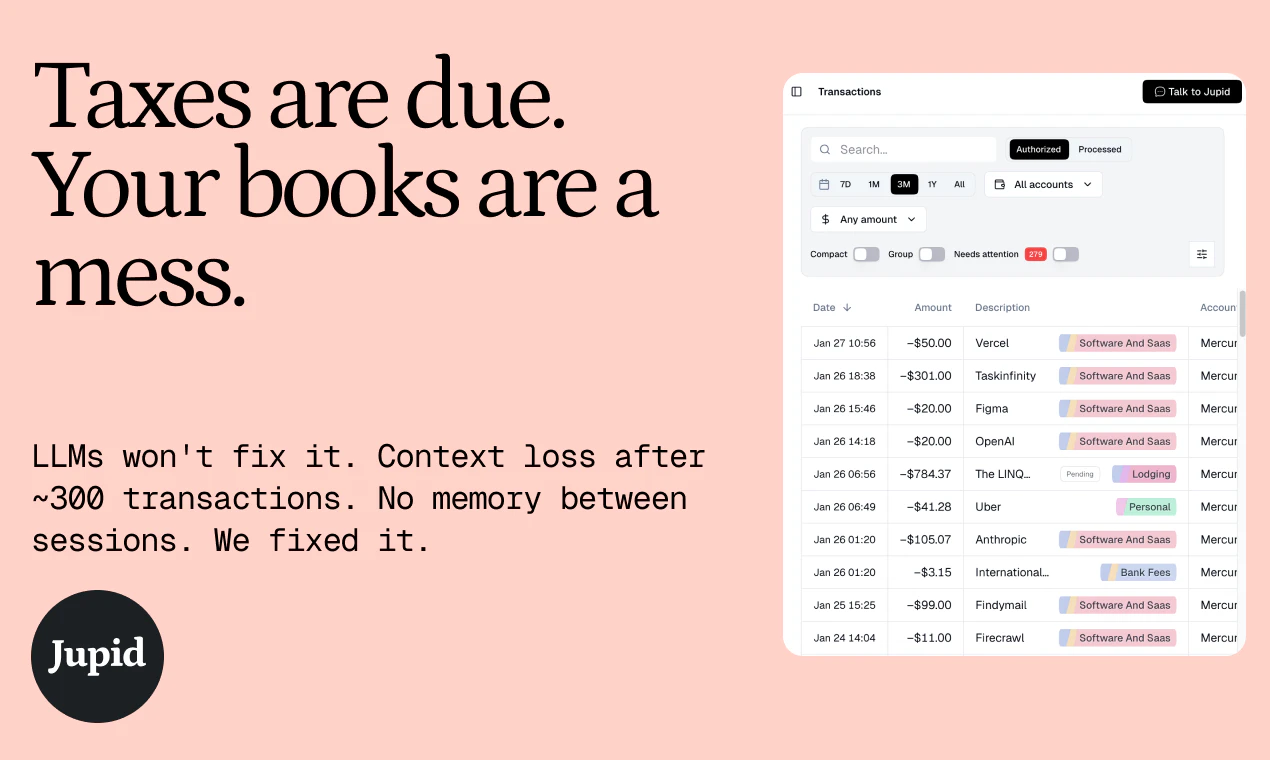
Jupid connects to your bank and does one thing obsessively: it learns your vendor relationships and never forgets them. That Figma charge on January 15? It knows it’s a software subscription on Schedule C Line 18. The WeWork charge? Office rent. It maps these once and holds them persistently across sessions, which is exactly what a raw LLM prompt cannot do.
The product claims 96% accuracy on IRS Schedule C categorization. That number comes from their own early user data, so I’d weight it accordingly. But the logic behind why it would be high is sound. Once you’ve told the system that AWS charges are cloud hosting for your specific business, it doesn’t need to rediscover that every time.
The Claude Code integration is the genuinely weird and interesting product decision here. You can query your books from the terminal. That’s a very specific user. They’re betting that the people most frustrated by AI’s accounting limitations are also the people comfortable enough with tooling to use Claude Code. That’s probably a small audience, but it’s a precise one. They also mention WhatsApp, iMessage, and Cursor as interfaces, so they’re not only building for command-line obsessives.
The free trial covers your first 100 transactions, which is a reasonable way to let a freelancer actually pressure-test it before committing. The promise is filing a Schedule C in five minutes from a messy bank feed.
It got solid traction on launch day, which tracks. The pain point is real and the framing is crisp.
The $1,249 average in found deductions is prominently displayed. Again, that’s their number. But the category of finding missed deductions isn’t implausible. Most freelancers who aren’t using an accountant are almost certainly under-deducting.
The Verdict
I think Jupid is solving a real problem and I think they’ve correctly diagnosed why existing tools fail. The memory and context issue is not a minor inconvenience. It is the reason AI bookkeeping hasn’t actually replaced anything yet.
What I’d want to know at 30 days: does the 96% accuracy hold across messy, multi-industry, years-old bank data or only on clean, tech-freelancer feeds like the demo shows? The demo transactions are extremely legible. Real small business books are not.
At 60 days: does the Claude Code integration get any real usage or does it become a marketing hook that nobody uses in practice? The Montty approach of being a full finance hire is the alternative vision here. Jupid is betting on being infrastructure instead. That’s a harder sell to a solo founder who just wants things handled.
At 90 days: retention. Deduction finding is a one-time wow moment. Categorization accuracy is the actual product. If it slips, people leave.
CEO Slava Akulov is also listed as co-founder at ANNA, according to Crunchbase, which suggests some prior fintech product experience. That’s worth something in a category where the technical surface area is larger than it looks.
I’m not calling this a sure thing. But the core idea is less hype than the tagline suggests.